






















Key Takeaways
-
The average startup fundraising pipeline contains 52 investors. A spreadsheet stops working somewhere around relationship 20, which is when most founders running a real raise switch to a purpose-built investor CRM.
-
A real investor CRM does five things a sales CRM cannot. It ships with fundraising pipeline stages, sends native investor updates, hosts a permissioned data room, tracks deck-level engagement, and connects to a metric dashboard, all in one system.
-
HubSpot and other sales CRMs require heavy customization to run a raise. Every investor-specific workflow (data room, updates, deck tracking) lives in a separate stack, and the stitching cost shows up in missed follow-ups and a fragmented contact record.
-
Free fundraising CRMs work until the pipeline crosses 20 active relationships. Past that point, the lack of engagement signal, permissioned data room access, and integrated investor updates becomes a daily tax on the raise.
-
The best CRM for founders carries forward after the round closes. Term sheet day is the start of investor relations work, not the end, so a CRM for startup fundraising that doubles as an IR platform keeps contacts, dashboards, and update cadence intact across rounds.
-
Purpose-Built Core Workflows: A dedicated investor CRM provides native pitch deck sharing, permissioned data rooms, and automated investor updates that generic platforms lack.
-
The Sales CRM Friction: Standard B2B sales tools require heavy customization to track venture capital milestones, resulting in hidden operational overhead for founders.
The average fundraising pipeline on Visible contains 52 investors.
That's 52 names to research, 52 first meetings to chase, 52 follow-ups to time correctly, and 52 sets of notes, term preferences, and partner dynamics to keep straight. Managing 52 relationships manually is exactly how rounds fail. Emails slip, warm intros go cold, and momentum quietly bleeds out of the process before founders realize what's happening.
Most founders start their raise in a spreadsheet, a Notion doc, or a free HubSpot account. It works for the first ten conversations. Then a partner asks for a deck you already sent, a "let's reconnect in Q2" reminder gets buried, and two of your highest-conviction investors stop responding because no one followed up at the right moment. That's the point most founders start searching for an investor CRM built for the realities of startup fundraising, not generic sales.
The best CRM for founders does six things well:
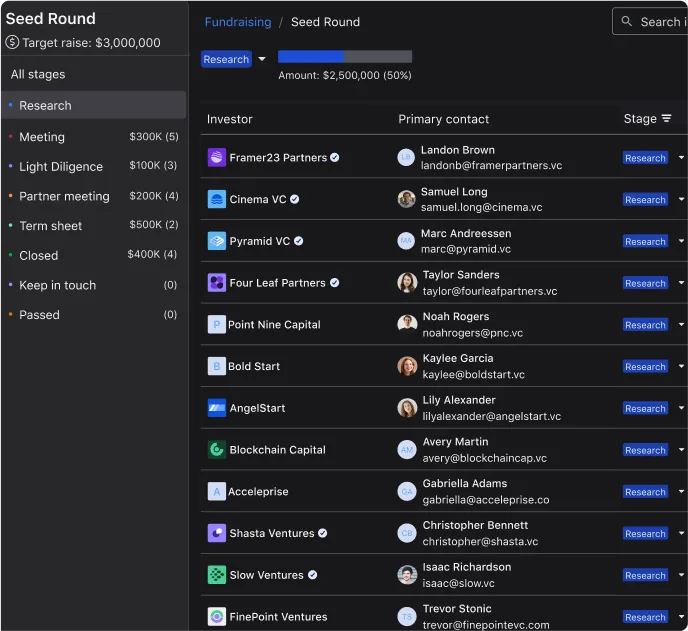
- Tracks the investor pipeline by stage (researching, contacted, meeting, diligence, committed, passed)
- Manages follow-ups and tasks so no warm intro or open thread falls through the cracks
- Centralizes conversations, notes, and documents across co-founders and advisors
- Monitors investor engagement (deck opens, data room views, update opens) so outreach prioritizes itself
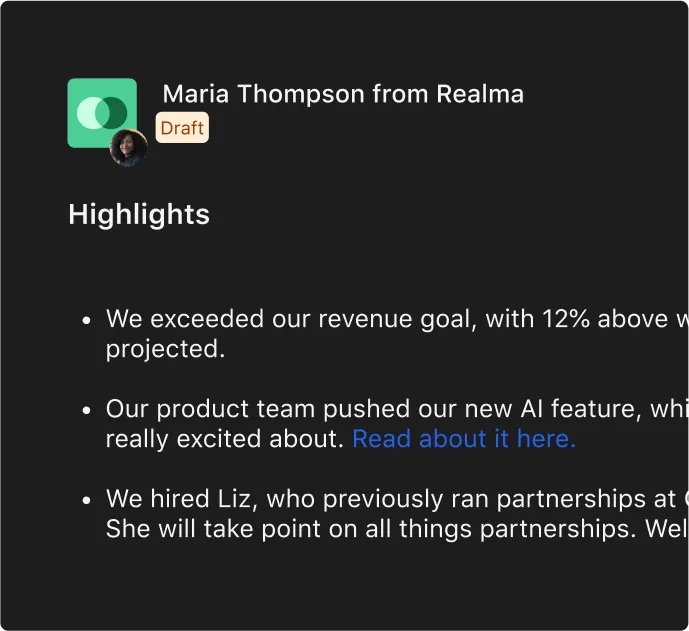
- Sends investor updates to current and prospective investors from the same system
- Coordinates the founding team so everyone knows who owns which relationship
This guide is an honest, data-backed breakdown of the actual investor CRM software founders use to run a raise: Visible, HubSpot, Affinity, Notion, and Airtable. By the end of this evaluation, you will know exactly which CRM for startup fundraising fits your operational workflow, and which tools to abandon once your pipeline scales past 25 investors.
Fundraising Pipeline Benchmarks:
Proprietary data from active raises run on Visible
- 52 investors. The average size of an active fundraising pipeline on Visible. Half of all founders are managing more relationships than that.
- Follow-up volume is consistently underestimated. Most founders plan for one or two follow-ups per investor. In reality, the majority of relationships require several more touchpoints before reaching a clear "yes" or a clean "no."
- Successful raises are won on multiple touchpoints, not a single great pitch. Investors commit after weeks of consistent updates, momentum signals, and well-timed nudges, not after one meeting.
Why this matters: A round is not won on the pitch. It's won on the discipline between conversations. When 50+ active relationships are each sitting in a different stage with different next steps, the organization stops being administrative work and becomes the difference between closing and stalling out. That's the job a purpose-built investor CRM is built to do, and the reason a generic sales tool eventually breaks under the weight of a real raise.
How the Top Investor CRMs Actually Compare (2026)
A useful comparison has to start with a real definition. By "investor CRM" we do not mean any sales CRM repurposed for fundraising. We mean a system designed around the actual workflow of running a raise: pipeline by investor stage, engagement signals on a small number of high-value relationships, centralized data room access, and a native way to keep current and prospective investors warm between conversations.
By that definition, only one tool on this list is a true CRM for startup fundraising. The rest are adjacent. Some are capable sales CRMs that founders bend into shape. Some are relationship-intelligence tools built for the investor side of the table. Some are flexible workspaces that act as a CRM only because nothing better was installed yet.
A useful investor CRM comparison covers six things: pipeline workflow, engagement tracking, data room, investor updates, reporting, and pricing. The table below evaluates Visible, HubSpot, Affinity, Notion, and Airtable across all six.
Quick-Reference: Which Investor CRM Fits Which Founder
| Tool | Built For | Best Use Case | Pricing | The Honest Take |
|---|---|---|---|---|
| Visible | Founders raising capital and managing investors | End-to-end fundraising and ongoing investor relations | Freemium | The only platform on this list purpose-built for the founder side of the table. Investor pipeline, data room, updates, and metrics dashboards all live in one system, and the same data carries forward into post-close IR. |
| HubSpot | Sales teams selling to customers | Founders customizing a sales CRM into a fundraising tool | Freemium, paid tiers escalate quickly | A mature B2B sales engine. While founders can customize its architecture for fundraising, user reviews on G2 frequently flag the "insane implementation friction" and the high cost of unlocking basic automation. Because it lacks native data rooms or slide-by-slide deck tracking, it forces you to stitch together an expensive, disjointed tooling stack |
| Affinity | VC firms and institutional investors | Relationship intelligence on the investor side | Paid, enterprise pricing | Built for the other side of the table. Excellent at network mapping and relationship strength scoring, but the workflow assumes you are a fund tracking founders, not a founder tracking funds. Pricing reflects the VC firm buyer. |
| Notion | Anyone organizing information | Lightweight investor tracking before the raise gets serious | Freemium | The default starting point because it is already in your stack. It becomes the wrong tool the moment your pipeline crosses 20 active investors. No email sync, no engagement signals, no automated follow-ups, no shareable data room with permissions. |
| Airtable | Teams building lightweight relational databases | Custom databases for specific operational workflows | Freemium | More structured than Notion, with the same fundamental ceiling. A spreadsheet with extra columns is still a spreadsheet when a partner asks for a deck you already sent or when your co-founder wants to know who's stuck in diligence. |
How Do Investor CRMs Compare Feature by Feature?
Symbols: ✅ native, full feature | ⚠️ partial, requires workaround or significant setup | ❌ not available
| Feature | Visible | HubSpot | Affinity | Notion | Airtable |
|---|---|---|---|---|---|
| Pipeline & Workflow | |||||
| Pre-built investor pipeline stages | ✅ | ⚠️ | ⚠️ | ❌ | ❌ |
| Drag-and-drop pipeline view | ✅ | ✅ | ✅ | ⚠️ | ⚠️ |
| Automated follow-up reminders | ✅ | ✅ | ✅ | ❌ | ⚠️ |
| Email integration (Gmail / Outlook sync) | ✅ | ✅ | ✅ | ❌ | ❌ |
| Activity and touchpoint logging | ✅ | ✅ | ✅ | ⚠️ | ⚠️ |
| Multi-user collaboration | ✅ | ✅ | ✅ | ✅ | ✅ |
| Investor Engagement | |||||
| Deck sharing with view tracking | ✅ | ❌ | ❌ | ❌ | ❌ |
| Centralized data room with permissions | ✅ | ❌ | ❌ | ⚠️ | ❌ |
| Native investor update tool | ✅ | ❌ | ❌ | ❌ | ❌ |
| Update open and click tracking | ✅ | ⚠️ | ❌ | ❌ | ❌ |
| Per-contact engagement analytics | ✅ | ⚠️ | ✅ | ❌ | ❌ |
| Investor Relations & Reporting | |||||
| Metric and KPI dashboards | ✅ | ⚠️ | ❌ | ⚠️ | ⚠️ |
| Investor-facing reporting | ✅ | ❌ | ❌ | ❌ | ❌ |
| Investor and firm database enrichment | ✅ | ❌ | ✅ | ❌ | ❌ |
| Access & Fit | |||||
| Free tier available | ✅ | ✅ | ❌ | ✅ | ✅ |
| Purpose-built for founder fundraising | ✅ | ❌ | ❌ | ❌ | ❌ |
What the Comparison Actually Tells You
Three patterns are worth pulling out, because they map to the three decisions every founder eventually has to make.
1. The "purpose-built vs. adapted" split is the only split that matters.
Every tool in this comparison can technically hold a list of investors. Only one was designed around the actual shape of a raise. HubSpot, Notion, and Airtable can be bent into a CRM for founders, but bending is not free. Founders pay for it in setup time, in the gap between activity logging and real engagement signal, and in the constant need to stitch tools together. The cost shows up as missed follow-ups, not as a line item.
2. The engagement-signal gap is where most tools quietly fail a raise.
A spreadsheet, a Notion table, and a standard sales CRM can all tell you who you contacted. None of them can tell you which three investors opened your deck five times last week, viewed the data room twice, and forwarded the update to a partner. That signal is the difference between cold outreach and a warm follow-up that converts. Visible and Affinity are the only tools on this list that surface it natively, and Affinity surfaces it for the wrong user.
3. The IR continuity question is the one no one asks until they close.
A raise does not end at term sheet. The day after you close, you owe quarterly updates, a clean cap table view for investors, and a system to keep your now-current investors warm for the next round. Every tool in this comparison except Visible forces a hand-off to a separate stack at that exact moment. Founders who used a startup fundraising CRM that doubles as an IR platform carry their data, their relationships, and their reporting infrastructure forward. Founders who used a sales CRM start over.
How Visible's Workflow Differs From an Adapted CRM
Every other tool in this comparison is adjacent to fundraising. Visible is the only investor CRM built for the founder side of the table, and for the same founder running investor relations after the round closes. Over 6,100 founders use it to run active raises.
The difference is not a feature checklist. It shows up in five places in the day-to-day workflow of running a raise, and in each one the gap between "adapted sales CRM" and "system built for founders" gets wider.
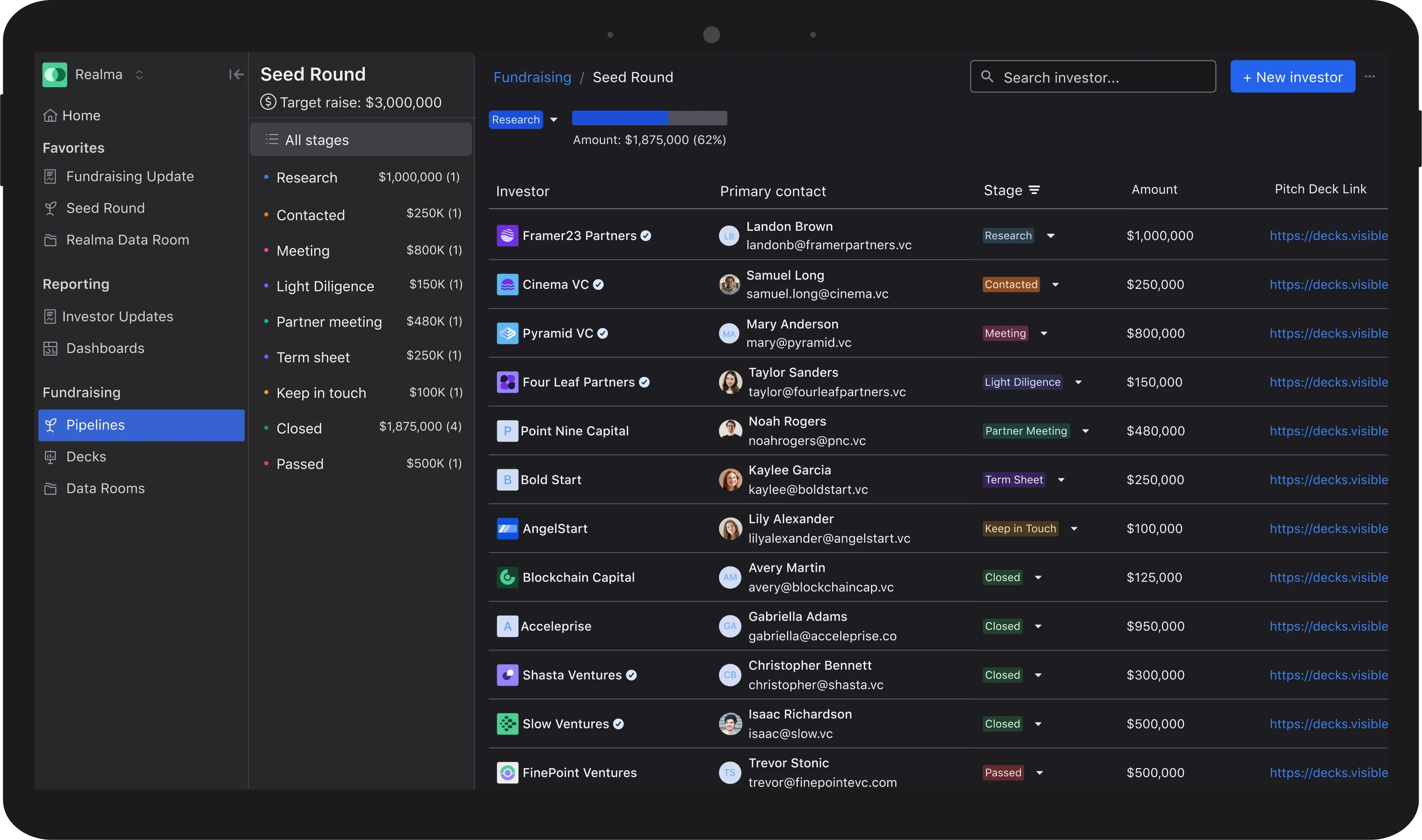
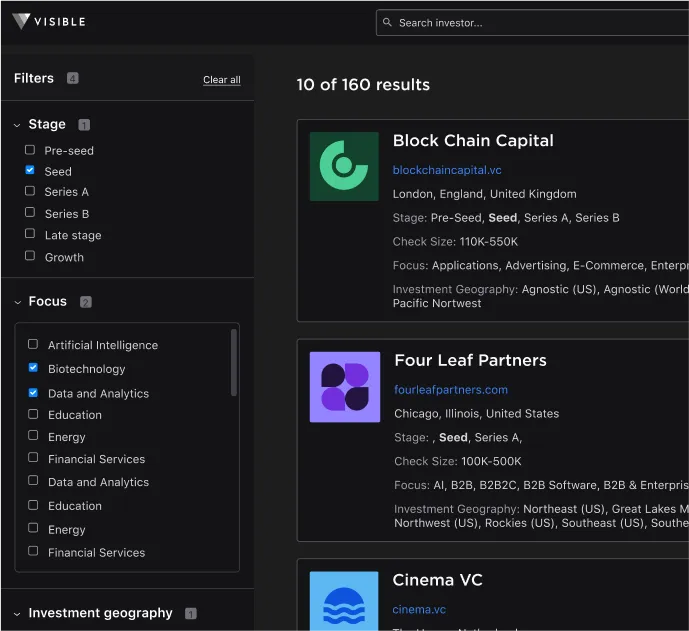
Pipeline. Visible's pipeline ships with Research, Contacted, Meeting, Pitched, Diligence, Committed, and Passed already configured, alongside fields for check size, fund stage focus, partner name, and source of introduction. An adapted sales CRM starts at Lead, Qualified, Closed Won, and asks the founder to spend a weekend rebuilding it. Visible Connect, the built-in investor database, sits inside the same pipeline workflow, so sourcing the next 50 names happens in the system of record rather than in a separate spreadsheet that has to be reconciled later.
Investor updates. The update tool sends to current and prospective investors from the same platform, with open, click, and reply tracking attached to each investor's contact record automatically. In Mailchimp or a BCC list, an investor who opens the update three times and clicks through to the metrics is an invisible signal. In Visible, that investor surfaces at the top of the follow-up queue the next morning. A monthly update stops being a chore and starts behaving like a piece of outbound.
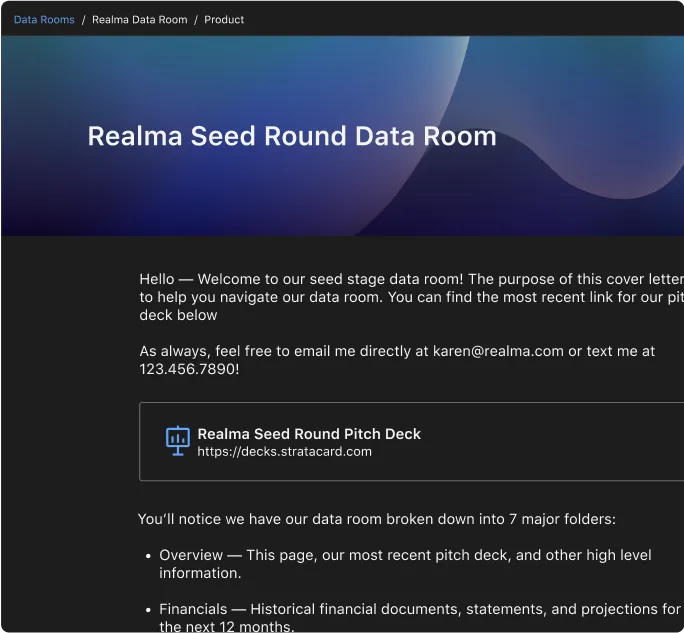
Data room. Permissioned per investor, tracked at the viewer level, revocable when an investor passes or the round closes. The real difference is not the file storage; it is that every view becomes an engagement signal on the right contact record. A returning partner who opens the data room twice in a week is a buy signal that Notion, Drive, and a generic CRM cannot see.
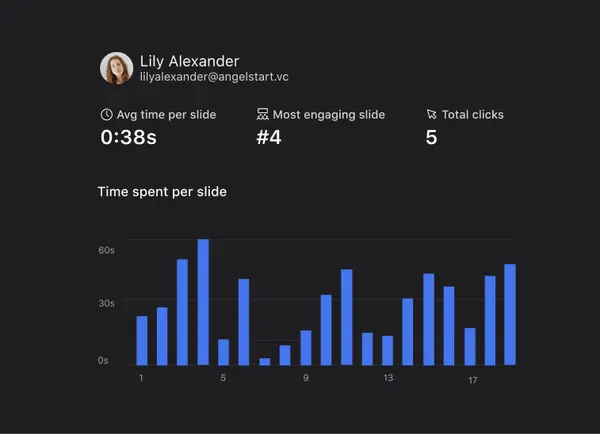
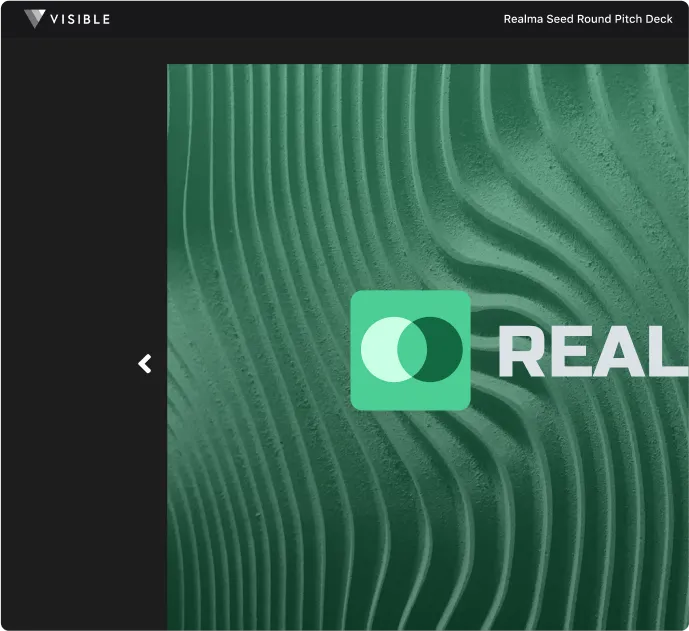
Pitch decks. Trackable share links replace PDF attachments, with slide-by-slide time on page and forward tracking. When a partner forwards the deck to a senior colleague, that second viewer becomes a known contact in the pipeline rather than a mystery open. The gap between "I sent the deck" and "the partner spent 8 minutes on it, returned the next day, and forwarded it to a senior partner" is the gap between guessing and knowing what to do next.
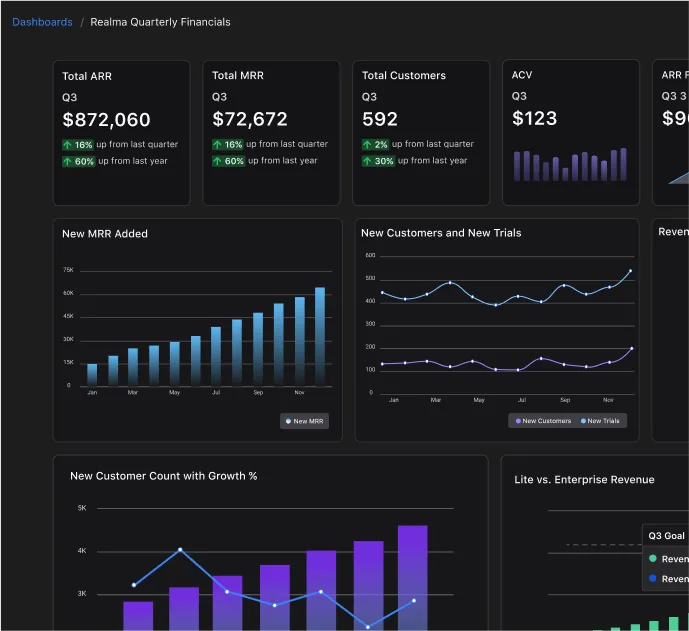
Metric dashboards. The KPIs founders track internally are usually the same KPIs investors want to see. Visible pulls them from the data warehouse, billing system, or spreadsheet of record once, then embeds them into updates, the data room, and the long-term IR view. Most stacks force founders to maintain two versions of every metric. Visible collapses them into one source of truth that carries forward after the round closes.
The honest accounting: Visible replaces the spreadsheet pipeline, the BCC update list, the Mailchimp send, the deck-tracking tool, the patched-together data room, and the post-close investor reporting deck. It does not replace accounting software, a cap table tool, or project management. It replaces the patchwork stack most founders inherit by default and outgrow within 60 days of opening a serious raise.
Start your next raise, get Visible for free here.
Why Founders Need a Dedicated Investor CRM
Fundraising is not a one-time event. It's a multi-month operations problem with 50+ moving parts, where every dropped thread costs optionality. Without a system designed for it, the typical founder ends up with investor names scattered across a Notion table, a Google Sheet, a personal Gmail inbox, and three Slack DMs with a co-founder. The data is technically "tracked." It's also unusable.
Purpose-built startup fundraising CRM tools solve this by giving founders one place to run the entire raise. The best CRM for founders does the following:
- Tracks every investor by stage so you always know who needs a nudge, who's in diligence, and who's gone cold
- Automates follow-up reminders so a "circle back in two weeks" never quietly becomes two months
- Logs every touchpoint (calls, emails, meetings, deck shares, update opens) on a single contact record
- Surfaces engagement signals in real time, including deck opens, data room views, and update click-throughs
- Shares centralized data rooms with permissioned access, viewer-level tracking, and revoke-anytime controls
- Sends investor updates from the same platform, keeping current and prospective investors warm without a second tool
- Coordinates the founding team so co-founders, advisors, and finance leads all see the same live pipeline
A generic sales CRM solves maybe 30% of this list. A spreadsheet solves less. A dedicated investor CRM like Visible is built around the specific shape of a startup raise: the long sales cycle, the small number of high-stakes relationships, the asymmetric power dynamics, and the ongoing investor relations work that begins the day you close.
What Breaks When You Use Spreadsheets
Every founder starts in a spreadsheet. Most realize within 60 days of opening the raise that the spreadsheet is actively working against them. Here's what tends to break first:
- Version control collapses. Your co-founder is editing row 47 while you're rewriting column G on your phone. By Friday, no one trusts the file.
- Follow-ups quietly disappear. A spreadsheet doesn't ping you when a partner said "let's reconnect in two weeks." That window closes, the lead investor moves on, and you find out three months later when their fund announces a competitor.
- There's no email integration. Every conversation lives in someone's personal inbox. When your co-founder asks "where did we land with that fund?" the answer is buried in a thread no one can search.
- Engagement is invisible. A spreadsheet can't tell you which investors opened your deck five times and which ones forwarded it to a partner. You're flying blind on the signal that matters most.
- Investor updates live somewhere else entirely. The update goes out from Mailchimp or a manual BCC. There's no record of who opened it on the investor's contact record, no way to act on the signal.
- The pipeline view doesn't exist. A spreadsheet is a list, not a pipeline. You can't see at a glance who's been stuck in "first meeting" for three weeks and needs unsticking.
Spreadsheets work for the first ten conversations. They stop working at exactly the wrong moment, usually right when momentum is building and a single missed follow-up has the highest cost.
How Founders Actually Use an Investor CRM
The mistake most first-time founders make is treating a CRM as a logging system. It's a workflow system. Here's how operators we work with actually run their investor CRM week to week:
Monday morning: pipeline review. Open the pipeline sorted by stage. Anyone sitting in "Contacted" for more than seven days gets a follow-up scheduled on the spot. Anyone in "Meeting Scheduled" gets a deck send and a calendar confirmation queued.
Mid-week: stage transitions. A partner replies and books a pitch. You drag the contact from "Contacted" to "Pitch Scheduled." That single action triggers an automated send of your data room link, logs the pitch date on the contact record, notifies your co-founder in the activity feed, and queues a 48-hour post-pitch follow-up reminder. What used to be four steps and a Slack message collapses into one drag.
Thursday: monthly update goes out. The update sends from the same platform as the pipeline. Every prospective investor on the list receives it, and you can see who opened it, who clicked through to the metrics dashboard, and who replied. The next morning, the investors who opened the update three times get prioritized. They are warm. Reach out today.
End of week: engagement review. Sort the pipeline by deck opens or data room views. Investors with high engagement and no recent touchpoint get a personal email. Investors with zero engagement after 30 days either get a final nudge or move to "Passed" and stay in the database for the next round.
This is the workflow that separates founders who close rounds in 8 weeks from founders who drag for 6 months. A real CRM for founders is not a place to store names. It is the operating system that makes a raise repeatable, and the reason mature startup fundraising CRM tools look almost nothing like the sales CRMs they evolved from.
Which Investor CRM Should You Actually Use?
The right answer depends on three filters: where you are in the raise, how many investor relationships you are actively managing, and whether the same system needs to carry forward into post-close investor relations. The honest framing is that no single tool fits every founder at every stage, and self-aware tool selection beats forcing the wrong tool to do a job it was not built for.
Here is how to identify which tool is built for your situation.
You Should Use Visible If
Visible is built for the operating reality of running a real raise, plus the investor relations work that follows it. It is the right CRM for founders if any of the following describes you:
- You are actively raising a pre-seed, seed, or Series A round. Your pipeline sits somewhere between 20 and 100 active investor relationships, you are moving multiple conversations forward in parallel, and dropped follow-ups have a measurable cost.
- You have co-founders, advisors, or a finance lead who need shared visibility. Two or more people are touching the pipeline, and everyone needs to see the same stage, the same next steps, and the same engagement signals.
- You care about engagement signal, not just activity logs. You want to know which investors opened your deck three times, which ones forwarded your update to a partner, and which ones returned to the data room before the second meeting.
- You expect to send investor updates during and after the raise. Monthly or quarterly updates are part of how you run the company, and you want one platform to handle current and prospective investors together.
- You want the system to carry forward after you close. Term sheet day is the start of your investor relations job, not the end of it. The contacts, the data room, the dashboards, and the update cadence all need to stay in place.
- You have raised before and know what breaks. Repeat founders who have run a raise on spreadsheets are generally not enthusiastic about doing it that way a second time.
If two or more of those describe you, Visible is the startup fundraising CRM built for your situation.
When Another Tool Might Genuinely Make Sense
Self-selection cuts both ways. A few scenarios where reaching for something other than a purpose-built investor CRM is defensible:
HubSpot might be the right call if the primary use of your CRM is customer sales and fundraising is a secondary, intermittent use case. Founders running a sales-led GTM with an occasional fundraising effort can extend HubSpot reasonably well. The ceiling: every fundraising-specific workflow (data room access, investor updates, deck-level engagement) lives in a separate stack, and that stack will eventually demand its own coordination layer. If raising capital is core to the next 12 months, you will outgrow this setup.
Affinity is the right call if you are a VC firm or family office. It is best-in-class for the investor side of the table. The ceiling for founders is structural: the workflow assumes you are the one writing checks, not the one taking them. The pricing assumes the same thing.
Notion is the right call if you are pre-raise, building a research list, mapping out which angels and funds focus on your space, and having early conversations without a real pipeline yet. The ceiling: the moment outbound becomes real and the pipeline crosses 20 active relationships, every limitation we covered in the comparison table (no email sync, no automation, no engagement tracking) becomes a daily tax on your raise. Plan to move before that point, not after it.
Airtable is the right call if you have a database-engineer mindset and genuinely want to build a custom system. Some founders enjoy the construction. The ceiling: you are rebuilding what a purpose-built investor CRM already ships, and what you build will still lack the deck tracking, data room, and update infrastructure unless you wire up four or five additional tools. The build time is not free, and neither is the maintenance.
A spreadsheet is the right call if you genuinely have fewer than 10 investors total and no plan to expand the list. This is rare. If it describes you, you have either a very small angel round or an exceptionally warm network. The ceiling arrives the day you decide to raise from anyone outside that initial list.
A 30-Second Decision Filter
If you only have time for one question, ask this:
Am I raising in the next 12 months, and will I owe investors updates afterward?
- If yes: use Visible. The pipeline, the data room, the update tool, and the dashboards are all in one system, and the data carries forward into post-close IR.
- If no, and your CRM exists primarily for customer sales: extend HubSpot for now and revisit when fundraising becomes central again.
- If no, and you are still in the research and early-conversation phase: a Notion table is fine for the next 60 days. Move before the pipeline crosses 20 active relationships.
The wrong move is staying with a tool you have already outgrown because switching feels like overhead. The cost of switching mid-raise is high. The cost of running a raise on the wrong system is higher.
Investor CRM Pricing: What a Real Startup Fundraising CRM Actually Costs in 2026
Pricing is the section most founders skip to first and forget about once the raise begins. The numbers matter less than the structure of what you are paying for. The real question is not "free or paid." It is "what does each tier actually unlock, and what does it leave on the table when the raise gets serious?"
Here is what each tool in this comparison actually costs as of 2026, and what that cost buys you for a fundraising workflow.
Pricing Comparison: Investor CRMs at a Glance
| Tool | Free Tier | Entry Paid Tier | Mid / Higher Tiers | Best Fit |
|---|---|---|---|---|
| Visible | ✅ Starter: $0 (investor pipeline, updates to 100 investors, 2 decks, 1 data room, KPI dashboards, Visible Connect, 2 users) | Base: $708/year ($59/mo) | Core: $1,548/year ($129/mo); Growth: $2,388/year ($199/mo); unlimited users on Core and above | Founders raising and managing investors |
| HubSpot | ✅ Free Smart CRM | Sales Hub Starter: $240/year ($20/mo) | Professional: $1,200/seat/year ($100/seat/mo); Enterprise: $1,800/seat/year ($150/seat/mo) | Sales-led teams |
| Affinity | ❌ None | Essential: $2,000/user/year (~$167/user/mo equivalent) | Scale: $2,300/user/year (~$192/user/mo); Advanced: $2,700/user/year (~$225/user/mo); Enterprise: Custom (annual contracts only) | VC firms and family offices |
| Notion | ✅ Free for individuals | Plus: $120/seat/year ($10/seat/mo) | Business: $240/seat/year ($20/seat/mo); Enterprise: Custom | Pre-raise research and lightweight tracking |
| Airtable | ✅ Free (1,000 records per base, 5 editors) | Team: $240/seat/year ($20/seat/mo) | Business: $540/seat/year ($45/seat/mo); Enterprise Scale: Custom | Custom database workflows |
All pricing reflects annual billing as of 2026, displayed as annual total with monthly equivalent in parentheses. Monthly billing without an annual commitment is higher at every vendor. Affinity sells annual contracts only, so its monthly figure is shown as a comparison reference, not an available billing option. Confirm directly with each vendor before purchase.
What You Are Actually Paying For
The pricing structure of each tool tells you what the company thinks its product is for.
Visible prices for founders, not for seats. The freemium model starts at $0 and gives founders an actual fundraising workflow: a working investor pipeline, monthly updates to 100 investors, two pitch decks with open analytics, a starter data room, KPI dashboards, and access to Visible Connect, an investor database for sourcing the next round's leads. Paid tiers scale on update recipients, data room count, integrations, and advanced engagement features like per-slide deck analytics. Pricing tops out at $2,388 per year on the Growth tier ($199 per month billed annually) with unlimited users, which keeps the cost predictable across a co-founder team, advisors, and a finance lead. That is the pricing logic of an investor CRM built for founders rather than for a seat-based GTM team.
HubSpot prices on seats and tier-locked features. That structure makes sense for a sales-led company with a growing GTM team. It makes considerably less sense for a fundraising team of two co-founders who need full automation for the 8 to 12 weeks the raise is active. Founders extending HubSpot for fundraising often need Sales Hub Professional at $1,200 per seat per year ($100 per seat per month billed annually) to unlock workflow automation, then still pay separately for a deck tracker, a data room tool, and an investor update platform on top of it. The all-in cost of bending HubSpot into a CRM for startup fundraising rises quickly, even before any of those add-on tools are factored in.
Affinity prices for the buyer it was built for. Plans run from $2,000 to $2,700 per user per year, with no free tier and a sales conversation required for every plan. VC firms can justify those numbers because relationship intelligence is core to their business model. Founders cannot, and that is the right outcome. Affinity is not trying to be a CRM for founders, and its pricing makes that explicit. For context: a single Affinity Advanced seat at $2,700 per year (annual contract only) costs more than Visible's top Growth tier ($2,388 per year, or $199 per month billed annually, with unlimited users). One seat versus an entire founding team. The pricing makes the buyer clear.
Notion and Airtable price like productivity tools because that is what they are. Notion runs from free to $240 per seat per year ($20 per seat per month) on Business. Airtable runs from free to $540 per seat per year ($45 per seat per month) on Business. The pricing is low because the functionality is general. Neither product has fundraising-specific features at any tier, so the question is not which tier to buy but whether the product itself is the right shape for the job in the first place.
Free CRM for Fundraising: When It Is Enough, and When It Stops Being Enough
There is a real case for using a free CRM at the start of a raise, and a real moment when free stops being enough.
Free is enough when all of the following are true:
- You are pre-raise, building a research list, and have not started outbound
- You have fewer than 10 active investor conversations
- You are sending updates to fewer than 100 investors (Visible Starter's cap, the cleanest free benchmark on this list)
- You only need a starter data room with a 25-file limit and basic folder management
- You are running the pipeline with no more than two people
Visible Starter is built for the moment you cross this threshold. Start for free here.
Free stops being enough the moment any of these become true:
- Your pipeline crosses 20 active investor relationships, or your update list crosses 100 recipients
- You need a permissioned data room with view-level analytics, advanced folder management, or custom branding
- You need per-slide deck analytics, auto-terminating share links, or custom deck domains
- You need integrations between your CRM, your data warehouse, and your dashboards
- More than two people need full pipeline access
- You have closed a round and now owe ongoing investor relations with variance reporting and shared dashboards
The smartest move is to choose a free tier that scales into the workflow you will need 90 days from now, not the one you need today. Visible Starter is purpose-built for that transition. The upgrade path runs from Starter to Base to Core to Growth, and every tier adds capacity to the same workflow rather than swapping in a different one.
A free HubSpot CRM does not offer that path, because the upgrade route leads toward a sales product, not a fundraising one. A free Notion or Airtable workspace does not either, because no upgrade path exists toward a fundraising-specific feature set at any tier.
The Hidden Cost of "Free" Tools
The honest accounting on free tools includes more than the subscription line item. Founders who run a real raise on a free spreadsheet, a free Notion workspace, or a free general-purpose CRM tend to pay in three other currencies:
- Setup and maintenance time. Custom-built CRMs in Notion or Airtable take a weekend to set up and a couple of hours a week to maintain. Multiply that by the length of the raise.
- Missed engagement signals. Free tools without integrated deck tracking, data room analytics, and update engagement signals will miss the moments that move a raise forward. The cost of a missed signal does not show up as a budget line. It shows up as a round that drags an extra eight weeks.
- Tool stitching. A free CRM plus a free deck tracker plus a free file share plus a free email sender is not free. It is four tools with no shared contact record, and every handoff between them is a place where signal gets lost.
A purpose-built investor CRM with a real free tier is the cleanest answer to all three. You pay zero up front, the workflow is integrated, and the system grows with the raise instead of fighting it.
What to Look for in an Investor CRM
Not every tool that calls itself a CRM is a real investor CRM. A startup fundraising CRM has to be built around the actual shape of a raise, and the difference between one that is and one that is not shows up in a specific set of features. Here is what to insist on when evaluating any CRM for founders, and what should signal that a tool was not built for founders in the first place.
The Features to Insist On
- ✅ Pre-built investor pipeline stages, not generic sales stages. The pipeline should ship with Research, Contacted, Meeting, Pitched, Diligence, Committed, and Passed. If you have to spend a weekend rebuilding "Lead → Qualified → Closed Won" into fundraising stages, the tool was not built for you.
- ✅ Email integration with Gmail and Outlook. Two-way sync that logs every thread to the right investor's contact record automatically, with no Chrome extension or manual "save to CRM" click required. If logging requires a thought, the logging will not happen.
- ✅ Native investor update tool. Updates should send from the same platform as the pipeline, with open, click, and reply tracking that flows back to each investor's contact record. Sending updates from Mailchimp or a manual BCC list breaks the engagement signal loop that makes the rest of the system work.
- ✅ Permissioned data room with viewer-level analytics. Not a shared Google Drive folder. A real fundraising data room controls which sections each investor can open, tracks who viewed which document for how long, and can be revoked the moment an investor passes.
- ✅ Deck sharing with slide-by-slide tracking. Sending a PDF attachment sends your raise into a black box. Real deck sharing tells you which slides each partner spent time on, who they forwarded the deck to, and where they stopped reading.
- ✅ Engagement signal surfacing, not just activity logging. Logging tells you what happened. Signal surfacing tells you which three investors opened your deck five times this week and need a follow-up today. Generic startup fundraising CRM tools do the first. A real investor CRM does the second.
- ✅ Connected metric dashboards. KPI dashboards that double as investor reporting, with charts that embed into updates and the data room without rebuilding them in PowerPoint. Two systems of record for the same metric is a system that drifts.
- ✅ Multi-user team access with co-founder visibility. Co-founders, advisors, and a finance lead should all see the same pipeline, the same stage transitions, and the same engagement signals in real time. A CRM that requires per-seat upgrades for basic team visibility is priced for sales teams, not for a 2 to 4 person founding team running a raise.
- ✅ Built-in investor database for sourcing the next round. A real CRM for founders helps you find the next 50 investors, not just track the ones you already know. Stitching a separate sourcing tool to your CRM through spreadsheet exports is the kind of integration tax that wastes the first two weeks of every raise.
Red Flags That Signal a Tool Was Not Built for Founders
- ❌ The default pipeline view starts at "Lead." This is a sales CRM with fundraising painted on top, not an investor CRM. Every workflow that follows assumes a sales cycle, not a fundraising one.
- ❌ The data room is a separate product, an add-on, or requires an integration. Two systems means two contact records, two activity feeds, and no engagement signal that ties data room views to the pipeline. The handoff between systems is exactly where signal gets lost.
- ❌ Investor updates require a separate email platform. The monthly update is the highest-leverage outreach in fundraising. If it lives outside the CRM, the engagement data from prospective investors never flows back to the right contact record, and the signal is wasted.
- ❌ Pricing is per seat with no founder team rate. A 2 to 4 person founding team should not pay for 4 seats to share a single pipeline. Per-seat pricing is a sales CRM logic, and it gets expensive fast across a multi-year fundraising relationship.
- ❌ A sales conversation is required to see pricing. Tools sold this way are priced for buyers with procurement teams, not for founders comparing options in 20 minutes between investor calls. The pricing model itself is a signal about who the product is for.
Most generic CRMs miss at least four of the nine features above. Most "investor CRMs" sold to VC firms hit them in ways that work for funds writing checks, not for founders taking them. A real CRM for founders is the narrow overlap between the two.
Best Practices for Running an Investor CRM
Having an investor CRM is half the work. The other half is using it with discipline. The founders who close fast on Visible are not the ones with the most sophisticated setup. They are the ones who follow a small number of operational principles consistently across the eight to twelve weeks of an active raise.
The list below is short by design. Add too many rules and the system becomes a chore. These are the ones that actually compound.
- Keep one source of truth. Pick the investor CRM as canonical and delete every parallel tracker. Two systems means two versions of the truth, and the one you trust will always be the one that is out of date. The pipeline lives in one place or it lives nowhere.
- Log every touchpoint within 24 hours. Memory decays fast on a raise. A meeting note logged the same day is detailed and useful. The same note logged a week later is generic and useless. The CRM is only as accurate as the last entry you made.
- Segment by pipeline stage, not by relationship temperature. "Warm" and "cold" are subjective and lazy. A stage label like "Pitched" or "Diligence" forces a concrete next action. If you cannot name the stage, you do not know what to do next, and that is the problem to solve before anything else.
- Review the pipeline once a week, on the same day. Friday afternoon or Monday morning. Sort by stage, surface anyone stuck for more than seven days, and either advance them, follow up, or move them to "Passed." A weekly review prevents the slow accumulation of dead conversations that quietly eats a quarter of your fundraising time.
- Use engagement signals to prioritize, not your gut. The CRM is telling you which three investors opened the deck five times this week and which ones returned to the data room. Trust the data. Founders who chase the investors they personally like instead of the ones who are engaging end up surprised by who actually closes.
- Send investor updates on a fixed cadence. Monthly or bi-monthly, scheduled in advance, sent on the same day each cycle. Sporadic updates train investors to ignore you. A predictable cadence trains them to read, and the CRM for founders that handles updates natively will track who is paying attention to which sections.
- Archive every pass for the next round. Investors who say no to this round are often the most likely lead for the next one. Tag them, move them to "Passed," and keep the contact record live with notes on why they passed. The investor CRM that wins is the one that compounds across raises, not the one that resets after each round.
A startup fundraising CRM is leverage. Leverage requires discipline. The tool will not save a raise on its own. It will make a disciplined founder dramatically more effective than an undisciplined one with the same number of investors on the list.
How to Actually Pick the Right Investor CRM
Every raise starts the same way. A founder builds a list of 10 names, opens a spreadsheet, and tells themselves they will figure out a real system later. Three months in, the average Visible pipeline has 52 investors on it, half a dozen conversations are stuck because no one followed up, and the spreadsheet has become a liability.
That is not a tooling problem. It is a workflow problem that the wrong tooling makes worse.
The three patterns from this comparison are the three decisions every founder eventually has to make:
- Purpose-built or adapted. Every tool on this list can hold a list of investors. Only one was designed around the actual shape of a raise. Bending a sales CRM, a Notion table, or an Airtable base into a fundraising tool is not free. You pay for it in setup time, in missed follow-ups, and in a stitched-together stack that has no shared contact record.
- Engagement signal or activity log. A spreadsheet can tell you who you contacted. It cannot tell you which three investors opened your deck five times, viewed the data room twice, and forwarded the update to a partner. That signal is the difference between cold outreach and a warm follow-up that converts.
- Carries forward, or hands off at close. Term sheet day is the start of your investor relations work, not the end of it. The investor CRM that handled the raise should be the same system that handles updates, dashboards, and the next round. Otherwise you are starting over the day after you close.
For founders raising in the next 12 months who care about all three, Visible is the startup fundraising CRM built for this exact workflow. The pipeline, the data room, the updates, the decks, and the dashboards live in one system. Visible Starter is free and includes the full fundraising workflow up to 100 investor recipients, so the upgrade path scales with the raise rather than forcing a tool change in the middle of it.
The cost of running your next raise on the wrong system is always higher than the cost of switching tools today.
Start your next raise on the right CRM for founders. Get Visible for free here.
Frequently Asked Questions
What is an investor CRM?
An investor CRM is a relationship management platform built for founders running a fundraising round, with pre-configured pipeline stages, native investor updates, deck tracking, and a permissioned data room in one system.
- Tracks the full investor pipeline by stage (Research, Contacted, Meeting, Pitched, Diligence, Committed, Passed) in a workflow built for fundraising, not sales
- Surfaces engagement signals like deck opens, data room views, and update click-throughs on each investor's contact record automatically
- Continues to power investor relations after the round closes, not just during the active raise
What is the best CRM for startup fundraising?
The best CRM for startup fundraising is purpose-built for founders, not adapted from sales. Visible ships with fundraising-specific pipeline stages, native investor updates, deck-level engagement tracking, and a permissioned data room in one system.
- Replaces the patchwork stack (spreadsheet pipeline, BCC update list, separate deck tool, file-share data room) with one connected platform
- Carries forward into investor relations work after the round closes, so the system doesn't reset at term sheet
- Available freemium up to 100 investor recipients, with paid tiers that scale on engagement features and data room count
When should founders switch from spreadsheets to an investor CRM?
The moment the pipeline crosses 20 active relationships, or when follow-up tracking starts consuming multiple hours a week. The average Visible pipeline contains 52 investors, well past where a spreadsheet still works.
- Spreadsheets have no email integration, so every investor conversation lives in a personal inbox that co-founders cannot search
- Spreadsheets cannot surface engagement signals like deck opens, data room views, or update click-throughs
- A single missed follow-up at the wrong moment costs more than a CRM subscription costs for the entire raise
Can I use HubSpot as a startup fundraising CRM?
Yes, but with friction. HubSpot is built for closing customers, not closing investors. Every fundraising-specific workflow (data room, investor updates, deck tracking, pipeline stages) requires custom setup or a separate tool.
- HubSpot ships with sales pipeline stages, not fundraising stages, so the stage logic has to be rebuilt before the tool fits the workflow
- The data room, investor update tool, and deck tracker all live in separate platforms, and the stitching cost shows up in missed engagement signals
- Per-seat pricing means a 2-4 person founding team pays for sales-CRM seat counts to share a single fundraising pipeline
What features should I look for in investor CRM software?
Look for pre-built fundraising pipeline stages, native investor updates, a permissioned data room with viewer-level tracking, deck-level engagement signals, and email integration that logs every thread to the right investor automatically.
- Pre-built investor pipeline stages out of the box, not a Lead, Qualified, Closed Won pipeline rebuilt by hand
- Engagement signal surfacing on each contact record, not just activity logging
- Multi-user team access without per-seat pricing for a 2-4 person founding team
Is a free fundraising CRM enough for early-stage startups?
Free is enough until the pipeline crosses 20 active relationships or the update list passes 100 recipients. Past that point, the lack of engagement signal and integrated data room becomes a daily tax on the raise.
- Visible Starter is free and includes a working investor pipeline, updates to 100 recipients, two pitch decks with open analytics, and a starter data room
- Free HubSpot lacks a data room, deck tracking, and a native investor update tool, so the stitching cost arrives almost immediately
- Free Notion and Airtable have no email sync, no engagement tracking, and no fundraising-specific pipeline stages at any tier