Key Takeaways
-
Learn how to build a compelling seed round pitch deck that captures investor attention and clearly communicates your startup’s story, vision, and growth potential.
-
Follow our 10-step framework to structure your pitch deck, from defining the problem and market opportunity to crafting a clear ask investors can act on.
-
Discover what investors really want to see in early-stage pitch decks, including storytelling, traction, market insights, and financial projections.
-
Access proven examples from Airbnb, Uber, and Buffer alongside templates from Sequoia Capital to model your own winning seed-stage presentation.
-
Use Visible’s free pitch deck template and fundraising tools to track metrics, share your deck securely, and streamline your investor outreach.
This guide covers everything you need to build a seed round pitch deck that gets investor meetings: a 10-step framework for structuring your slides, a free downloadable template, and annotated examples from Airbnb, Uber, and Buffer. Whether you are raising for the first time or refining a deck that is not converting, you will find a clear, actionable path forward below.
Seed fundraising is more competitive than ever. In the first half of 2025, investors deployed approximately $145 billion into seed-through-growth rounds across North American startups. The founders who stand out are not necessarily the ones with the most traction or the most polished slides. They are the ones who tell a clear, compelling story and back it up with evidence that their team, market, and timing are aligned.
A seed round pitch deck is your primary tool for telling that story. Most investors will see your deck before they meet you, and many will decide whether to take a meeting based on it alone. This guide will show you exactly what to put in it, how to structure it, and how to present it in a way that moves investors to yes.
Related resource: 11 Presentation Design Trends for Startup Pitch Decks in 2026
What is a Seed Round Pitch Deck?
A seed round pitch deck is a carefully crafted presentation that communicates your startup's vision, business plan, metrics, and other critical insights to potential investors. It is designed to provide a comprehensive overview of your business, highlighting its potential and viability in the market.
The primary goal of a pitch deck is to engage investors, moving them further down your fundraising funnel and increasing your chances of securing the capital you need to grow. By effectively presenting your story, team, product, market opportunity, and financial projections, you can make a compelling case for why investors should support your startup.
Related resource: How To Build a Pitch Deck, Step by Step
What Investors Want To See in Seed Round Pitch Decks
Companies raising funds for the first time need a seed round pitch deck to share their story with investors effectively. In a seed round, it’s common to raise funds from angel investors, startup accelerators, and early-stage VCs. With the growing number of pre-seed and seed-stage investors, venture capital has also become more accessible for early-stage startups.
Regardless of the investor type, there are certain key elements that every early-stage startup should include in their pitch deck. Founders should tailor their pitches based on their audience, but successful seed round pitches generally include a succinct and exciting story, an exceptional team, product potential or traction, and a clear growth plan.
Related resource: Tips for Creating an Investor Pitch Deck
A Succinct but Exciting Story
Your pitch deck needs a compelling narrative outlining your vision and future plans. Since your company is still developing, it's crucial to inspire and excite your audience about your mission and potential. Make your story engaging and relatable, showing why your company’s purpose is important and why you are the right team to execute this vision. The goal is to make investors want to be part of your journey and invest in not just your company, but also in your vision and the impact it aims to create.
An Exceptional Team
Having a top-notch team is one of the most critical factors for many venture capitalists. In this slide, you need to establish credibility, demonstrate expertise, and build trust in both your idea and your company. Highlight the relevant experience, unique skills, and past successes of your team members to show why they are the best people to execute this vision. This builds confidence in investors that your team can navigate challenges and drive the company to success.
Product Potential or Traction
If you have achieved product-market fit, gathered user/customer metrics, or generated revenue, make sure to share these as proof of concept. Highlight any key metrics that demonstrate traction, such as user growth, engagement rates, or revenue figures. This evidence helps build investor confidence in your product’s potential and market demand.
However, if you’re in the early stages and have limited or no data, be transparent about it. Investors understand that early-stage startups might not have extensive metrics yet. Focus on showcasing your product’s potential, the problem it solves, and the market opportunity. Use qualitative data, pilot program results, or early user feedback to support your claims.
A Growth Plan
Even if your product is still in development or you haven't finalized your business model, it’s essential to demonstrate a thorough understanding of your market, customers, and scalability. Present a well-thought-out growth plan that highlights your strategy for reaching and expanding your customer base, penetrating the market, and scaling your business.
Your growth plan should be data-driven to lend credibility to your projections. Use market research, customer insights, and relevant data points to support your strategy. This approach shows investors that you have a realistic and actionable plan for growth. For more detailed guidance on modeling your company's future, check out our guide, “Building A Startup Financial Model That Works.”
Our 10-Step Guide to Building a Seed Round Pitch Deck (+ A Free Template)
Seed-stage startups should approach their first pitch deck differently than they would in later rounds because they typically won’t have extensive stats or user data to rely on. This is why storytelling is crucial. Focus on elements such as the team, competitive advantages, and the market opportunity to help investors understand the future value of your company. These elements can paint a compelling picture of your startup’s potential, even if there isn’t much data available at this stage.
For a more detailed breakdown of successful pitch deck examples check out Visible’s guide here and download our free pitch deck template here.
Step One: Create The Cover/Title Slide
Your cover slide is the first impression investors will have of your pitch, so make it count. It should be visually appealing and include your startup’s name, logo, and a tagline that encapsulates your mission. This slide sets the tone for the rest of your presentation and should immediately grab attention.
An example of a successful title slide includes:
- Startup Name: Clearly displayed at the top
- Logo: Positioned near the name for brand recognition
- Tagline: A short, compelling statement about your mission or value proposition
- Visuals: High-quality images or graphics that align with your brand

Create your own by downloading our free pitch deck template here.
Step Two: Introduce The Team
The team is one of the most critical factors for seed investors when considering a seed round investment. A strong team is often seen as a key to a company's success. Highlight how each team member brings a unique and beneficial aspect to the company, including their roles, relevant experience, and contributions to the company’s mission, the problem being solved, or competitive advantage. This establishes a solid foundation for the rest of the presentation, allowing investors to understand who they are engaging with and lending credibility to your pitch.
An example of a successful team slide includes:
- Photos: High-quality images of each team member
- Names and Titles: Clearly displayed for each person
- Brief Bios: Highlighting relevant experience and expertise
- Unique Contributions: How each member's skills and background benefit the startup
Create your own by downloading our free pitch deck template here.
Step Three: Diagnose The Problem
Clearly articulate the problem your startup aims to solve. Help investors understand the significance of the issue and its impact on the world or specific groups of people. Explain why this problem needs to be addressed and why existing solutions are inadequate or nonexistent.
Your goal is to make the problem relatable and compelling, showing that there is a genuine need for a solution. This sets the stage for introducing your product as the ideal answer.
An example of a successful problem slide includes:
- Clear Problem Statement: Concisely describe the problem.
- Impact: Explain how the problem affects individuals or industries.
- Data and Examples: Use statistics or real-world examples to illustrate the problem's significance.

Create your own by downloading our free pitch deck template here.
Step Four: Propose The Solution
State that the right solution to this problem hasn't been solved yet or can be significantly improved upon. Explain how your startup has innovatively developed a way to address the problem, why this solution will benefit customers, and why your company is uniquely positioned to execute it. This is essentially your elevator pitch and should be short, compelling, and to the point—aim for around 30 seconds.
An example of a successful solution slide includes:
- Clear Solution Statement: Concisely describe your innovative solution.
- Customer Benefits: Highlight how your solution benefits customers and addresses their needs.
- Unique Positioning: Explain why your company is best suited to deliver this solution.
Create your own by downloading our free pitch deck template here.
Step Five: Prove Your Product Has Traction
Investors are backing a story. At the early stages, momentum and traction are a critical part of the story. At the seed stage, traction is how you make your story credible. In terms of pitching, this is often visualized in a “Traction” slide.
Typically, this looks like strong growth in revenue, new users, etc. However, investors are asking entirely different questions for AI companies:
- What is your inference cost trajectory?
- Do you have proprietary data?
- Is your retention driven by genuine value or switching cost?
With lower barriers to entry, being able to answer, demonstrate traction, and build conviction in questions like the ones above can set apart AI companies from the slew of competitors.
The right balance of leveraging the hard metrics that drive revenue and the modern questions investors are asking is where you will find the most success with a traction slide.
For the most successful Visible founders, this looks like a few bold metrics and charts followed by qualitative information to back it up. We recommend:
- Choose two to four metrics that demonstrate traction — have the most significant stand out. Be sure to use visuals, likely a large call-out number or bar chart, to demonstrate growth.
- Show future potential — recent traction is great, but highlighting potential can strengthen your narrative. This could be a pipeline number, upcoming events, signed LOIs, or other signals. Be sure not to lean on LOIs too much as investors want to know the hard numbers.
- Use qualitative data — Use a customer testimonial or a quote from a well-known customer to tie it all together.

Traction should fit into your larger narrative as well. If you believe and pitch on the idea that your technology is your differentiator, your traction slide should lean into technology-based metrics and data. If distribution is your differentiation, lean into distribution metrics.
Create your own by downloading our free pitch deck template here.
Step Six: Define Market Size and Opportunity
The market size slide is one of the most commonly done wrong in seed decks. Investors see hundreds of pitches where founders cite a $50 billion TAM pulled from a Gartner report, then jump straight to "we only need 1% of this market." That framing does not work. It tells investors you found a large industry, not that you understand where you fit in it or how you will grow.
What investors actually want to see is that you have thought rigorously about who your first customers are, why they will pay you, and how the addressable market expands as you grow. That requires a bottoms-up analysis, not a top-down one.
Check out our detailed guide on How to Model Total Addressable Market (Template Included). The guide covers:

Top-down vs. bottoms-up: why it matters
- Top-down (avoid)
- Example: "The global HR software market is $35B. If we capture 1% we reach $350M in revenue."
- This tells investors nothing about your go-to-market, your ICP, or whether 1% is realistic. It is how every underprepared deck is structured.
- Bottoms-up (use this)
- Example: "There are 80,000 companies in the US with 50 to 500 employees that use legacy HR tools. We charge $400 per month. At 5% penetration that is $192M ARR."
- This shows you know your buyer, your price point, and what realistic capture looks like. Investors can stress-test each assumption.
How to structure your TAM, SAM, and SOM
Use the three-tier framework but build each number from the ground up rather than narrowing down from an industry report. Here is a worked example for a B2B SaaS company targeting small law firms:
- TAM (Total Addressable Market) - $4.2B
- All law firms in the US that could theoretically use practice management software
- ~170,000 firms x $2,500/yr avg = $4.2B
- SAM (Serviceable Addressable Market) - $1.1B
- Small firms (1 to 10 attorneys) open to cloud-based tools, currently underserved
- ~90,000 firms x $1,200/yr target price = $1.1B
- SOM (Serviceable Obtainable Market) - $55M
- Firms reachable via your current channels in years 1 to 3
- ~4,500 firms, 5% SAM penetration = $55M
Note that the SOM is modest and grounded. Investors are not expecting you to capture 20% of a market in three years. They are looking for a number that is achievable AND that, if achieved, represents a meaningful business. A $55M ARR outcome at seed stage is a perfectly fundable story if your unit economics are strong.
Sequencing your market expansion
As Peter Thiel notes in Zero to One, the most successful companies start by dominating a specific niche before expanding to adjacent markets. Your slide should show not just where you are starting but where the natural expansion path leads. Investors are funding the long arc, not just year one. A simple visual showing your initial wedge and two or three adjacent market opportunities is more persuasive than a single large TAM number.
For more detail on building your market model, see our guide on how to model total addressable market, which includes a free TAM template you can adapt for your own deck.
Create your own by downloading our free pitch deck template here.
Step Seven: Conduct a Competition Analysis
Having competitors in your space doesn’t mean your business idea isn’t viable; in fact, it can validate the need for your solution. However, you must clearly understand and articulate what sets you apart from the competition. Investors and customers need to know why your product or service is the better choice.
In your competition analysis slide, focus on the following elements:
- Identify Competitors: List your main competitors and provide a brief overview of each.
- Highlight Differentiators: Clearly state your unique value proposition and competitive advantages. Explain why your solution is superior or more effective than existing options.
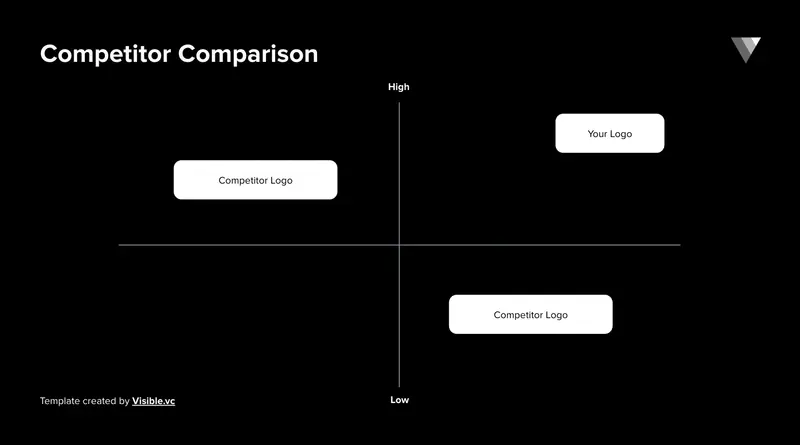
- Market Positioning: Use a visual representation, such as a competitive matrix, to show where you stand in relation to your competitors. Highlight the areas where you excel.
By presenting a well-thought-out competition analysis, you demonstrate to investors that you have a strategic understanding of the market and a plan to capture and defend your market share.
An example of a successful competition analysis slide includes:
- Competitor Overview: Brief descriptions of key competitors.
- Competitive Matrix: A visual chart comparing features, pricing, market share, etc.
- Unique Value Proposition: Clear articulation of what makes your product unique and better.
Create your own by downloading our free pitch deck template here.
Step Eight: Prove Profitability With Financials/Metrics
Investors know that seed-stage financials are projections built on assumptions, not track records. They are not expecting precision. What they are evaluating is whether your assumptions are grounded in reality, whether you understand the key drivers of your business, and whether the opportunity is large enough to justify venture returns if things go well.
Your financials slide should cover a three-year projection at minimum, with a simple revenue model, a path to gross margin improvement, and a view of your burn rate relative to the capital you are raising. Keep it to one or two slides. A dense spreadsheet screenshot signals that you do not know what matters; a clean chart with a few key numbers signals that you do.
The metrics that matter most at seed stage:
Not all metrics are equally important, and including too many dilutes the ones that actually move investors. Focus on the numbers that speak directly to the viability of your business model.
- MRR / ARR - Your current revenue run rate and month-over-month growth trend
- CAC - What it costs to acquire one customer across all channels
- LTV - Projected lifetime value of a customer; LTV:CAC ratio should be at least 3:1
- Gross margin - Especially important for SaaS and AI companies where infrastructure costs vary widely
- Burn rate - Monthly cash out, and how many months of runway the raise will provide
- Break-even timeline - When you expect to reach profitability under your base-case assumptions
A few things to include on your financials slide:
- 3-year revenue projection with clearly stated assumptions
- Current and projected gross margin
- Monthly burn rate and runway post-raise
- Key growth driver (the one metric that, if it moves, changes everything)
- Break-even point on a timeline
A few things to leave out or save for due diligence:
- Granular monthly P&L for years 2 and 3
- Bottom-up hiring plans before Series A
- Multiple scenario models (base, bear, bull) — pick your base case and own it
- Cap table details (this belongs in your data room
If your revenue is pre-launch or very early, do not try to hide it with aggressive projections. State your current position clearly, show the assumptions behind your model, and let the market size argument carry the weight. Investors fund potential; they penalize founders who obscure reality.
One number worth including that many founders overlook: the specific milestone your seed funding will get you to. "This raise gets us to $50K MRR and 18 months of runway" is more compelling than a revenue chart alone because it connects the capital you are asking for to a concrete, investable outcome.
Step Nine: Answer The Question: “Why Now? Why Me?”
Investors are structurally incentivised to wait. More data, more traction, and a lower risk profile are always available at the next funding round. Your job in this slide is not just to explain your timing but to make waiting feel costly. A strong "why now" argument reframes the investor's choice from "should I fund this?" to "can I afford to miss this window?"
By the time you reach this slide, your deck has already established the problem, the solution, and the market opportunity. This slide does one specific job: it answers why the conditions that make your company possible and necessary exist right now, and why the founder standing in front of the investor is the right person to capitalise on them.
The timing argument
The most compelling timing arguments are built on genuine inflection points, not just market size. An inflection point is a specific, recent change in technology, regulation, consumer behaviour, or infrastructure that has made your solution newly viable or newly urgent. The strongest "why now" slides name the inflection point explicitly and connect it directly to the problem you are solving.
There are typically four sources of timing leverage worth considering:
- Technology shift - A new capability has emerged that makes your solution possible in a way it was not two or three years ago. AI infrastructure costs, new APIs, or a platform shift are common examples right now.
- Regulatory or structural change - A law, policy, or industry standard has changed in a way that creates new demand or removes a previous barrier to adoption.
- Behavioral shift - Customer expectations or habits have changed in a durable way, creating a gap between what incumbents offer and what buyers now want.
- Market timing - A window is opening, whether that is a dominant incumbent weakening, a new distribution channel maturing, or an adjacent market creating pull for your category.
The "why you" argument
Timing alone is not enough. Investors back founders, not just opportunities. As Jonah Midanik, managing partner at Forum Ventures and one of the most active early-stage B2B investors in the market, explains:
"First and foremost we are betting on the founder. It can be that they are wildly ambitious, they have a great insight, they are magic in the room, any combination of things. But ultimately we are betting on an individual and their ability to evolve as the business evolves. Your job this quarter is going to be different than your job next quarter. We are really trying to look ahead and saying, are you going to be able to meet the moment, quarter after quarter after quarter?"
This is not a repeat of your team slide. Where your team slide established credibility, this section connects your team's specific background to the specific moment you are in. The question is not just whether you are qualified in the abstract. It is whether you are uniquely positioned to move on this particular opportunity, at this particular time, faster than anyone else.
The strongest version of this argument is what some investors call an unfair advantage: a reason why you will move faster, know more, or have access to something your competitors do not. That could be domain expertise, proprietary relationships, unique data access, or prior experience building something adjacent.
Handling early and late market entry
If you are entering a market early, your timing argument should focus on the specific signal that tells you the market is about to inflect. What do you know or see that others do not yet? First-mover advantage is only compelling when paired with a credible explanation of why the market is ready now and was not ready before.
If you are entering a more mature market, the timing argument shifts. Your "why now" is not about the market emerging but about why the existing solutions have a structural weakness that your approach solves. Incumbents move slowly. Customer expectations have shifted. A new distribution channel exists that was not available when the market leaders were built. Any of these can be a legitimate timing argument if you can back it up with evidence.
What a strong "why now" slide looks like in practice
- Name one specific inflection point that has occurred in the last 12 to 24 months
- Connects that inflection point directly to the problem you are solving
- Explains why your team is specifically positioned to act on it
- Makes the cost of waiting clear without being hyperbolic
- Is supported by at least one data point, trend, or external validation
Every founder thinks their timing is right. The ones who convince investors are the ones who can show, not just assert, that a specific window exists and that they are already inside it.
Create your own by downloading our free pitch deck template here.
Step Ten: Wrap Things Up With The Ask Slide
The ask can often be an underutilized section in investor updates, and founders might not realize it’s also essential to include in a pitch deck. Investors should not only be seen as capital resources but also as sources of knowledge and connections. Clearly stating your ask shows investors where you need help and allows them (and you) to determine if they are in a position to provide that support. When they decide to invest, it is in their best interest to contribute to the success of your business in any way they can.
Key Elements of a Successful Ask Slide
- Funding Request: Clearly state the amount of capital you are seeking. Provide a breakdown of how you plan to use the funds, such as product development, marketing, hiring, etc.
- Additional Support: Mention other forms of support you are looking for, such as mentorship, industry connections, or specific expertise. This shows that you value the investor's experience and network.
- Milestones: Outline the key milestones you aim to achieve with the requested funds. This gives investors a clear picture of your goals and how their investment will be utilized.
An example of a successful ask slide includes:
- Clear Funding Amount: Specify the total amount you are raising.
- Detailed Use of Funds: Breakdown of how the funds will be allocated.
- Support Requests: Mention any additional support needed beyond capital.
- Milestones: Key objectives to be achieved with the funding.
Create your own by downloading our free pitch deck template here.
The Best Seed Funding Pitch Deck Examples
Many successful founders and startups have shared the pitch decks they used to raise their seed rounds. Studying these examples can provide valuable insights and inspiration for your own pitch. Here are a few of our favorite pitch deck examples:
Airbnb Pitch Deck
Before becoming a publicly traded company, Airbnb (originally AirBed&Breakfast) used a pitch deck to raise $600k to get things off the ground. The Airbnb seed round deck is an excellent example of effective storytelling and hooking potential investors with a compelling narrative.

Uber's Original Pitch Deck
Uber, initially named UberCab, started with a humble pitch deck that emphasizes the importance of clarity and brevity. Their original deck focuses on facts and data, avoiding unnecessary fluff, and clearly presenting their value proposition and market potential.

Buffer's Seed Round Pitch Deck
Buffer, a social media management toolkit for small businesses, raised a $500k seed round and shared their deck on their blog. The Buffer seed round deck is notable for its focus on traction, showcasing the product's early success and growth potential. The Buffer team reached out to over 200 investors, conducted 50 meetings, and ultimately secured 18 investors.

Sequoia Capital Pitch Deck Template
Sequoia Capital, one of the leading venture capital firms, has also shared a pitch deck template that outlines key elements of a successful pitch. This template is designed to help startups communicate their vision and value proposition effectively. You can view Sequoia’s pitch deck template here.
For more detailed breakdowns and to download our free pitch deck template, check out Visible’s guide here.
Related resource: 23 Pitch Deck Examples for Any Startup
How to Pitch Seed Stage Investors
Once your pitch deck is complete, the pitching process begins. Here are some best practices for pitching seed stage investors:
Best Practices for Pitching Seed Stage Investors
- Target the Right Investors: Save time by only reaching out to investors who match crucial factors such as industry, funding amount, stage, and geography. Use tools like our Connect Investor Database to find suitable matches. For tips on emailing your first investors, check out 5 Strategies for Cold Emailing Potential Investors.
- Incorporate Feedback: Treat feedback as a gift. When you start receiving feedback from your pitches, implement it back into your deck immediately. Notice which slides grab investors’ attention and consider moving those to the beginning or integrating their elements into other slides.
- Be a Confident Storyteller: Confidence and good storytelling are key to delivering a compelling pitch. Ensure investors feel your passion, energy, and ability to drive the company forward. Consider taking a stand-up comedy or public speaking class to enhance these qualities. Researching what makes good storytelling can also be advantageous.
- Prepare Thoroughly: Know your pitch deck inside out. Be ready to answer any questions investors might have about your business, market, financials, and growth plans. The more prepared you are, the more confident you’ll appear.
- Leverage Your Network: Whenever possible, seek warm introductions to investors. A recommendation from a mutual connection can significantly increase your chances of getting a meeting and receiving serious consideration.
For more inspiration and resources on creating a compelling pitch, check out our free pitch deck template here.
How Visible Helps Startups Raise Capital
There is no one-size-fits-all pitch deck solution these points are meant to help guide the process but you should also see what makes sense for your company. Fundraising can be boiled down to storytelling.
We believe a VC fundraise mirrors a B2B sales motion. The fundraising process starts by finding qualified investors (top of the funnel) and building relationships (middle of the funnel) with the goal of them writing a check (bottom of the funnel).
Just as a sales team has dedicated tools for their day-to-day, founders need dedicated tools for managing the most expensive asset they have, equity. Our community can now find investors, track a fundraise, and share a pitch deck, directly from Visible.
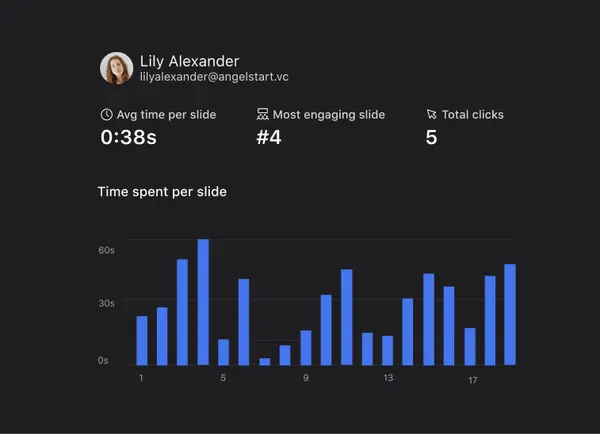
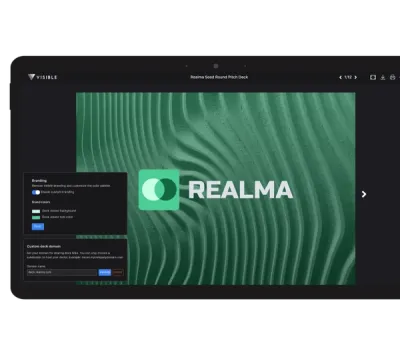
Easily upload your deck, set your permissions, and share your deck with potential investors via a unique link (check out an example deck here). In return, we’ll surface the analytics that matter most so you can better your odds of closing a new investor. Try Visible here.
Frequently Asked Questions
What should a seed round pitch deck include?
A strong seed round pitch deck covers ten core elements: a cover slide, team introduction, problem statement, solution, traction or early validation, market size (TAM/SAM/SOM), competitive analysis, financial projections, a "why now / why us" slide, and a clear funding ask. At the seed stage, investors weigh your team and market opportunity most heavily because they understand that data may be limited. Aim for 10 to 15 slides total. Every slide should serve the story; if it does not, cut it.
How many slides should a seed stage pitch deck have?
Most successful seed decks are 10 to 15 slides. Airbnb's original deck was 10 slides. Buffer's was 13. Uber's was 25 but notably dense with data. The right number is however many you need to tell a complete, compelling story without filler. If you are going beyond 15, scrutinize every slide for whether it moves the investor closer to yes. A tight 12-slide deck almost always outperforms a sprawling 20-slide one at the seed stage.
How do I build a seed round pitch deck with no traction?
Without traction, your deck has to work harder on three things: team credibility, market conviction, and narrative clarity. Lead with why your founding team is uniquely qualified to solve this specific problem. Use qualitative signals in place of metrics. Early user interviews, waitlist numbers, letters of intent, or pilot results all count. Make your market sizing rigorous and bottoms-up rather than top-down. Be explicit about what you will use the seed funding to prove: clearly stating "we will use this capital to reach X milestone by Y date" shows investors you understand what de-risking looks like even before the data exists.
What do investors actually look for in a seed pitch deck?
At seed stage, most investors are evaluating four things above all else: team (do these founders have an unfair advantage in domain expertise, prior exits, or deep industry relationships?), problem (is this a real, painful, and large enough problem?), timing (why is now the right moment for this solution?), and traction signal (even a small proof point such as a paying customer, strong retention, or a notable pilot matters enormously). Financial projections are expected but rarely believed at this stage. What investors look for in your numbers is whether your assumptions are realistic and your thinking is rigorous.
What do investors look for in a seed stage AI startup pitch deck?
For AI startups specifically, investors want to understand your data advantage, model differentiation, and defensibility. Generic "we use AI" framing is a red flag. Be specific about what model or approach you are using and why it is better than what a competitor could build in six months. Demonstrate that you have access to proprietary data, unique distribution, or a feedback loop that compounds over time. Investors will also probe your unit economics closely because AI infrastructure costs are real. Showing that your gross margins are sustainable at scale is increasingly important even at the seed stage.
How long should a seed stage pitch deck presentation be?
Plan for a 10 to 15 minute presentation, leaving at least half the meeting for questions. In practice, most investor meetings run 30 to 45 minutes and you want your deck to spark a conversation, not fill a slot. Practice delivering your core story in under 10 minutes so you have flexibility regardless of the room. The slides you spend the most time on in a live pitch (team, traction, market) are often not the ones you would dwell on in a leave-behind deck, so consider maintaining both a presentation version and a standalone version investors can read asynchronously.
Is it worth hiring an agency or designer for a seed round pitch deck?
It depends on your situation. A professionally designed deck will not save a weak story, and investors at the seed stage are generally more forgiving of rough design than at later stages because they are betting on you, not your slides. That said, if your team has no design capacity and your deck is genuinely hard to read, a one-time polish from a freelancer can be worth the cost. The better investment of time is almost always in sharpening the narrative and the numbers. Use a free template as a starting point and only bring in a designer once your content is solid.
How can I share my pitch deck with investors securely?
Avoid attaching PDFs to cold emails. They can be forwarded without your knowledge and you lose all visibility into engagement. Instead, use a tool like Visible to share your deck via a tracked link. You can set permissions (view-only, no download), see who opened it, which slides they spent time on, and whether they forwarded it. This data is genuinely useful: a VC who spends three minutes on your traction slide but skips your financials tells you something specific about what resonated and what to lead with in the follow-up conversation.
What are the best examples of seed round pitch decks?
The most studied examples are Airbnb (strong storytelling, clear problem and solution framing), Uber (data-heavy, concise, focused on market size), and Buffer (exceptional transparency about traction and the investor outreach process; they contacted over 200 investors and documented every step). Each illustrates a different strength. Airbnb is worth studying for narrative arc. Uber for clarity and brevity. Buffer for demonstrating that modest early traction can be presented compellingly. You can find annotated breakdowns of all three, plus a free pitch deck template, at the links above.