























Key Takeaways
-
Study proven success: Explore top fundraising pitch deck examples from successful startups to see exactly what narrative structures and slide layouts capture investor attention.
-
Follow the standard framework: Master the essential 10–12 slide sequence that venture capitalists expect, ensuring your presentation is clear, concise, and focused on momentum.
-
Accelerate your design: Download free, editable pitch deck templates (PDF and PPT) to bypass the blank screen and start building your foundation immediately.
-
Leverage AI smartly: Learn how to use AI tools to structure your narrative without sacrificing the authentic founder voice and real-world data that actually close rounds.
-
Optimize your fundraising workflow: Discover how to seamlessly integrate your pitch deck into a broader investor strategy by actively tracking core metrics and sending consistent updates.
Fundraising Pitch Deck Examples (With Templates + Step-by-Step Guide)
Raising capital is one of the highest-leverage activities for a startup founder, and one of the most challenging. Before you can secure a term sheet, you need to secure a meeting. Your pitch deck is the key that unlocks those initial investor conversations.
But staring at a blank slide is daunting. You don't just need theoretical advice; you need to see what actually works in the market right now. Reviewing a proven fundraising pitch deck example is the fastest way to understand the narrative, structure, and data presentation that successfully catches an investor's eye.
Whether you are raising a pre-seed round or preparing for a Series A, this guide is designed to bridge the gap between inspiration and execution.
In this comprehensive guide, we will cover:
- The best pitch deck examples from successful startups (and exactly why they worked).
- The standard 10–12 slide framework that venture capitalists expect to see.
- Free templates to help you create a pitch deck without starting from scratch.
- How to clearly present your traction, track your metrics, and communicate with investors to build long-term trust.
Fundraising Pitch Deck Examples You Can Learn From
Before you start designing your own slides, it helps to see what has actually worked. Investors see hundreds of presentations a month, so understanding the baseline of a professional deck is critical. Below is a curated list of top examples, from iconic early-stage tech giants to modern SaaS companies.
Top Startup Pitch Deck Examples (With PDFs)
What are some great pitch deck examples? Great pitch deck examples include Airbnb’s original seed deck for its clear problem-solution narrative, Uber’s early presentation for its massive market vision, and modern SaaS decks that highlight rapid user traction. The best pitch deck examples effectively communicate core business value and scalability to investors quickly and clearly.
Here are five standout examples to study:
- Airbnb (Seed Stage): Raising $600K in a market that didn't fully exist yet. This is arguably the most famous pitch deck examples pdf available. It is incredibly simple. Airbnb clearly articulated the problem (price, limited authentic travel experiences) and the solution in just a few words per slide.
- Front (Series A): Raising a $10M Series A. Front’s deck is a masterclass in transparency and metric-driven storytelling. They included detailed slides on capital efficiency, CAC, and LTV, proving the value of maintaining clean metric dashboards long before a fundraise begins.
- Uber (Seed Stage): Raising their initial capital for "UberCab." Uber’s deck aggressively highlighted a massive market inefficiency. It focused heavily on the "best-case scenario" and the sheer size of the total addressable market (TAM).
- Mixpanel (Series B): Raising $65M. Mixpanel leaned heavily into competitive differentiation. They used their deck to show exactly why legacy solutions were failing and how their specific product architecture was the inevitable future.
Creative Pitch Deck Examples That Stand Out
If you are looking for creative pitch deck examples, remember that "creative" should mean compelling storytelling, not confusing design.
- Canva: Canva's early deck was creative because of how it framed the problem. They used highly visual, relatable diagrams to show how complicated the traditional design process was, contrasting it immediately with their simple drag-and-drop future.
- Sendbird: Sendbird used incredible visual scaling in their traction slides. Instead of just listing numbers, they visually represented the massive volume of messages their API was handling, making an abstract B2B product feel explosive.
What Makes a Great Fundraising Pitch Deck
A beautifully designed presentation cannot save a flawed business model, but a confusing deck can easily kill a great startup's chances. Ultimately, a great deck does one thing: it builds a compelling, de-risked narrative about your company's future.
The 5 Key Elements of a Winning Pitch Deck
What are 5 key elements of a pitch?
A winning pitch deck must clearly articulate a pressing problem, present a compelling solution, demonstrate a massive market opportunity, show undeniable traction or proof of concept, and highlight a credible team capable of executing the vision. These elements build investor confidence and drive term sheets.
To build a professional pitch deck, ensure these pillars are bulletproof:
- A Clear Problem: Prove that a painful, urgent problem exists for a specific target audience.
- A Compelling Solution: Your product must solve the problem in a unique, highly scalable way.
- A Strong Market Opportunity: Show that capturing this market will result in a venture-scale return.
- Traction and Proof: Show momentum, whether that is revenue, active users, or successful pilot programs.
- A Credible Team: Highlight domain expertise, previous exits, or unique technical skills that make you uniquely qualified.
What Investors Actually Look For in a Pitch Deck
Venture capitalists are skimming for patterns, signals of quality, and immediate red flags. They are constantly filtering for risk.
Signals of Quality:
- Clear, Up-and-to-the-Right Metrics: Clean data shows operational discipline.
- Focus: A concise narrative without technical jargon shows that the founder deeply understands their core value proposition.
- Prior Relationship Building: Investors love a "line, not a dot." Founders who consistently share structured investor updates in the months leading up to a fundraise face far less friction when they finally send their deck, as trust has already been established.
Red Flags That Kill the Pitch:
- Unrealistic Market Sizing: Claiming you will capture "1% of a trillion-dollar market" shows a lack of go-to-market strategy.
- Hiding the Numbers: Vague traction charts without labeled axes immediately destroy credibility.
- Overcrowded Slides: If an investor has to squint to read a wall of text, they will simply close the file.
The Essential Fundraising Pitch Deck Structure
Every great fundraising pitch deck follows a proven, repeatable framework. Investors expect information in a specific sequence so they can quickly evaluate the opportunity.
The Standard 10–12 Slide Pitch Deck Framework
What is the 10-20-30 rule for pitch decks?
Popularized by Guy Kawasaki, the 10-20-30 rule states that a pitch deck should have exactly 10 slides, last no longer than 20 minutes to present, and contain no font smaller than 30 points. While modern decks often expand to 12–15 slides, the core principle of extreme brevity remains essential today.
Here is the standard 12-slide sequence that venture capitalists expect to see:
- Title: Company name, logo, and a highly focused one-sentence value proposition.
- Problem: The specific, urgent pain point you are solving.
- Solution: How you solve it (the "Aha!" moment).
- Market Timing (Why Now?): Why today is the exact right time to build this company.
- Market Size: Total Addressable Market (TAM) and realistic capture strategy.
- Product: How it works (use clear screenshots or simple architecture flows).
- Traction: Proof that it is working (revenue, users, or pilot engagement).
- Business Model: Exactly how you make money.
- Competition: Where you sit in the landscape and your proprietary advantage.
- Team: Key founders and their relevant domain expertise.
- Financials: High-level projections, burn rate, and unit economics.
- The Ask: How much capital you are raising and the primary milestones it will unlock.
What to Include in Each Slide (With Examples)
What to include in a creative pitch deck?
A creative pitch deck should include a compelling narrative hook, highly visual problem-solution framing, intuitive product demonstrations, and clear, data-driven traction charts. Instead of dense text, leverage strong design, white space, and impactful storytelling frameworks to make the core business model memorable.
Focus heavily on clarity in these heavily scrutinized slides:
- The Problem Slide: Focus on a single, undeniable pain point.
- Copy Snippet Example: "Mid-market sales teams spend 40% of their week updating legacy software instead of closing deals."
- The Solution Slide: Position your product as the painkiller.
- Copy Snippet Example: "A zero-click workflow that automatically logs calls and notes into the CRM."
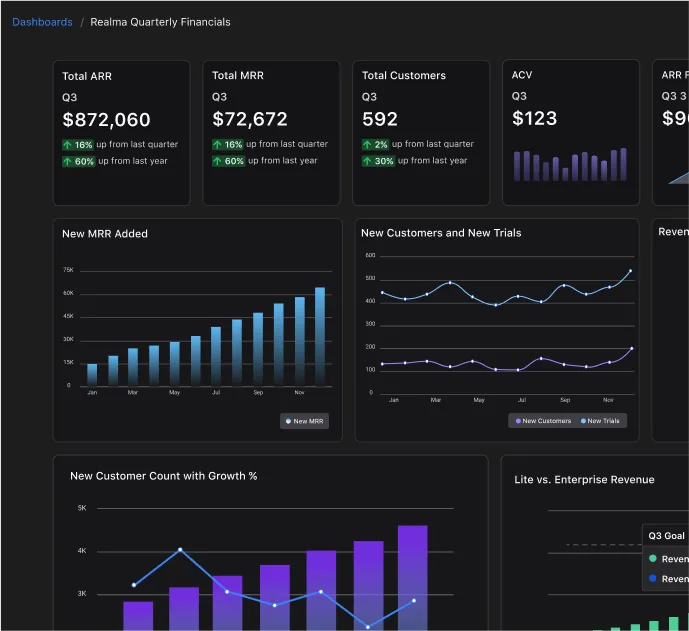
- The Traction Slide: Show compounding growth. Instead of manually calculating metrics right before a pitch, successful founders pull these numbers directly from their tracking dashboards to ensure complete accuracy.
- The Market Slide: Build your market size from the bottom up (price of product × total accessible customers) rather than pasting a massive top-down industry valuation.
Real Pitch Deck Breakdowns (Why These Examples Worked)
Understanding why an investor said "yes" is where the real value lies.
Example Breakdown #1: The Classic Airbnb Deck
Slide-by-Slide Breakdown:
- Problem: Three simple bullet points.
- Solution: A clear, one-sentence statement followed by three supporting benefits.
- Market Validation: A quick snapshot showing temporary housing was already a massive market.
- Product: Three screenshots showing the user journey.
Why it worked: The founders did not use a single piece of industry jargon. They presented a massive, relatable problem and offered an impossibly simple solution. Replicate their discipline and restrict yourself to no more than 10–15 words per slide where possible.
Example Breakdown #2: Modern SaaS and AI Startups
A modern startup fundraising pitch deck example looks different from those created a decade ago. Simply stating that you use "AI" is no longer a differentiator. Modern investors are looking for clear data moats and aggressive go-to-market motions.
Differences from Older Decks:
- Less Tech, More Workflow: Modern founders use their product slides to show how deeply their tool integrates into a customer's daily workflow rather than explaining the tech stack.
- The Y Combinator Pitch Deck Format: The modern y combinator pitch deck heavily emphasizes "Traction" and "Why Now." If you have strong traction, move that slide directly after your "Solution" slide to immediately hook the investor.
Key Patterns Across Successful Pitch Decks
- The "Villain" Narrative: Great decks frame the "Problem" as a villain that is costing businesses money. The "Solution" is perfectly positioned as the hero.
- The "Why Now" Urgency: The best decks answer why this company must be funded today, highlighting recent regulatory shifts or technological breakthroughs.
- Unassailable Metrics: Successful founders never make investors guess about their numbers. They present a single, undeniable KPI and make it the focal point.
How to Create Your Own Fundraising Pitch Deck (Step-by-Step)
Jumping straight into a pitch deck designer or presentation software usually leads to bloated slides. Follow this systematic approach to create a pitch deck that actually converts.
Step 1: Define Your Story Before Designing Slides
Write your entire pitch as a one-page memo. Positioning your startup requires a logical, unbreakable chain of reasoning: This is a massive problem → We have a unique solution → The market timing is perfect → Here is the proof we can execute. ### Step 2: Build Each Slide Using Proven Frameworks Limit yourself to one core idea per slide. Use fill-in-the-blank copy frameworks to keep your messaging sharp:
- The Problem: "[Target audience] loses [Amount of Time/Money] every week because of [Specific Inefficiency]."
- The Solution: "We built a [Product Category] that allows [Target Audience] to achieve [Specific Benefit]."
Step 3: Design for Clarity, Not Complexity
- The 3-Second Rule: If an investor cannot understand the main takeaway of a slide within three seconds, you have too much text.
- Font Sizing: Stick to 30-point fonts or larger for body text to force brevity.
- Data Visualization: Keep your graphs simple, labeled clearly, and focused on a single KPI.
Step 4: Validate Your Deck Before Sending
Never send your first draft to your top-tier target investors. Share early drafts with your existing investors, advisors, or mentors. If you are already in the habit of sending monthly updates, use your next update to share a link to your draft deck to gather strategic feedback.
Free Fundraising Pitch Deck Templates (PDF + PPT)
While reviewing a free fundraising pitch deck example is great for inspiration, having a structured, editable file saves hours of formatting.
Downloadable Pitch Deck Templates
Using a structured fundraising pitch deck example ppt allows you to immediately start plugging in your company narrative without worrying about layout alignment. Keeping a pitch deck examples pdf on hand ensures the core slide structures stay top of mind.
How to Customize a Template for Your Startup
Sending a deck that looks like a generic template is a massive mistake.
- Avoid the "Franken-deck": Adjust the typography and color palette to match your actual brand guidelines.
- Tailor the Messaging to Your Stage: If you are raising a Pre-Seed round, dedicate more visual real estate to the problem. If you are raising a Series A, expand the slides focused on unit economics.
- Swap Placeholder Charts for Real Proof: Replace generic hockey-stick growth charts immediately with your actual key performance indicators.
Using AI to Create a Pitch Deck (Pros and Limitations)
Searching for a pitch deck ai tool is increasingly common. However, while AI is a powerful assistant, relying on it entirely can strip your presentation of authenticity.
Can ChatGPT Create a Pitch Deck?
Yes, ChatGPT and other AI tools can create a pitch deck by generating outlines, drafting slide copy, and structuring your narrative. However, AI cannot replace the deep market insights, proprietary data, and authentic founder storytelling required to actually convince investors and close a funding round.
How to Use AI Without Hurting Quality
Where AI Helps:
- Overcoming the blank page by drafting the initial 12-slide structure.
- Summarizing dense market research into simple bullet points.
- Polishing grammar and cutting word counts to force brevity.
Where Human Input is Critical:
- Your Core Strategy: AI does not know your unique go-to-market motion.
- Authentic Traction: AI cannot generate your actual business momentum. You still need to rely on your own operational systems to meticulously track your real-world metrics and build your traction slides.
Common Pitch Deck Mistakes That Hurt Fundraising
Avoiding unforced errors is just as important as having a groundbreaking product. Here are the most common pitfalls:
- Too Much Text: Rely on your actual investor meetings to provide nuance; use your slides strictly as visual anchors.
- Weak or Confusing Traction: Vague charts without labeled axes, or relying heavily on vanity metrics, destroys credibility.
- Poor Storytelling: A pitch deck is not a data room; it is a narrative arc. You must clearly connect the severe pain of the problem to the inevitability of your solution.
- Lack of Clarity: Avoid industry jargon and overly complex architectural diagrams. Explain your product so simply that someone outside of your industry can immediately grasp its value.
How Pitch Decks Fit Into Your Fundraising Process
Your pitch deck serves three distinct roles depending on where you are in the investor pipeline:
- Outreach (The Teaser): A condensed 5-slide deck to generate enough interest to secure a 30-minute introductory call.
- Meetings (The Visual Aid): Run the full deck in the background as a visual anchor while you drive the conversation.
- Follow-ups (The Leave-Behind): Send the detailed deck after the meeting for the investor to share with their partners.
What Slides Matter Most by Stage (Pre-seed vs Seed vs Series A)
- Pre-seed: Focus on the Problem and the Team.
- Seed: Focus on the Solution and early Go-to-Market strategy.
- Series A: The Traction, Unit Economics, and Financials slides become the undisputed stars.
How to Present Traction (Even Without Revenue)
If you are pre-revenue, you must highlight proxy indicators that prove market demand, such as rapidly growing waitlists, high Daily Active Users (DAU), or signed Letters of Intent (LOIs).
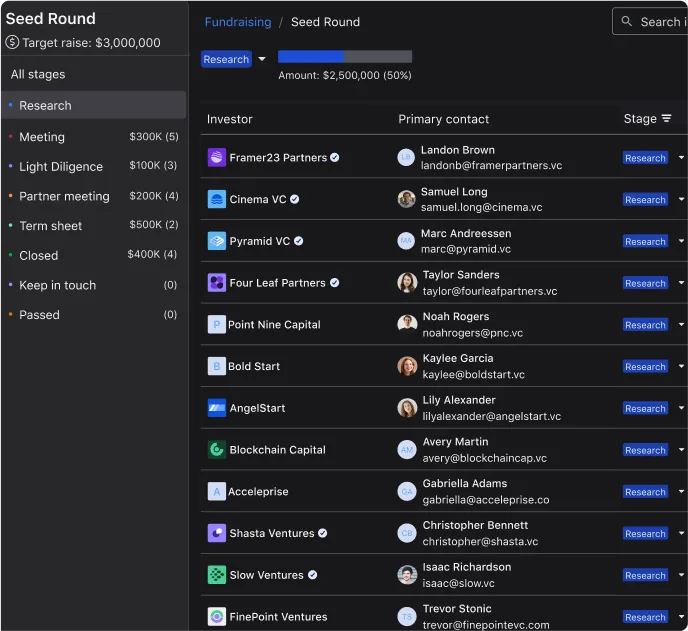
Traction is ultimately about showing progress over time. Managing your fundraising process efficiently, tracking who you are speaking to, what stage they are at, and consistently sharing those early metrics through platforms like Visible, builds a track record of execution that makes your formal pitch significantly more compelling.
Final Checklist: Is Your Pitch Deck Investor-Ready?
Before you export your final PDF, run through this final checklist to ensure your deck is primed to convert:
- Clear Story: Does your narrative flow logically from a massive problem to an inevitable solution?
- Strong Metrics: Is your traction undeniably clear and accurately pulled from your core data?
- Clean Design: Have you embraced the three-second rule and cut excess text?
- Clear Ask: Do you have a specific fundraising target and clearly mapped milestones?
Fundraising is an exercise in building trust. Your pitch deck is the starting point, but the systems you use to manage your data, track your metrics, and communicate with stakeholders are what actually close the round.
Frequently Asked Questions
How many slides should a fundraising pitch deck have?
A standard fundraising pitch deck should be 10 to 15 slides long. Investors look for extreme brevity and clarity. Sticking to a tight 12-slide framework ensures you cover the essential elements, like the problem, solution, market size, and traction, without losing the reader's attention.
Should I send my pitch deck to investors as a PDF or PowerPoint?
Always send your pitch deck as a PDF unless an investor specifically requests a PPT or editable file. A PDF ensures your formatting, fonts, and charts look exactly as intended on any device, preventing layout errors that can make your presentation look unprofessional.
How do I show traction in a pitch deck if I am pre-revenue?
If you do not have revenue, show traction through proxy metrics that prove market demand. Highlight daily active users (DAU), rapid waitlist growth, successful unpaid pilots, or signed Letters of Intent (LOIs). Investors want to see momentum and execution over time, even in the earliest stages.
Do I need a different pitch deck for Pre-Seed, Seed, and Series A?
Yes, your pitch deck must evolve with your funding stage. A Pre-Seed deck heavily emphasizes the team and the core problem. A Seed deck focuses on the solution and early product-market fit. A Series A deck shifts focus entirely to unit economics, revenue traction, and scalable growth metrics.
Can I use AI to create my pitch deck?
You can use AI to outline your structure, summarize dense market research, and refine your copy for brevity. However, AI cannot replace authentic founder storytelling, proprietary insights, or real-world traction. Use AI as an assistant to draft the deck, but rely on your actual business metrics to close the round.