
Key Takeaways
-
Your investor presentation is a 10 to 15-slide narrative designed to earn a second meeting, not close an investment on its own.
-
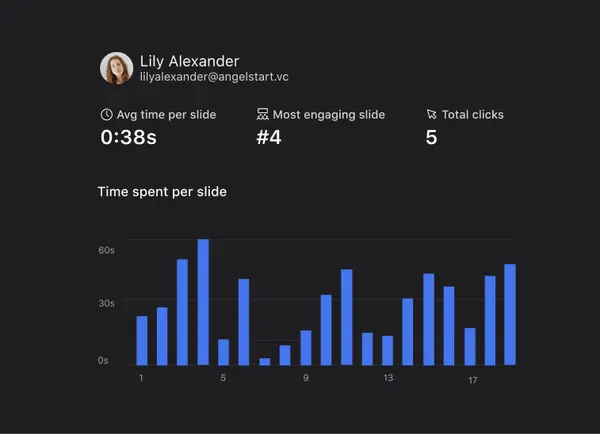
Venture investors spend under 3 minutes on a first-pass review of a deck, which means the first three slides determine whether the rest gets read.
-
Deck length should match stage: 10 to 12 slides at pre-seed, 12 to 15 at seed and Series A, and up to 20 at Series B, with the appendix doing the heavy lifting.
-
2026 investors scrutinize gross revenue retention, unit economics, and AI-specific moat framing far more than they did two years ago.
-
Maintain two decks: a 10-slide reading version for cold outreach and a 12 to 15-slide presenting version for live meetings.
-
A strong deck earns you the next meeting; a clean, well-organized data room is what gets you to a term sheet.
An investor presentation is the founder's story condensed into 10 to 15 slides, built to earn the next meeting with a VC. Every choice about what goes in that deck shapes how investors size up the company, the team, and the opportunity. This guide covers what a strong investor presentation looks like in 2026: the slide structure investors expect, deck length by stage, design and delivery, and what happens after the pitch. It pulls from current DocSend and PitchBook data, the Thrive Through Connection podcast, and Visible's own sharing data across thousands of founder decks.
What Is an Investor Presentation?
An investor presentation is a 10 to 15-slide document that explains a company's problem, solution, market, traction, team, and funding ask to potential investors. Founders use it to earn a first meeting with a VC, walk through the business in live pitches, and leave behind a reference document that investors can share internally. Most investor presentations are shared as a PDF or tracked link, and the best ones work both as a standalone reading experience and as a support for a live walkthrough. At the earliest stages, the deck is a vehicle for vision and narrative; by Series A and beyond, it is a vehicle for metrics and proof.
Investor Presentation vs Pitch Deck: What Is the Difference?
An investor presentation and a pitch deck are the same document in most practical usage. Some founders use "investor presentation" to describe the broader narrative and "pitch deck" to describe the physical slide file, but investors and accelerators use the terms interchangeably. The work is identical: communicate the business clearly enough to get to the next conversation.
"The only purpose of a pitch deck is to get a meeting or a date. The purpose of a first date is to get a second date, ultimately culminating in marriage." - Jonah Midanik, Managing Partner at Forum Ventures
Investor Presentation vs Business Presentation for Investors
A business presentation for investors is usually a broader term that includes board meetings, earnings calls, or general company updates delivered to financial stakeholders. An investor presentation specifically refers to the narrative used during a fundraise to attract capital. Founders raising venture capital often encounter both phrases in search results, but the document they actually need is the pitch deck.
Why Investor Presentations Matter for Venture Fundraising
An investor presentation is the single most scrutinized document in an early-stage raise. Investors use it to decide whether to take a first meeting, whether to invite partners into a second meeting, and whether to issue a term sheet. A clear deck accelerates that process; an unclear one ends it. The deck also forces founders to make choices about positioning and market framing, and it asks them to defend those choices in every subsequent conversation.
When Founders Need an Investor Presentation
Founders need an investor presentation whenever they are raising capital, but the document has uses outside of fundraising, too. Common moments include:
- Active fundraising rounds at pre-seed, seed, Series A, or later stages
- Warm investor conversations when a round is 3 to 6 months out
- Accelerator or demo day pitches
- Board meetings at early stages, where outside observers are present
- Investor updates where the deck serves as a reference document
- Due diligence handoff, where a current deck lives in the data room alongside financials and legal materials
A founder who keeps the deck updated on a rolling basis avoids scrambling when a surprise intro lands or an existing investor asks for a quick share-out.
The 11 Slides Every Investor Presentation Needs
Every strong investor presentation covers the same core questions, in roughly the same order, regardless of stage or sector. The specific slide count varies, but the narrative arc does not: problem, solution, market, product, traction, business model, go-to-market, competition, team, financials, and ask. Founders who try to invent a new structure usually lose investors in the first two minutes, because VCs are skimming for the same information in the same places they always have. The work is not to be original in its structure; it is to be specific and credible in its content.
Kristian Andersen of High Alpha breaks down how founders should think about crafting their pitch deck and story below:
Related resource: 11 Presentation Design Trends for Startup Pitch Decks in 2024
The Standard Slide-by-Slide Structure
The 11-slide structure below matches what most venture investors expect to see in a first-meeting deck. Founders can combine or split slides based on their business, but all of these questions need to be answered somewhere in the narrative.
- Title slide. Company name, one-line description of what the company does, founder name, and date. Keep it clean.
- Problem. The specific pain point the target customer experiences, supported by data or a short customer example. The sharper the problem, the more credible the rest of the deck becomes.
- Solution. How the product solves the problem, in one clear sentence, followed by the mechanism. This is not the product tour; it is the elevator version.
- Market opportunity. Total addressable market sized from the bottom up, with a credible path from the current wedge to a larger category. Investors will discount top-down market numbers.
- Product. Screenshots, a live demo link, or a short walkthrough of what the product actually does. The product slide is underweight in most decks and deserves more space than founders give it.
- Traction. Revenue, customer count, retention, pipeline, or engagement metrics that prove the business is working. At pre-seed, traction can be waitlists, design partners, or LOIs.
- Business model. How the company makes money, pricing structure, and unit economics in rough terms.
- Go-to-market. The specific path to the first 50 or 100 customers, including channel, motion, and early proof points.
- Competitive landscape. A clear articulation of why the company wins, framed around a unique insight rather than a feature matrix.
- Team. Founders, key hires, and the specific experience that makes this team uniquely positioned to solve the problem.
- Financial projections and ask. Three-year projections, the amount being raised, use of funds, and what the next 18 months will produce.
Founders who want to see how this structure plays out in real decks can reference Visible's pitch deck examples hub, which breaks down how companies like Airbnb, Uber, Dropbox, Brex, and Front handled each slide in their earliest rounds.
Related resource: How to Create Impactful Problem/Solution Slides for Your Pitch Deck
Which Slides Do Investors Scrutinize Most?
Investors do not spend equal time on every slide. DocSend's research shows that the business model, traction, and financial slides consistently receive the longest viewing time in first-pass deck reviews. The why-now slide and the competition slide have also come under greater scrutiny since 2023, as investors look for market-timing signals and defensible positioning.
What this means in practice: these slides need to hold up under the most pressure. A thin business model slide, a traction slide that hides churn, or a why-now slide that reads as boilerplate will kill a deck faster than a weak team slide or a generic problem statement. Founders should spend disproportionate time on the slides that investors actually read carefully.
Related Resource: Pitch Deck 101: How Many Slides Should My Pitch Deck Have?
Slides to Cut or Move to the Appendix
Many decks include slides that add no information and occasionally hurt the founder's position. The most common offenders are competition slides with feature-matrix grids, advisor slides, multi-slide product tours, and three-year roadmap slides at the pre-seed stage.
"You could immediately never show me another competition slide. I don't care about competition slides ever. If you have a slide that shows advisors to your company on it, I would throw that one away first." - Brett Brohl, Managing Partner at Bread & Butter Ventures
A better approach is to keep a lean 10 to 12-slide main deck and move supporting detail to the appendix. Cohort analyses, detailed financial assumptions, product roadmaps, and customer logos all belong in the appendix, where they are available if asked, but do not clutter the core narrative. Appendix slides also give founders something to pull up during Q&A, which signals preparation without forcing investors to sit through unnecessary content in the main pitch.
How Long Should an Investor Presentation Be?
An investor presentation should be 10 to 15 slides for most seed and Series A raises, with the exact count scaling by stage. Pre-seed founders often succeed with 8 to 10 slides, while Series B decks sometimes stretch to 20 when investors expect deeper traction data and operational detail. The principle behind the range is that every slide must earn its place: investors spend an average of 2 minutes 24 seconds on a first-pass review, and extra slides dilute rather than add. Founders who find themselves at 25 or 30 slides have almost always over-explained something that belongs in the appendix or the data room.

Pre-Seed and Seed Deck Length
Pre-seed decks should run 8 to 10 slides, and seed decks should run 10 to 12. At this stage the business has limited proof points, so extra slides create opportunities to raise questions the founder cannot yet answer. A tight pre-seed deck forces the story down to its essentials: problem, solution, why now, early traction or design partners, team, and ask.
Seed founders typically have more to show, including early revenue, customer retention data, and a clearer go-to-market motion. The additional 2 to 4 slides over a pre-seed deck usually go to traction detail, a more substantive product walkthrough, and a clearer business model slide. Anything beyond 12 slides at seed signals that the founder has not yet prioritized what matters most.
Series A and Series B Deck Length
Series A decks run 12 to 15 slides, and Series B decks run 15 to 20. Series A expectations have risen over the past two years: most institutional funds now want to see at least $3M in ARR and a repeatable sales motion before they lead. That means the Series A deck needs room for cohort retention, unit economics, sales efficiency metrics, and detailed pipeline data that a seed deck does not.
"You can sell the vision once. Sometimes, if I squint, I see founders sell selling vision twice. By Series A, people really want to see metrics." Jenny Fielding, Co-Founder and Managing Partner at Everywhere Ventures
Series B decks add more depth to the financial model, go-to-market expansion, organizational structure, and category leadership. Investors at this stage are buying a proven business, not a thesis, and the deck has to reflect that shift.
Related Resource: How to Pitch a Perfect Series B Round (With Deck Template)
Reading Deck vs Presenting Deck: When to Use Each
A reading deck and a presenting deck are two different documents, and founders who try to use one for both jobs usually end up doing neither well. A reading deck is what a founder emails to an investor before a meeting. It runs 10 to 12 slides, carries more context in each slide, and stands alone without a voiceover. A presenting deck is what a founder walks through live. It runs 12 to 15 slides, uses less text per slide, and assumes the founder is filling in the narrative aloud.
Founders should also maintain a short teaser deck of 5-6 slides for initial outreach. The teaser exists to earn a meeting, not to pitch the business in full. Sharing the full reading deck too early removes the reason for the first conversation and lets investors make a pass decision without ever hearing the founder speak.
How Long Should Founders Present Live?
A live pitch should run 10 to 15 minutes in a 30-minute meeting, leaving the remaining time for Q&A. The temptation is to use the full meeting to walk through every slide, but that trades the most valuable part of the conversation for a monologue investors could have read on their own. The Q&A is where investors test conviction, probe for weaknesses, and decide whether to move forward. Founders who protect that time consistently out-convert founders who do not.
For longer meetings, the same rule applies: spend no more than two-thirds of the available time presenting, and reserve at least one-third for open conversation. Founders should also build a 5-minute version of the pitch for situations where time gets cut short, which happens more often than most first-time founders expect.
What Makes an Investor Presentation Compelling in 2026?
A compelling investor presentation in 2026 is specific, current, and built around a clear insight rather than a generic market thesis. The bar has risen on every dimension: investors want sharper unit economics, a defensible moat that goes beyond AI-powered branding, and a founder who can articulate why the business exists in language a non-expert can follow. Capital is harder to raise than it was two years ago, and the decks that convert are the ones that respect investor time and lead with proof. Polish alone does not move the needle; specificity does.
What VCs Look for in a Deck Today
Investors evaluate early-stage decks against four core criteria: a real problem with real customers, a market that can realistically reach $100M in annual revenue, a founder who can evolve as the company grows, and early evidence that the solution is working. Pre-seed investors weigh the founder and market most heavily, since proof is limited. Seed and Series A investors shift the weight toward traction, retention, and unit economics.
The common thread across stages is that VCs are looking for outliers, not averages. A deck that reads as competent but unremarkable tends to get a polite pass. Founders who show they are thinking about their business in a way no one else has are the ones who earn second meetings.
How to Present Unit Economics and Capital Efficiency
Unit economics belong in the main deck, not the appendix, for any business past seed. Investors in 2026 expect to see CAC payback period, gross margin, contribution margin, and net revenue retention on a single slide, with the underlying assumptions ready to defend in Q&A. For SaaS businesses, gross revenue retention has become the metric investors scrutinize most carefully, because it reveals whether a business is genuinely healthy or whether expansion revenue is masking churn.
"Gross revenue retention is arguably the most important metric for a scaling enterprise software company right now. Are you closing new deals and are you not hiding a churn or attrition problem with expansion?" - Kyle Poyar, Founder at Tremont
Capital efficiency metrics have also risen in prominence. ARR per employee went from a CFO-only number to a public benchmark over the past two years, with breakout companies now reaching $1M or more per full-time employee. Founders who can show strong efficiency alongside growth signal that they understand how the market has shifted away from growth-at-all-costs.
What AI Startups Need to Include That Other Startups Do Not
AI founders face a distinct set of investor questions that traditional SaaS founders do not. Investors want to see a defensible moat beyond proprietary AI framing, a clear path to sustainable gross margins as inference costs scale, and evidence that customers stick with the product rather than churning after a trial. The 2026 AI deck needs a slide on cost structure, a slide on data or workflow lock-in, and a clear articulation of what the company can do that a foundation model cannot replicate.
Revenue definitions also deserve special care. Many AI companies book pilot revenue, usage-based revenue, and experimental deployments as ARR, but investors have become sharper at distinguishing among them. A deck that shows $5M in ARR, where most of that revenue is from 90-day pilots, will be discounted quickly. Founders should be explicit about what portion of revenue is in production, annual, and contractually locked in.
For regulated verticals like healthcare and finance, compliance positioning has moved from a checkbox slide to a trust-building one. Founders who can show SOC 2 readiness, data governance, and hallucination mitigation signal that enterprise buyers can actually deploy the product.
Related Resource: How To Write the Perfect Investor Update (Tips and Templates)
How to Tell a Story That Sticks
Founders who spend time crafting a comprehensive pitch often end up making it forgettable. The strongest investor presentations lead with a single insight or proof point that is hard to ignore, then build the rest of the deck around it. That means resisting the instinct to put the problem slide first just because every template does, and instead asking: what is the one thing about this business that makes an investor want to hear more?
"Until you can explain the business opportunity in 90 seconds to a normal person in plain English, your deck is going to be bad because it's just slides." - Jonah Midanik, Managing Partner at Forum Ventures
The practical test is to deliver the pitch to a friend or advisor with no context about the business. Suppose they cannot explain back what the company does, why it matters, and why the story needs more work after 90 seconds. Founders should also prepare the vision slide to connect current traction to a larger future in concrete steps, not abstract handwaving. Investors fund believable paths, not aspirational leaps.
Investor Presentation Design Principles
Design in an investor presentation exists to serve the narrative, not to decorate it. The goal is to make the deck easy to scan in under three minutes, because that is how investors will actually consume it. Clean typography, consistent visual hierarchy, and one clear idea per slide will outperform elaborate design every time. Founders who spend weeks perfecting animations or hiring a design agency before they have a clear story tend to produce decks that look polished but communicate nothing specific.
Related Resource: Tips for Creating an Investor Pitch Deck
Design Principles That Help Investors Read Faster
The strongest decks follow a small number of design rules that prioritize readability. Each slide should carry one idea, supported by one chart or one visual. Headlines should state the takeaway, not the topic: instead of "Traction," use "Revenue grew 4x in the last 12 months." Charts should be labeled clearly and use color intentionally, with the one data point the founder wants the investor to notice highlighted.
White space is a design tool, not wasted real estate. Slides with more space read as confident; slides that fill every pixel read as nervous. Fonts should be large enough to read on a Zoom screen share, typically 24 points or higher for body text. Consistency across slides matters more than any single design choice: the same typeface, color palette, and chart style throughout the deck signal professionalism without requiring a designer.
How Much Text Should Each Slide Have?
Presenting decks should carry under 30 words per slide, and reading decks can carry up to 60. The common mistake is using a presenting deck as a reading deck, which forces the founder to either over-write every slide or leave investors confused when they read it alone. A presenting slide with 10 words and one chart works because the founder's voice fills in the context; the same slide in an email attachment looks incomplete.
Guy Kawasaki's 30-point font rule is still a useful discipline here. If the text on a slide is too small to read at 30-point font, there is too much text. The rule forces founders to prioritize, which is exactly what investors want to see on the other end of the deck.
Related Resource: How To Write the Perfect Investor Update (Tips and Templates)
Pitch Deck Templates: When to Use Them and When to Skip
Templates are a reasonable starting point for founders without design resources, but they become a trap when they dictate the pitch's structure. The most common failure mode is treating the deck as a fill-in-the-blank exercise, where the founder adapts their business to the template rather than adapting the template to their business. The result is a deck that hits every slide on the checklist but fails to communicate what makes the company distinct.
"Founders treat pitch decks like a collection of slides, and that's not how humans communicate. Start with a story you can tell, and then put slides against it." - Jonah Midanik, Managing Partner at Forum Ventures
The better approach is to write the narrative first, ideally in a single document or as a 90-second spoken pitch, and then build slides to support each beat of that narrative. Founders who work this way find that some standard slides are unnecessary for their business, while others are essential. A design-first approach rarely catches that; a story-first approach always does.
How Should Founders Deliver an Investor Presentation?
Most fundraising processes in 2026 are hybrid. Founders typically start on Zoom, mix formats as the round progresses, and save in-person time for moments that matter: partner meetings, final diligence, and relationship building with the lead investor. The format changes how the deck is delivered, what the founder emphasizes, and how the conversation flows. A pitch that works in person often falls flat on Zoom, and vice versa, because the constraints of each medium are different.
Related Resource: 18 Pitch Deck Examples for Any Startup
Zoom vs In-Person Delivery
Zoom pitches are the default for first meetings. Investors increasingly run entire fundraising processes over video, from the initial intro to the term sheet, and founders who wait for in-person meetings to make their case will miss out on most of the round. In-person meetings still carry weight for partner meetings, final diligence, and any conversation where reading the room matters more than efficiency.
The practical difference between the two formats is attention. In-person meetings give the founder more of their full attention for the duration of the pitch. Zoom meetings give the founder an attention span that fluctuates between 40 and 80 percent, depending on what else is on the investor's screen. That means Zoom pitches need to be shorter, tighter, and more visual, with the first 60 seconds doing more work than in person.
How to Reduce Zoom Fatigue
Zoom fatigue kills more pitches than founders realize. On video, long decks feel longer, dense slides feel denser, and a monologue that works in a conference room sounds soporific through a laptop speaker. Founders should assume the investor is more tired than they look and design the pitch accordingly.
A few tactical adjustments help:
- Shorter deck, fewer slides. If the pitch is on the edge of adding a slide, cut one instead.
- More white space, fewer words. Slides should support the story, not compete with it.
- Use chapters. A simple structure like Problem, Solution, Proof, Plan, and Ask helps listeners stay oriented without following every slide.
- Pause intentionally. A 2 to 3-second pause after a key point gives investors space to absorb it and ask a question.
Running a Crisp Screen Share
Screen share problems are the fastest way to lose momentum in a Zoom pitch. The recovery time from a glitchy share, a missing slide, or a desktop notification is far higher than founders assume, because it breaks the rhythm of the pitch. A few habits prevent most of these issues:
- Use presenter view if it helps the founder stay on script, but make sure attendees only see the slides.
- Close everything unrelated before the call: Slack, email, calendar notifications, and any second monitor overlays.
- Have a PDF backup ready in case fonts, animations, or embedded media fail.
- Know the escape hatch. If sharing glitches mid-pitch, stop sharing, reset, and keep talking. Do not apologize for five minutes.
Camera setup also matters more than founders expect. A laptop camera at eye level, a front-facing light source, and a working microphone read as professional. A camera pointed up at the founder's ceiling fan does not.
How to Handle the Q&A Confidently
The Q&A is where most investment decisions actually get made. Investors use the questions to test conviction, stress the business model, and see how the founder handles pressure. A founder who treats Q&A as a free-form conversation rather than a scripted defense will consistently outperform one who tries to control every response.
Preparation makes the difference. The strongest founders have already written out the 25 to 30 questions they are most likely to receive, practiced the answers out loud, and refined them until they sound conversational. That work sounds tedious, but it is what separates founders who look sharp under pressure from founders who look defensive.
"At the core of what we believe is that the moment a founder is defensive in a fundraise, they've lost. Being defensive is a fear reaction, and repetition eliminates fear." - Jonathan Lowenhar, Partner at Enjoy The Work
The questions to prepare for fall into predictable buckets: market size and why now; business model and unit economics; competitive dynamics; team and hiring; product roadmap; and fundraising mechanics. Any founder who has not rehearsed answers to each of these categories is walking into meetings underprepared. And when an investor asks a question the founder does not know the answer to, the right answer is to say so, note the question, and follow up within 24 hours. Guessing under pressure is how small concerns become deal-breakers.
What Investors Expect After the Deck
A strong investor presentation earns the next meeting. Diligence readiness is what earns the term sheet. Once investors are interested, they move fast and in parallel, pulling on every thread the deck surfaced: financial model, customer references, legal structure, product roadmap, and metrics definitions. Founders who have prepared the supporting materials in advance shorten their diligence cycle by weeks. Founders who scramble to assemble them in real time signal that the business is earlier than the pitch suggested.
Related Resource: Startup Metrics You Need to Monitor
What Belongs in a Fundraising Data Room
A fundraising data room should be organized, up to date, and concise. The goal is not volume; it is clarity. Investors want to quickly find what they need, verify that the numbers match what the founder said in meetings, and flag anything unusual without having to ask. A well-organized data room signals operational maturity; a messy one invites more questions about diligence than it answers.
The core categories for most early-stage data rooms are:
- Company and legal: formation documents, bylaws, major amendments, board consents, key customer and vendor contracts, IP assignment agreements.
- Cap table and fundraising: current cap table, option pool details, SAFEs or notes, prior term sheets, and a summary of key investor rights.
- Financials: driver-based financial model, historical P&L (ideally monthly for the past 12 to 24 months), burn and runway, revenue detail by customer or product.
- Traction and metrics: cohort or retention exports, unit economics with assumptions, growth channels, and concentration risk.
- Go-to-market and sales (especially for B2B): pipeline by stage, top customer list with ARR and renewal timing, pricing, and packaging.
- Product and security: product roadmap, SOC 2 status or plan, data-handling overview, regulated-industry considerations, where applicable.
- Team: org chart, key hires planned, founder and executive bios, hiring plan tied to use of funds.
Founders raising their first institutional round should share the data room selectively, not up front. The data room is a diligence tool, not a marketing asset.
"Data rooms are where deals go to die. When you send a data room, you've lost all leverage. Drip them the information instead." Jenny Fielding, Co-Founder and Managing Partner at Everywhere Ventures
For a deeper breakdown of what belongs in each section, see Visible's guide to startup data rooms.
How to Keep Due Diligence From Stalling
Diligence stalls when requests pile up, answers are scattered across different places, or the numbers shift depending on who is asking. Founders who close fastest maintain a consistent answering discipline throughout the entire process. A few habits prevent most of the delays:
- Centralize requests. Keep one shared tracker with questions, owners, and status. Even a simple shared document works.
- Answer once, share many times. Create a living FAQ for recurring questions about metric definitions, pricing, ICP, and churn drivers.
- Be consistent with numbers. Use one source of truth for every metric and define exactly what counts. What is active? How is ARR calculated? These definitions need to hold across the pitch, the data room, and the model.
- Send a weekly diligence update. A short, structured note covering what was shared, what is pending, and what is next keeps the process moving and signals momentum.
- Control the narrative. If a metric looks weak, address it directly. Explain what the team learned, what changed, and what the early results show.
What Investors Ask for Between First Meeting and Term Sheet
The diligence process is a funnel, not a single event. Investors follow a predictable sequence of asks after the first meeting, and founders who understand it can anticipate requests rather than react to them. The typical progression runs roughly as follows:
- Second meeting or product deep dive. Detailed walkthrough of the product, demo, and architecture.
- Business diligence. Financial model, unit economics, cohort retention, and detailed traction data.
- Customer references. 3 to 5 customer calls, with the investor setting the agenda.
- Partner meeting. The lead partner brings the deal to the full partnership for discussion.
- Term sheet. The investor issues terms, subject to confirmatory diligence.
- Legal diligence and close. Cap table verification, contract review, and final documentation.
Each stage can take days or weeks, depending on the investor's process and the founder's preparedness. Founders who treat each stage as a separate conversation, with its own materials and preparation, consistently close faster than those who try to collapse the whole process into one back-and-forth.
The Biggest Investor Presentation Mistakes Founders Make
Most failed pitches fail for predictable reasons. The founder talks too much, the deck reads as generic, the traction slide hides a problem, or the follow-up lands as a chore. These mistakes are fixable, but only if founders recognize them before they compound across dozens of meetings. The best way to avoid them is to understand exactly how investors read a deck, what they flag as a concern, and where the process typically breaks down.
What Kills a Deck in the First Two Minutes
Investors decide within the first two or three minutes whether to keep reading. The fastest ways to fail that test are an unclear problem statement, a vague market framing, no visible traction indicator, or an opening slide that buries the business under jargon. Once an investor disengages in the first 90 seconds, the rest of the deck rarely recovers their attention.
The most common pattern behind a dead-in-the-water pitch is over-explaining. Founders with deep technical knowledge often pack the early slides with context, nuance, and caveats that feel necessary but read as confusing. The opposite approach works better: lead with the clearest, most specific claim the business can make, and let the detail emerge in later slides or Q&A.
"Super smart people, many young people, have been programmed early on: the more you say, the more in-depth you are, the smarter you sound. You need to deprogram yourself from that. The less you say, the more tight and concise, the better." - Jenny Fielding, Co-Founder and Managing Partner at Everywhere Ventures
Founders should also assume the investor is skimming on a phone, between meetings, with one eye on email. A deck designed for that reader beats a deck designed for a perfect attention environment every time.
Slides That Read as Red Flags to VCs
Certain slide patterns trigger skepticism regardless of how polished the rest of the deck is. The most common red flags are:
- Hockey stick revenue projections. Three-year curves with no grounding in the current pipeline or sales-efficiency signal that the founder is hoping for, not planning.
- Inflated TAM with no bottom-up logic. A $500 billion market size from a Gartner report, with no path from the current wedge to the category, reads as lazy.
- Team slides without relevant experience. A deep-tech company with a team slide that emphasizes brand-name employers but lacks domain expertise invites the question of who will actually build the product.
- Polish that exceeds substance. Over-designed decks with thin content invite the question of what the founder is concealing.
- Mismatched metrics across slides. ARR on one slide that does not reconcile with the growth chart on another suggests the founder has not done the work, or is obscuring it.
For AI startups specifically, a retention slide that papers over early churn with expansion revenue from a handful of accounts is a near-automatic pass. Investors have become adept at dissecting net retention, and a founder who presents it as a single, healthy number without context will face pointed follow-up questions.
Follow-Up Mistakes That Cost Founders Funding
Even founders who run a strong pitch often lose deals in the follow-up. The most common mistake is sending weak, generic check-in emails that give the investor nothing to respond to. A founder who sends five of these over three weeks has trained the investor to ignore the inbox.
"The worst email I receive all the time is, Hey Jenny, just following up, see what next steps are. It's a soul-sucking email. Only two things get an investor to move: momentum in your business or momentum in the round." - Jenny Fielding, Co-Founder and Managing Partner at Everywhere Ventures
The better approach is to send follow-ups that carry new information. A signed customer, a hired executive, a new pilot launched, a competitor move that shifted the landscape, or a term sheet from another investor all qualify as reasons to reach back out. Founders who save one or two of these updates for specifically timed follow-ups maintain momentum across a multi-week process.
Other follow-up mistakes that cost founders funding include waiting too long between check-ins, which lets the round lose heat; inconsistent numbers between the pitch and the data room, which forces the investor to re-diligence every claim; and failing to send a short recap after each meeting, which misses an easy chance to reinforce the strongest points of the conversation. For founders who want a system for managing these communications at scale, Visible's investor update tools are built for exactly this workflow.
Frequently Asked Questions
What is an investor presentation, and how is it different from a pitch deck?
An investor presentation and a pitch deck are the same document in most practical usage. Both refer to the 10 to 15 slide narrative founders use to explain their company to potential investors. The goal is to earn the next meeting, not close an investment on its own. Investors and accelerators use the terms interchangeably.
What should an investor presentation include for venture capital investors?
An investor presentation should include a title slide; problem, solution, market opportunity, product, traction, business model, go-to-market strategy, competitive landscape, team, and financial projections, including the funding ask. Most strong decks cover these 11 elements in roughly that order. Supporting details like cohort analyses, product roadmaps, and detailed financials belong in the appendix.
How many slides should a pre-seed or seed pitch deck have?
Pre-seed decks should run 8 to 10 slides, and seed decks should run 10 to 12. Extra slides at these stages create opportunities for questions the founder cannot yet answer. A tight early-stage deck forces the story down to its essentials: problem, solution, why now, early traction, team, and ask.
What makes an investor presentation compelling to investors at seed or Series A?
A compelling investor presentation leads with a specific insight or proof point, supports it with current data, and connects traction to a believable larger future. In 2026, that means sharper unit economics, clear gross revenue retention, a defensible moat beyond AI-powered framing, and a founder who can explain the business in 90 seconds to someone with no context. Polish alone does not move the needle; specificity does.
What happens after an investor presentation, and what should be in the data room?
After an investor presentation, interested investors move into diligence and request a data room. A strong data room includes formation documents, cap table, SAFEs or notes, financial model and historicals, revenue detail, cohort retention, unit economics, product roadmap, and team bios. Founders should share the data room selectively after a first meeting confirms genuine interest, not up front.
Should founders send an investor presentation before a meeting?
Founders should send a short 5 slide teaser deck before a meeting to secure the conversation, not the full deck. Sharing the full reading deck too early removes the reason for the first meeting and lets investors make a pass decision without hearing the founder speak. The complete 10 to 15 slide deck typically gets shared after the first meeting as a follow-up.