











Key Takeaways
-
Automated Data Collection: Investor reporting software replaces fragmented spreadsheets by automating the collection of structured financial and operational metrics directly from founders.
-
Real-Time Portfolio Visibility: Centralized dashboards map bespoke company data to standardized fund-level KPIs, allowing partners to instantly analyze performance trends and benchmark growth.
-
Frictionless LP Reporting: Modern platforms seamlessly translate individual company updates into aggregate fund metrics, turning a weeks-long manual reporting process into a streamlined workflow.
-
Category Differentiation: Unlike basic document portals or relationship-focused CRMs, dedicated reporting tools serve as the active operational infrastructure for your portfolio data.
-
Scalable Infrastructure: The best solutions prioritize an intuitive founder experience, enterprise-grade security, and deep integrations to support your firm from Fund I through maturity.
What Is Investor Reporting Software?
Investor reporting software is a centralized platform used by venture capital firms, private equity funds, and angel investors to collect, standardize, and analyze portfolio data. It automates the process of gathering financial and operational metrics from founders, replacing fragmented spreadsheets with structured, real-time dashboards. By establishing a single source of truth, this software allows fund managers to effortlessly track portfolio health and generate accurate updates for limited partners (LPs).
At its core, investor management software bridges the gap between portfolio companies and fund operators. The primary function of the platform is to eliminate manual data entry and solve three critical workflows:
- Data Collection: Automating recurring requests for KPIs and financial statements directly from founders.
- Data Standardization: Converting raw, inconsistently formatted updates into uniform, trackable metrics across the entire fund.
- Stakeholder Communication: Streamlining LP reporting and securely sharing fund-level performance insights.
Why Venture Capital Firms Need Investor Reporting Software
When managing a handful of early-stage investments, ad-hoc emails and basic spreadsheets might seem sufficient. However, as a fund deploys more capital, the operational overhead of tracking performance grows exponentially.
Without purpose-built tools, fund operators spend more time chasing data than actually analyzing it. Adopting dedicated investor relations solutions shifts a firm from reactive administrative work to proactive portfolio management.
What Breaks as Your Portfolio Scales
- Founder Reporting Inconsistency: Every founder tracks different KPIs in varying formats. Reconciling these bespoke updates into a single fund-level view drains resources and delays insights.
- Lack of Portfolio Visibility: Without centralized, real-time data, fund managers cannot quickly identify which companies need strategic introductions, operational support, or bridge funding.
- Manual Reporting Inefficiencies: Copying and pasting financial data from disparate PDFs into master tracking sheets introduces human error and creates dangerous data silos.
- LP Reporting Complexity: Limited partners expect institutional-grade, transparent updates. Relying on fragmented data turns quarterly LP reporting into a stressful, weeks-long ordeal.
The Workflow Shift: Manual vs. Automated Reporting
Firms that rely on manual data entry or heavily outsourced investor relations services often experience a severe bottleneck at the end of every quarter. Modern reporting platforms fundamentally change this dynamic.
- Before (The Manual Approach): Sending individual reminder emails to founders, extracting metrics from varying file types, manually transcribing numbers into a master ledger, and spending weeks formatting static LP updates.
- After (The Automated Approach): Founders receive automated, standardized update requests. Submitted data instantly populates a centralized portfolio dashboard, allowing fund operators to analyze trends and generate LP-ready reports in a fraction of the time.
How Investor Reporting Software Works (Step-by-Step Workflow)
The mechanics of investor reporting software are designed to replace fragmented communication with a seamless, automated data pipeline. Instead of treating data collection and LP reporting as two separate, grueling tasks, modern platforms connect them into one continuous workflow.
Here is the step-by-step system that top-tier venture capital firms use to manage their portfolios:
1. Collect Structured Updates from Founders
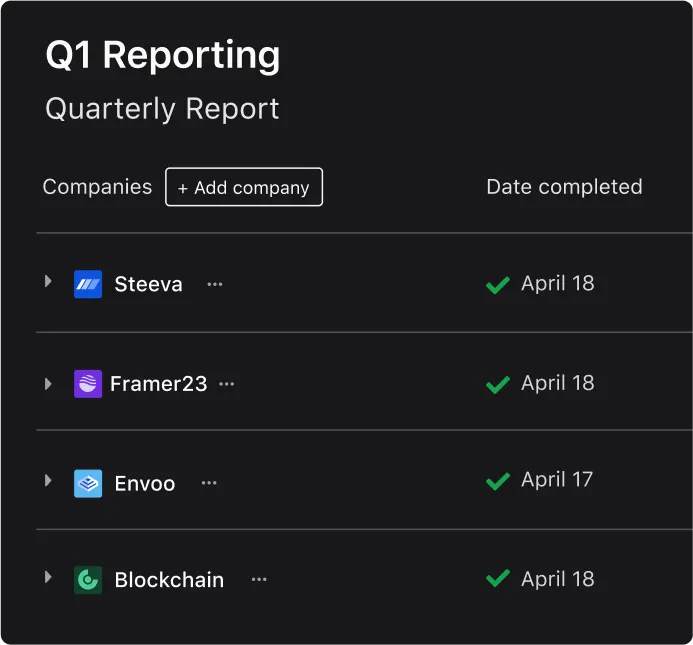
The platform automates the outreach process. Instead of sending manual reminder emails, the software automatically prompts founders to submit their monthly or quarterly metrics through a frictionless, secure web form.
2. Standardize Data Across Companies
Venture portfolios contain diverse businesses, but fund managers need uniform data. The software automatically maps bespoke company metrics (like custom revenue definitions) to standardized fund-level KPIs, ensuring apples-to-apples comparisons.
3. Aggregate into Portfolio Dashboards
As founders submit their updates, the investor management software instantly syncs the data. This creates a centralized, real-time dashboard where every metric, qualitative update, and financial statement lives in one place.
4. Analyze Performance Trends
With clean, structured data readily available, investors can instantly filter their portfolio by sector, vintage year, or performance tier. This allows partners to quickly identify outliers, spot macro trends, and determine which founders need immediate operational support.
5. Generate LP-Ready Reports
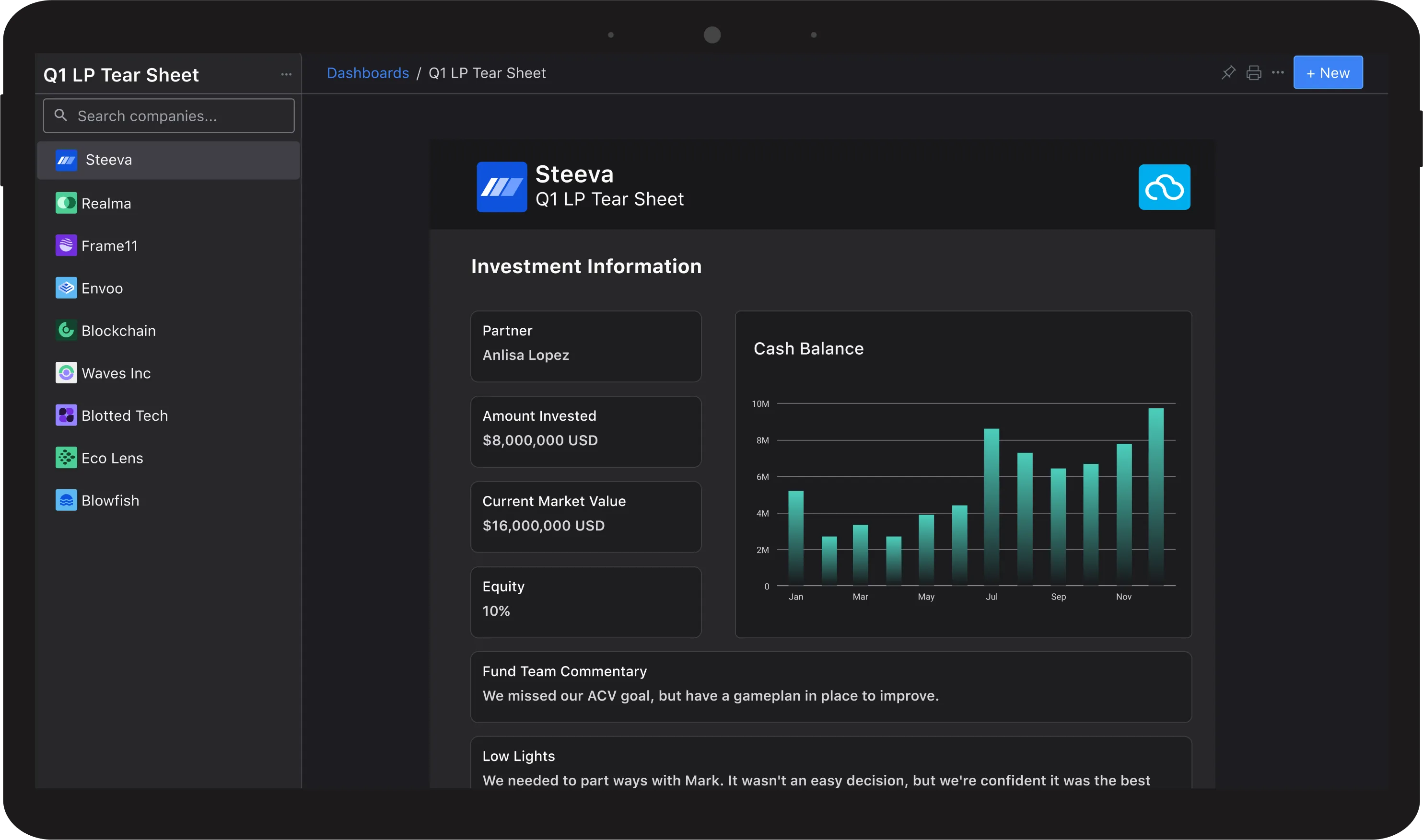
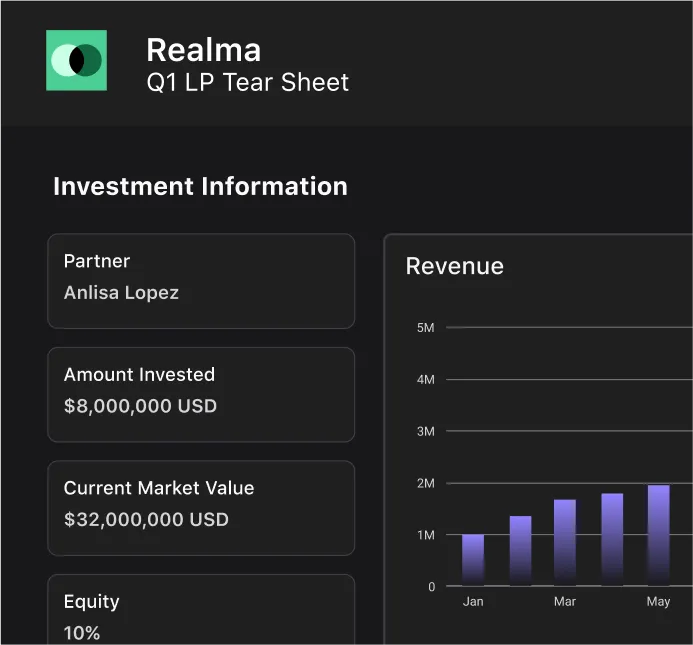
Because the data is already standardized and centralized, building quarterly reports becomes a frictionless process. Fund operators can pull live portfolio metrics directly into professional, branded tear sheets and distribute them securely to Limited Partners.
The Old Workflow vs. The New Workflow
The difference between manual processes and a dedicated platform is a shift from administrative overhead to strategic insight.
- The Old Workflow: Chasing email threads → Parsing unstructured PDFs → Manually entering data into Excel → Triaging broken formulas → Sending delayed, static reports to LPs.
- The New Workflow: Automated data requests → Founders fill out structured templates → Instant database sync → Live portfolio dashboards → One-click LP report generation.
What is the best investment tracking software?
The best investment tracking software is a platform that automates data collection from founders, standardizes core metrics, and provides real-time portfolio dashboards. For venture capital firms, the ideal solution seamlessly connects portfolio company updates directly to fund-level LP reporting, eliminating manual data entry entirely.
Core Features of the Best Investor Reporting Software
When evaluating the best investor reporting software, fund operators must look beyond basic document storage. The right platform acts as the operational heartbeat of the fund, transforming raw data into actionable insights.
Automated Data Collection from Portfolio Companies
Chasing founders for metrics is the biggest bottleneck in portfolio management. Modern software automates this by sending recurring, scheduled requests for structured updates.
This eliminates manual follow-ups and ensures founders can submit their data in minutes rather than hours. By reducing the friction of reporting, funds see significantly higher compliance rates.
Portfolio Dashboards & Real-Time Visibility
Investors need immediate answers about portfolio health without digging through nested folders or outdated spreadsheets. A centralized dashboard provides real-time visibility into revenue growth, cash runway, and headcount across the fund.
This immediate access allows partners to make rapid, data-driven decisions during Monday morning partner meetings and instantly identify which founders need support.
KPI Tracking & Benchmarking
Tracking bespoke metrics across dozens of unique companies makes fund-level analysis nearly impossible. Software solves this by mapping custom data points to standardized core KPIs across the entire portfolio.
VCs can easily benchmark performance, compare growth rates, and identify outliers across different funds, sectors, or vintage years.
Investor Update Templates & Standardization
Unstructured email updates lead to messy, unusable data. By utilizing standardized templates, investors ensure they receive consistent, high-quality information during every reporting cycle.
This structure makes it effortless to parse qualitative notes, such as recent hires or product launches, alongside hard financial data, ensuring nothing slips through the cracks.
LP Reporting & Fund-Level Insights
Translating company-level data into fund-level performance is traditionally a heavy lift. The best tools automatically aggregate portfolio metrics directly into professional, branded tear sheets.
This streamlines quarterly LP communication, reduces administrative overhead, and builds long-term trust through consistent transparency.
Integrations with Financial & Operational Tools
An effective platform does not operate in a data silo. Look for systems that integrate seamlessly with existing accounting software, data warehouses, and your firm's investor relations CRM.
This connectivity ensures financial data flows securely and accurately from the source without requiring manual import and export cycles.
Permissions, Access Control & Security
Managing sensitive financial data requires enterprise-grade security protocols. A robust investor portal software provides granular, role-based access control.
Fund managers can easily dictate exactly which metrics, documents, and company updates individual LPs, partners, or team members are permitted to view.
How to Choose the Best Investor Reporting Software
Selecting the best investor reporting software requires evaluating how well the platform reduces friction for both your team and your portfolio companies. The right solution should feel like a natural extension of your firm’s operations, eliminating manual work at every stage.
When evaluating the top investor reporting software solutions (2026), fund managers should use the following decision framework.
Ease of Use for Founders and Investors
If a platform is difficult for founders to navigate, reporting compliance drops and data quality suffers. The best tools prioritize a frictionless experience, allowing founders to submit metrics in minutes without reading a user manual.
- Choose this if: You want 100% compliance on monthly or quarterly data requests from your portfolio.
- Red flags to avoid: Platforms that require founders to navigate clunky interfaces, download desktop apps, or create complex multi-step logins.
Level of Automation
The most significant ROI from an investor reporting platform comes from eliminating repetitive administrative tasks. Look for systems that automatically schedule data requests, send reminders, and instantly sync responses to your central dashboard.
Data Accuracy & Standardization
Raw data is useless if it cannot be compared across your portfolio. Your software must automatically map bespoke founder metrics into standardized, fund-level KPIs to ensure accurate benchmarking.
- Choose this if: You need to confidently compare revenue growth, burn multiples, or cash runway across different sectors and vintage years.
LP Reporting Capabilities
The end goal of collecting portfolio data is communicating performance to your Limited Partners. Choose a platform that seamlessly pulls live portfolio data directly into professional, branded LP tear sheets without requiring manual data entry.
- Red flags to avoid: Tools that force you to export raw data to Excel or Google Sheets before you can even begin formatting an LP update.
Integration Ecosystem
Your reporting software should act as the central hub connecting your entire tech stack. Ensure it integrates effortlessly with your accounting software, data warehouses, and existing CRM systems so that financial data flows without manual intervention.
Scalability as Your Fund Grows
The tool you implement for Fund I needs to support the operational complexity of Fund III and beyond. Ensure the platform can smoothly handle an increasing volume of portfolio companies, complex entity structures, and a growing base of institutional LPs.
Security and Compliance in Investor Reporting Software
For venture capital firms, portfolio financial data is highly sensitive. An effective reporting platform must act as an impenetrable vault, ensuring that proprietary company metrics and fund-level performance are never exposed to unauthorized parties.
When evaluating tools, fund managers must look for enterprise-grade security features that address every layer of data protection.
- Data Encryption: All sensitive financial data should be encrypted both at rest and in transit. This ensures that even in the unlikely event of a breach, the raw portfolio data remains completely unreadable.
- Role-Based Access Control: Fund managers need granular control over who sees what. Partners, analysts, and LPs should only have access to the specific dashboards and metrics relevant to their roles, preventing accidental internal exposure.
- Secure Document Sharing: Distributing sensitive K-1s or quarterly updates via standard email attachments is a major security risk. Using secure investor portal software allows firms to share documents through encrypted environments with strict access restrictions.
- Compliance Standards: The platform should adhere to global data protection frameworks, such as SOC 2 Type II, GDPR, and CCPA. This guarantees that the software provider undergoes rigorous, third-party security audits.
How to Create an Investor Report (With and Without Software)
Whether you are a founder updating your board or a fund manager tracking a portfolio, consistency is the foundation of good reporting. Establishing a standardized format ensures that data is actually usable rather than just a collection of vanity metrics.
How to make an investor report?
To make an investor report, gather your core financial metrics, qualitative updates, and key performance indicators (KPIs) into a structured format. Compare current performance against historical data, highlight major operational wins or challenges, and clearly outline any strategic asks for your investors.
What a Great Investor Report Includes
The most effective updates strip away the noise and focus on the levers that actually drive the business. A standard, high-impact report should always cover four core pillars:
- Core KPIs: Top-line growth metrics such as Monthly Recurring Revenue (MRR), Customer Acquisition Cost (CAC), and net revenue retention.
- Financial Health: High-level income statements, current cash balance, gross margin, and total months of runway.
- Highlights and Lowlights: Honest qualitative context behind the numbers, detailing product launches, key hires, or lost enterprise deals.
- Strategic Asks: Direct, specific requests for investor assistance, such as introductions to potential pilot customers or candidates for an executive search.
Example Investor Report Structure:
- Executive Summary: A brief, two-sentence TL;DR of the month or quarter.
- Key Metrics: A quick-glance table of the 3–5 most critical KPIs.
- Financial Update: Cash on hand, burn rate, and runway.
- Department Updates: Bulleted notes on Sales, Product, and Team.
- The "Ask": 1–2 specific ways investors can provide immediate value.
The Manual Reporting Process (Limitations)
Historically, creating these reports has been a heavily manual exercise. Founders typically start by downloading a static spreadsheet or document template, pulling numbers from various SaaS tools, and pasting them into the file.
While this works for a single update, it creates a massive bottleneck for the venture capital firm receiving it. Fund operators are forced to open dozens of uniquely formatted PDFs, manually extract the unstructured data, and transcribe it into their master portfolio tracking models. This introduces human error and creates dangerous reporting lags.
How Software Automates Investor Reporting
Implementing dedicated investor reporting software fundamentally changes this dynamic, moving the process out of static documents and into a connected pipeline.
Instead of building a report from scratch every month, founders simply input their numbers into a secure, standardized web form. The platform instantly formats the data, calculates month-over-month growth rates, and maps the metrics directly to the fund’s centralized dashboard without any manual data entry.
Investor Reporting for LPs: Why It Matters More Than Ever
Limited Partners (LPs) are increasingly demanding institutional-grade transparency from their fund managers. Gone are the days when a high-level, annual email summary was enough to satisfy institutional investors or family offices.
Today, proactive and transparent LP reporting is a competitive advantage. For emerging managers looking to secure capital for their next fund, delivering consistent, highly accurate portfolio insights is non-negotiable.
LP Expectations vs. Quarterly Reporting Challenges
Delivering on these elevated expectations is a massive operational hurdle for growing venture capital firms. The primary challenge is transforming chaotic, raw data from dozens of portfolio companies into clean, fund-level insights.
Without a standardized system, fund operators spend weeks each quarter manually consolidating spreadsheets and chasing down missing metrics just to produce a basic quarterly update.
Fund-Level vs. Company-Level Reporting
There is a fundamental translation layer required in venture capital reporting. Founders report on operational company-level metrics, such as Monthly Recurring Revenue (MRR) or cash runway.
LPs, however, care primarily about fund-level financial performance. Translating individual company updates into aggregate fund metrics requires a centralized platform to ensure absolute data accuracy and prevent calculation errors.
Metrics LPs Actually Care About
When LPs review a quarterly update, they want to quickly gauge the overall health of the fund and assess the manager's capital deployment strategy. Key metrics include:
- Gross and Net IRR: The annualized return of the fund.
- MOIC (Multiple on Invested Capital): How much value the portfolio has generated relative to the capital deployed.
- DPI (Distributions to Paid-In Capital): The actual realized cash returned to LPs.
- Portfolio Concentration: How capital and risk are distributed across sectors or specific breakout companies.
Example LP Reporting Workflow
A modern, software-driven workflow eliminates the stressful end-of-quarter scramble, turning a multi-week project into a streamlined process.
- Automated Collection: Software gathers structured financial data from founders seamlessly at the close of the quarter.
- Instant Aggregation: The platform maps individual company metrics to fund-level performance automatically.
- Performance Analysis: General Partners review the consolidated, real-time dashboard to identify key narrative points and highlight macro trends.
- One-Click Generation: The system pulls the aggregated data directly into a branded, secure LP tear sheet for instant distribution.
Which VC tool offers the best LP reporting?
The most effective VC tool for LP reporting is a purpose-built platform that directly links portfolio company data collection to fund-level outputs. By automating the aggregation of KPIs and financial metrics, these tools allow fund managers to instantly generate accurate, professional quarterly reports for Limited Partners without relying on manual spreadsheet consolidation.
Additional resource: Venture Capital Reporting Software
Frequently Asked Questions
What is investor reporting software?
Investor reporting software is a dedicated platform that venture capital firms use to automate the collection, standardization, and analysis of portfolio data. It replaces manual spreadsheets with real-time dashboards and streamlines the creation of limited partner (LP) updates.
What is the best investor reporting software?
The best investor reporting software seamlessly connects portfolio data collection with fund-level reporting to eliminate manual data entry. It provides automated metric standardization, real-time performance dashboards, and frictionless LP report generation in a single platform.
What software do professional investors use?
Professional investors rely on a specialized tech stack consisting of investor reporting platforms, relationship management CRMs, and internal portfolio valuation tools. Dedicated reporting software acts as the core infrastructure, ensuring the financial data shared with stakeholders is always accurate and up to date.
Which VC tool offers the best LP reporting?
The most effective VC tools for LP reporting directly link founder-submitted metrics to fund-level outputs. By automating data aggregation across the portfolio, these platforms allow fund operators to instantly generate branded, highly accurate quarterly reports for their limited partners.
How secure are investor portals?
Modern investor portals are highly secure, utilizing enterprise-grade data encryption, granular role-based access controls, and strict compliance frameworks like SOC 2 Type II. They provide a significantly safer environment for distributing sensitive financial metrics and legal documents compared to traditional email attachments.