
Key Takeaways
-
Learn exactly what to include in a data room for investors to streamline due diligence, showcase transparency, and accelerate your fundraising process.
-
Discover the essential investor data room structure, from financials and legal docs to team bios and customer references, that builds investor confidence.
-
Understand what not to include in a startup data room so you can protect sensitive information and control your company’s narrative during fundraising.
-
Get practical tips for organizing your data room efficiently, ensuring it’s easy to navigate and always up to date for potential investors.
-
See how tools like Visible make it simple to create, share, and track investor engagement in your data room throughout your fundraising journey.
A startup data room is a secure, organized repository of documents that you share with investors during the fundraising process. It is where your financials, legal documents, team information, and market data live so that investors can conduct due diligence without a back-and-forth chain of individual document requests.
At its best, a data room does two things simultaneously: it speeds up your fundraise by answering investor questions before they are asked, and it signals to investors that your team is organized, transparent, and ready to be scrutinized. At the seed stage, where traction may be limited, a well-built data room can be a meaningful differentiator.
Andrea Funsten, investor at Basecamp Fund, put it plainly after receiving a data room from a founder two months ahead of their raise: "Left me so impressed and eager to move fast on the deal." That is the outcome a good data room creates, not just access to documents, but investor momentum.
This guide covers what a startup data room is, what to include at each stage of fundraising, how to structure and share it, and what to leave out. Whether you are preparing for your first seed round or getting ready for a Series A, the sections below will walk you through exactly what you need.

Related Resource: You can now build and share your data room with Visible. Give it a free try here.
What is a Data Room?
A data room is a secure online repository used by startups and businesses to store, manage, and share critical documents with potential investors, partners, and stakeholders. This virtual space enables startups to present vital information in an organized and accessible manner, ensuring that investors have all the necessary data to make informed decisions.
The primary purpose of a data room is to facilitate the due diligence process during fundraising. By having a well-structured data room, startups can efficiently provide investors with access to financial records, legal documents, market research, and other essential materials. This not only speeds up the fundraising process but also demonstrates the startup's professionalism and preparedness.
A data room is particularly beneficial for startups as it allows them to control the flow of information, maintain confidentiality, and track investor engagement. With all important documents centralized in one secure location, startups can easily manage updates and ensure that investors always have access to the most current data. In summary, a data room is an indispensable tool for any startup looking to streamline their fundraising efforts and build trust with potential investors.
Why Startups Need a Data Room
The fundraising process is, at its core, an information problem. Investors need to evaluate your business quickly and thoroughly. Founders need to field dozens of requests without losing focus on running the company. A data room solves both sides of that problem at once.
According to a recent industry analysis, 89% of investors now require secure digital access to due diligence materials via a virtual data room. This is no longer a best practice reserved for later-stage companies. It is the expected baseline from seed onwards.
Related resource: Startup Due Diligence: What Every Founder Needs to Prepare For
Related resource: How to Get Your Startup Ready for Investors’ Operational Due Diligence
Beyond speed, there are four specific things a well-built data room does for a startup raising capital.
It reduces back-and-forth with investors
Instead of responding to individual document requests from every investor you speak with, a data room lets you direct all parties to one place. Every investor works from the same information at the same time, which eliminates version control problems, reduces email overhead, and keeps your fundraising process moving at the pace you set rather than the pace of the slowest document request.
For founders running a competitive process with multiple investors simultaneously, this efficiency compounds quickly. Time spent fielding redundant requests is time taken away from actual conversations that advance the round.
It signals organizational maturity
A well-organized data room tells investors something about how you run your company before they have asked a single question. It shows that you have thought ahead, that your documents are in order, and that you treat investor relationships with the same rigor you bring to operations. At early stages where product and revenue data may be limited, operational credibility carries real weight in how investors form their overall conviction.
Andrea Funsten, investor at Basecamp Fund, described receiving a data room from a founder two months before their raise officially kicked off: "Left me so impressed and eager to move fast on the deal." The data room did not just answer questions. It created urgency.
It gives you control of the narrative
You decide what goes in, how it is organized, and when it is shared. That control matters when fundraising at scale, where investors may form early impressions from your documents before they have ever spoken with you. A thoughtfully structured data room lets you lead with your strongest material and contextualize anything that requires explanation, rather than leaving investors to draw their own conclusions from a disorganized file dump.
Rawand, co-founder of Helix Earth, learned this lesson the hard way in earlier rounds. In a previous raise, the team was, by his own admission, winging it. "The biggest mistakes were having no process, not getting investors on the same timeline, and giving too much time to funds that were never going to invest." Those lessons shaped the Seed 2 approach: a data room and FAQ built six months before the raise kicked off, so nothing was reactive when it mattered.
It creates actionable investor engagement data
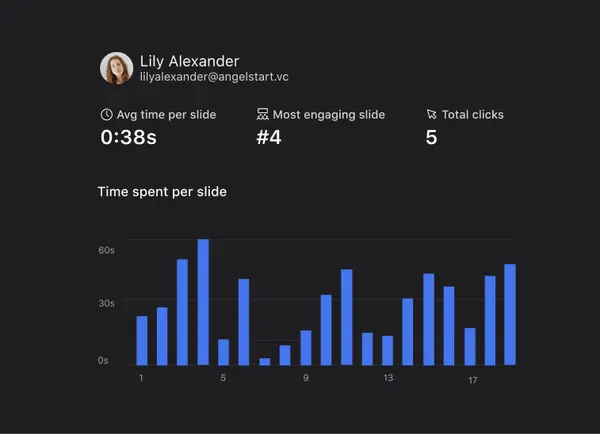
With a tracked data room, you can see which investors opened your documents, which sections they spent the most time on, and whether they came back for a second look. That engagement data is not just interesting. It is operationally useful for deciding who to follow up with, what to address in the next conversation, and which investors are genuinely in the process versus quietly stalling.
"Those signals are gold. If someone revisited the deck after a week of silence, that was our cue to re-engage with a targeted follow-up. On the flip side, it helped us stop wasting time on investors who just never opened the deck or only looked at it once."
Rawand, co-founder, Helix Earth
Helix Earth used Visible's data room and deck analytics throughout their $12M oversubscribed Seed 2 round. At one point midway through the raise, Rawand noticed an investor had gone quiet in the pipeline. He spotted them, followed up, and they joined the round. It is a small moment that illustrates a larger point: a tracked data room does not just store documents. It tells you who is paying attention and when to act.
The debate about whether data rooms slow down fundraising is largely a timing question rather than a question of whether to have one at all. The consensus among early-stage investors today is clear: if you are running a process with multiple investors simultaneously, a data room is not optional. The question is how to build it well.
Should I Have an Investor Data Room?
Before putting together your investor data room you need to ask yourself, “Should I have a data room?” The idea of data rooms is widely debated between VCs and founders. As seen above, access to a data room allowed Andrea to move quickly on her deal. On the flip side, Mark Suster claims that “you should never have a data room.” Why?
Mark makes the case that a data room actually slows down the process. After meeting with an investor for the first time they may ask for a data room, hem and haw over the details, and delay giving a solid yes or no for as long as possible.
However, there are clear advantages to using an investor data room. If done correctly, a data room can field most questions and due diligence that investors will have. In a world that continues to move away from in-person events, the ability to control the story of your data and startup is vital. The scale at which you can contact and answer questions from potential investors will allow you to focus on other aspects of your business — not just fundraising.
If you have a line of investors out the door eager to write a check — sure, you can probably skip the data room. If you’re like the 99% of companies speaking to countless investors and pressing to close your round, you may benefit from a structured and scalable way to share your data. Learn more about why you should have a data room from Elizabeth Yin of Hustle Fund below:
If you have decided a data room is right for your company, the question now becomes “How and what should be in my investor data room?”
What Should Be in My Investor Data Room?
Deciding what to include in your investor data room can be intimidating. You don’t want to include too much or too little. Remember the goal is to be more efficient to speed up your fundraise. However, most investors will be looking for similar things in a data room.
It is important to share what feels right to you — some blanket tips/best practices:
- Do not over-share information
- Share the most up-to-date information
- Well-organized and easy to navigate
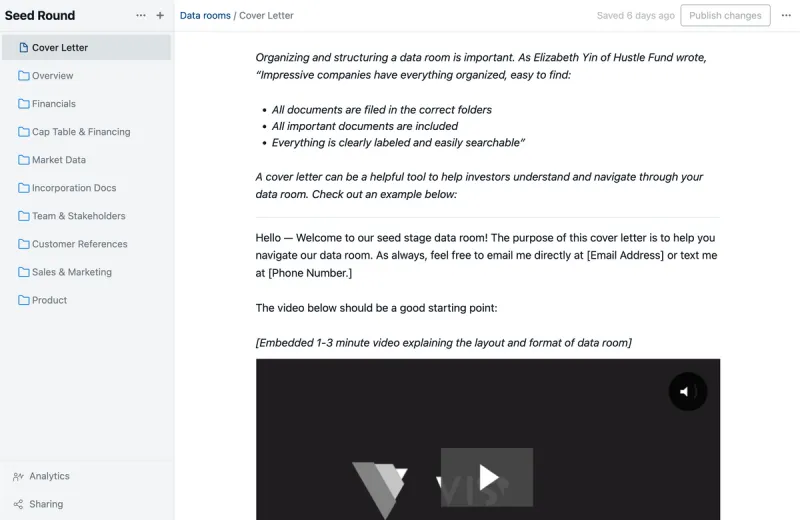
Every business is different. These are simply suggestions for what founders can include in a data room. For example, a Series A company might have more robust financials and documents to include compared to a pre-revenue company. Check out a few suggestions for what to include in a data room below (we recommend each major section being a main folder with sub-folders underneath).
Overview Folder & Documents
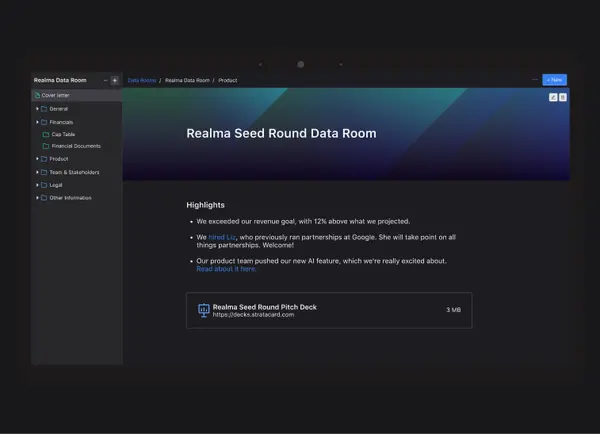
As we mentioned above, organization is crucial for a successful data room. Having an overview folder with key information is a great way to set the tone. You can include a cover letter to help lay out the data room, your most recent pitch deck, and term sheet.
Related Resource: How to Write a Cover Letter for Your Data Room
Financials & Cap Table
To start, you will want to include the basics for your fundraise. This includes your deck, basic financials (cash metrics, OpEx, etc.), projections for the following year, and your cap table. Be sure to include any happenings and commitments for the current round as well. All of these things should be easily accessible for you and should require minimal effort to get them together.
The team at Corl suggests including the following documents as well:
- Voting agreements
- Investor rights agreements
- First refusal & co-sale agreements
- Stock purchase agreements
- Capitalization table
- Any documents/details on previous raises
Related Resource: The Startup Metrics Potential Investors Want to See
Market Data & Research
This section is intended to show you have a deep understanding of your market and your immediate competitors. Include any first-hand market research or public reports that are relevant to your market. You will also want to share a competitive analysis showcasing different price points and feature differences.
As Andrea Funsten wrote, “include a competitive Landscape Tracking Sheet – a list of companies that they are tracking, some that are not on the market yet. I love that they were not afraid to share this and were extremely thorough.”
Incorporation Docs
Investors will want to quickly glance at incorporation docs to make sure your company is set up for success. A couple of example docs that are worth including
- Amended and restated articles of incorporation.
- Bylaws
- Business certificates
- Tax IDs
Team & Stakeholders
This is exactly what is sounds like, a section to highlight your team members. This should also show the exact titles, salaries, and job description for current team members.
Also use this as a section to showcase where your next hires will be. This will not only help share the vision of the team you are building but can also allow investors to jump in and help hire from their network. To go above and beyond, you can also include things like onboarding documents to offer a glimpse of your culture and hiring process. A couple of example ideas:
- Employee contracts
- Team overview
- Onboarding documents
- Info on current board members
- Past board decks
Related resource: The Startup’s Guide to Investor Agreements: Building Blocks of VC Funding
Past investor Updates
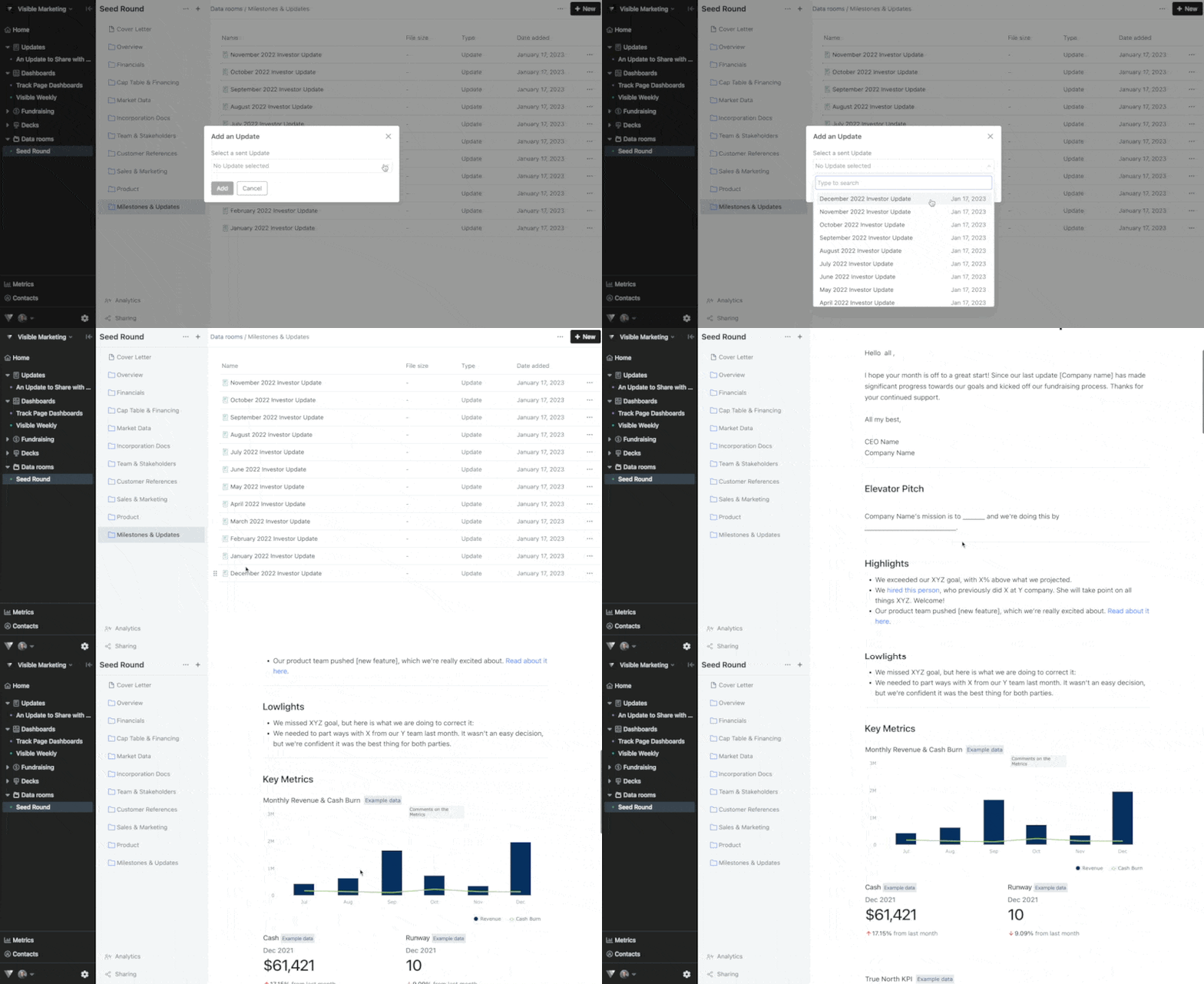
Not only will including past investor updates help them assess the growth of the business, it is a surefire way to show you take investor communication and transparency seriously. As Andrea Funsten Tweeted, “Recent investor updates for the last 6 months. Helps me not just gauge the level of transparency that they have with their investors (sharing the bad just as much as the good) but I can see the progression over time.”
Customer References
During due diligence, investors will likely want to understand how your customers view your company. You can include a customer references and referrals section in your data room to help demonstrate how much your customers love your company.
Marketing materials
This can be a quick section showcasing your brand and marketing vision. Include your pitch deck as well as a deck you may share with customers. The team at Corl suggests sharing a 1-pager on your brand and marketing vision here as well.
Related Resource: Are Your Marketing Efforts Really Enabling Sales Performance?
Product
Some companies might want to include a section about their product or service. This can include anything from a demo video to IP information and patents. Check out a few examples of what you might want to include with your product folder below:
- IP information
- Demo video
- Technology (APIs, integrations, roadmaps, etc.)
What else?
These are the basics to get you started with your data room. While different investors may want to see different things, these should give you a solid start. You may be asked to include things like intellectual property, technology stacks, and more company documentation.
Related resource: Investor Agreement Template for Startup Founders
Data Room Contents By Funding Stage
One of the most common mistakes founders make is treating a data room as a fixed document set that applies equally to every round. What investors expect to see changes significantly from pre-seed through Series A, and building the right data room for your current stage, rather than a generic one, is both more efficient and more credible. The sections below break down what to include at each stage, why it matters, and the principle that should guide your choices.
Pre-seed data room
At the pre-seed stage, investors are primarily betting on founders and ideas. There is rarely extensive revenue data or product metrics to lean on, so your data room should reflect that reality honestly rather than padding it with documents you do not yet have. Keep it tight, typically 8 to 12 documents, and focus on the materials that communicate who you are, what you are building, and why the market opportunity is real.
- Pitch deck
- Founder bios and LinkedIn profiles
- Problem statement and market research summary
- Product demo or prototype (video or live link)
- Early user feedback, waitlist data, or pilot results
- Basic cap table
- Incorporation documents
- Financial model with clearly stated assumptions
At pre-seed, a sparse but well-organized data room is more credible than an artificially padded one. Investors are not expecting comprehensive financials. They are evaluating whether you understand your market and whether they want to back you as a founder.
Seed round data room
By the seed stage, investors want to see early evidence that something is working. Your data room should lead with your strongest traction signal, whether that is revenue growth, user retention, customer contracts, or meaningful pilot results, and let the rest of the room provide context and supporting depth. Seed investors are still comfortable with uncertainty, but they need a proof point to anchor their conviction.
- Pitch deck
- Financial model and 12 to 24 month projections
- Current MRR or ARR and month-over-month growth
- Cap table with current round details and any SAFEs or notes outstanding
- Key customer contracts, letters of intent, or pilot agreements
- Competitive landscape analysis
- Team overview and org chart
- Incorporation and legal documents
- Last 6 months of investor updates
- Product roadmap
Sharing past investor updates is one of the most underused documents in a seed data room. It signals transparency, shows the progression of your business over time, and demonstrates that you take investor communication seriously, all of which build the trust that closes rounds.
Series A data room
Series A due diligence is substantially more rigorous than earlier rounds. Investors writing checks of $8M to $15M or more are evaluating whether your unit economics and sales motion are repeatable at scale, not just whether the underlying idea is compelling. Your data room at this stage should anticipate detailed financial scrutiny and answer it proactively, before the questions are asked. Gaps or inconsistencies that might have been forgiven at seed will receive close attention here.
- Detailed financial model covering 3 years with scenario assumptions
- Monthly profit and loss statement and cash flow
- Full cap table including all previous rounds
- Customer cohort analysis and retention data
- CAC, LTV, and payback period by acquisition channel
- Sales pipeline and conversion rate metrics
- Team bios and compensation structure
- Board deck history (last 4 to 6 decks)
- IP filings and patents documentation
- All material contracts (customer, vendor, partnership)
- Full legal and compliance documentation
- Customer references (2 to 3, pre-briefed and ready)
The difference between a seed data room and a Series A data room is not just more documents. It is a shift from storytelling to proof. Every claim your deck makes should be substantiated by something in the data room. If it is not, find the data or adjust the claim.
What Shouldn’t Be Included in My Investor Data Room
As a founder it is important to control your story during a fundraise. To help with this it is important to make sure what your investors are seeing and engaging with throughout a fundraise. Certain data or documents without context can be dangerous to a raise so it is important to keep tabs on what is in your data room. A few things that might not be worth including in an investor data room:
- Documents that aren’t vital to investors for decision making
- Sensitive information or data that might require additional context
- Documents that are not important to the stage an investor is at in the journey – for example, if they are only taking a coffee meeting, limit what you are sharing with them.
Build Your Data Room With Visible
At Visible, we oftentimes compare a fundraise to a B2B sales and marketing funnel. At the top of your funnel, you are finding new investors. In the middle, you are nurturing and pitching potential investors. At the bottom of the funnel, you are working through diligence and ideally closing new investors.
With the introduction of data rooms, you can now manage every aspect of your fundraising funnel with Visible.
- Find investors at the top of your funnel with our free investor database, Visible Connect
- Track your conversations and move them through your funnel with our Fundraising CRM
- Share your pitch deck and monthly updates with potential investors
- Organize and share your most vital fundraising documents with data rooms
Beyond DocSend: Exploring Innovative Document Sharing Platforms for Modern Teams
Manage your fundraise from start to finish with Visible. Give it a free try for 14 days here.
Frequently Asked Questions
What is a data room for startups?
A startup data room is a secure, organized collection of documents that founders share with investors during fundraising. It typically contains financials, legal documents, team information, market research, and product materials. The purpose is to give investors everything they need to conduct due diligence in one place, without requiring founders to respond to individual document requests for each investor they speak with.
What should be in a startup data room?
The contents of a startup data room depend on your funding stage. At the seed stage, the essentials are your pitch deck, financial model and projections, cap table, incorporation documents, key customer data or early traction metrics, team overview, and the last few months of investor updates. At Series A, investors will expect a more complete set including detailed financials, cohort analysis, customer references, board deck history, and all material contracts. The principle across all stages is the same: include what you have, organize it clearly, and do not pad with documents that are not ready.
What goes in a data room vs. what should I leave out?
Include anything an investor would reasonably need to evaluate your business and make a decision. Leave out anything that is either not ready (early drafts, unaudited financials presented as final), legally sensitive without appropriate NDAs in place, or irrelevant to the current stage of due diligence. Avoid over-sharing competitive intelligence that could cause harm if the investor ultimately passes and shares information with a competitor. A common mistake is including too many documents in an attempt to appear thorough, which actually makes navigation harder and buries the documents that matter most.
How do I set up a data room for investors?
Start by organizing documents into clear top-level folders: overview, financials, legal, team, market, and product. Each folder should contain a small number of well-named files. Use a dedicated data room tool rather than a shared Google Drive folder, because dedicated tools give you access controls, tracking analytics, and the ability to revoke access. Set permissions so that early-stage investors see a lighter version and investors in active due diligence see the full room. Before sharing, do a full review to make sure every document is current, clearly named, and actually opens correctly.
When should I share my data room with investors?
Share your data room after an initial meeting when an investor has expressed genuine interest and asked for more information. Do not send a data room link in a cold outreach email or before a first conversation. The data room is a due diligence tool, not a marketing document. Sharing it too early can trigger a review process before you have had the chance to build the relationship and context that makes that review go well. A good rule of thumb: if an investor has not asked for more information, they are not ready for your data room.
What is the difference between a data room and a pitch deck?
A pitch deck is a narrative presentation designed to generate investor interest. It is typically 10 to 15 slides covering the problem, solution, market, traction, team, and ask. A data room is a document repository designed to support due diligence once interest exists. Your pitch deck lives inside your data room as one of many documents. The deck opens the door; the data room handles everything that comes after.
How can I track which investors are engaging with my data room?
Use a data room tool that provides per-document analytics. With Visible, you can see which investors opened your data room, which specific documents they viewed, how long they spent on each one, and whether they forwarded access to a colleague. This engagement data is practically useful: an investor who spent significant time on your financial model but not your market research is telling you something specific about what to address in the follow-up conversation.