

Key Takeaways
-
While global markets cool, Saudi Arabia’s venture ecosystem surged 116% in early 2025 to reach $860 million in capital deployed.
-
Founders can extend their runway using aggressive government incentives like the Regional Headquarters Program for a 30-year tax holiday and NTDP salary subsidies.
-
Access a curated list of the most active investors in Saudi Arabia alongside a guide to essential accelerators like Sanabil 500 and The Garage.
-
Navigate the unique public-private landscape where understanding the Series A gap and establishing a physical presence are now mandatory for fundraising success.
-
Discover how the Nomu Parallel Market offers startups a realistic path to early liquidity with listing requirements starting at just a $2.6 million market cap.
Global venture markets have cooled, but Saudi Arabia is an aggressive outlier.
While other ecosystems are pulling back, Saudi Arabia is deploying capital at record rates. In the first half of 2025 alone, venture investment in Saudi Arabia surged to $860 million, marking a 116% year-over-year increase. This isn't just a temporary spike; it’s a structural shift that has positioned Riyadh as the undisputed capital of venture funding in MENA, capturing over 50% of the region's total liquidity.
For founders, Vision 2030 is no longer just a policy PDF; it is active infrastructure. The government has moved from planning to execution, launching aggressive incentives such as the Regional Headquarters (RHQ) Program, which offers a 30-year tax exemption to eligible companies.
However, raising capital here requires more than a pitch deck. The Saudi ecosystem operates on a unique public-private axis, where understanding the roles of key enablers, such as the Public Investment Fund (PIF), the National Technology Development Program (NTDP), and the Saudi Venture Capital Company (SVC), is mandatory for success.
This guide is for founders ready to raise capital and navigate the startup landscape in Saudi Arabia. You will find a curated list of the top active investors, a breakdown of the specific government incentives that impact your runway, and the on-the-ground reality of building in the Kingdom today.
The Most Active Investors in Saudi Arabia
Wa’ed Ventures

Backed by Aramco, Wa’ed Ventures is a $500 million venture capital fund with the aim to accelerate the development of an integrated startup ecosystem by investing in local tech-based startups and incentivizing global entrepreneurs to localize their tech innovations in the Kingdom.
Merak Capital
Merak Capital is an investment firm focused on technology companies across multiple industries, and licensed by the Capital Market Authority of Saudi Arabia.
Impact46
Impact46 focuses on alternative investment opportunities in Saudi Arabia. We invest in theme-specific venture capital and private equity opportunities from the seed stage all the way to mature, profitable businesses.
STV
STV is the largest technology investment firm in the Middle East. With over $1.5B in AUM, STV backs and scales the region’s most exciting and disruptive technology companies.
Khwarizmi Ventures

Khwarizmi Ventures is a Saudi-based Venture Capital fund investing in early-stage startups in the MENA region. Ever since its launch in 2018, Khwarizmi has seed-funded notable startups, assisted various founders, and scaled multiple regional companies.
Shorooq
Shorooq Partners is the leading alternative investment manager in the MENA region, specializing in Venture Capital and Venture Debt. Founded in 2017 and headquartered in Abu Dhabi, the firm was the first fully licensed fund manager in ADGM and now operates offices in Riyadh, Dubai, Cairo, and Korea.
Khwarizmi Ventures
Khwarizmi Ventures is a Saudi-based Venture Capital fund investing in early-stage startups in the MENA region. Ever since its launch in 2018, Khwarizmi has seed-funded notable startups, assisted various founders, and scaled multiple regional companies.
SEEDRA Ventures

SEEDRA Ventures is an early-stage venture capital firm branching out of Riyadh, Saudi Arabia and focused on cultivating disruptive innovations and trends across the region. As an active participant in the transformation of our economy, a key mission of ours is to promote innovation, finance the development of new products, new technologies and processes, and support local entrepreneurs and early-stage businesses in their journey to transform the economy directly and positively.
Outliers Venture Capital

Outliers is an early-stage venture capital fund backing outlier founders building compounding businesses in the MENA. Built by operators, Outliers partners with teams who are leveraging unique insights to address current or emerging market needs with technology solutions.
The Saudi Startup Ecosystem: Trends & Realities
The Saudi market is currently decoupling from global venture trends. While liquidity has tightened in the US and Europe, Saudi Arabia is experiencing a capital surge driven by government-backed deployment. In the first half of 2025 alone, venture funding hit $860 million, representing a 116% increase compared to the previous year.
This growth is not accidental. It is engineered by a "public-private" machinery where sovereign funds like the Public Investment Fund (PIF) and the Saudi Venture Capital Company (SVC) act as the primary limited partners (LPs). They de-risk the market for private VCs, creating a floor for deal activity that does not exist in other ecosystems.
For founders, this creates a unique environment where capital is available, but the rules of engagement are different. You are not just pitching a business; you are often pitching alignment with national mandates like Vision 2030.
Where the Money Is Flowing
Capital allocation is heavily skewed toward sectors that support infrastructure and digital transformation.
- Fintech: This remains the most active sector by deal volume. In 2025, fintech startups captured 26% of all venture deals as Saudi Arabia races to a 70% cashless society target.
- E-Commerce & Retail: While fintech wins on volume, retail tech wins on dollar value. It attracted the highest share of funding (36%) in early 2025, driven by late-stage rounds for logistics and B2B marketplace enablers.
- Gaming & Esports: This is the new frontier. With specific funds managed by firms like Merak Capital and Impact46, this sector is benefiting from a $120 million injection aimed at localizing content creation.
The Challenges
Despite the liquidity, Riyadh is not an easy market to navigate. The "fly-in, fly-out" fundraising model is effectively dead. Investors now demand physical presence, often tied to the Regional Headquarters (RHQ) requirements.
Founders must also navigate three specific friction points:
- The Talent Tax: There is an acute shortage of senior technical talent. Competition from multinational corporations establishing their RHQs has driven salary expectations for engineers and product leads to levels comparable to those in London or San Francisco.
- Regulatory Velocity: The pace of regulatory change is blistering. Founders in fintech and data-heavy sectors often face compliance costs that shift quarterly as new frameworks from the Saudi Central Bank (SAMA) or the Data & AI Authority (SDAIA) are rolled out.
- The Series A Gap: While early-stage capital is abundant, the "Series A Gap" has become the primary bottleneck for founders. According to the Saudi Arabia Venture Capital Report, early-stage rounds (Pre-seed to Seed) accounted for 89% of all transactions. While mid-stage activity (Series A and B) made up just 10% of total deals. This data confirms that while investors are eager to write small validation checks, the bar for growth capital remains exceptionally high, requiring proven unit economics and clear paths to profitability.
Founder Resources: Accelerators, Incubators & Events in Saudi Arabia
Money follows traction, and in Saudi Arabia, traction often starts in specific hubs. This section covers the "Big Three" programs that act as primary feeders for VC deal flow, along with the events where term sheets are actually discussed.
Programs
- Best For: Deep-tech and hardware startups that need physical infrastructure.
- About: Located in a converted parking structure (literally), this is Riyadh’s largest innovation district. It isn't just a co-working space; it’s a direct link to government pilots.
- Program Details: Their flagship Garage Plus accelerator runs four cohorts annually. They also host the Techstars Startup Weekend, with the next edition scheduled for February 12–14, 2026.
- Incentive: Grants of up to SAR 100,000 and access to deep-tech labs often unavailable elsewhere.
- Best For: University spinouts, biotech, and research-heavy founders.
- About: Powered by King Abdullah University of Science and Technology (KAUST), this is widely considered the most "founder-friendly" program because it offers non-dilutive funding.
- Program Details: The program runs annually (August to March). Startups receive up to $140,000 in funding without giving up equity upfront, a rarity in the region.
- Status: Applications for the upcoming cohort typically close in early Q2.
3. Sanabil 500 MENA Accelerator
- Best For: B2B SaaS and high-growth software looking for Seed funding.
- About: This is the primary "finishing school" for startups wanting to raise from regional VCs. It is a partnership between Sanabil (a PIF company) and 500 Global.
- Program Details: The program runs 12-week intensive sprints. Batch 10 was announced in December 2025, and applications for Batch 11 are open until March 8, 2026.
- Deal: Selected companies receive a $100,000 investment (standard 500 Global terms) and direct access to Demo Day, which is heavily attended by the investor list mentioned earlier.
Key Networking Events (2026)
1. LEAP
- Dates: April 13–16, 2026
- Why Go: This is the world’s most-attended tech event. It is not just for listening to speakers; it is where major government deals and "Mega Rounds" are announced. If you are raising, you need to be on the floor at the Riyadh Exhibition and Convention Center.
2. Biban Forum
- Dates: November 5–8, 2026
- Why Go: Organized by Monsha’at (the SME authority), Biban is less about "hype" and more about "business." It is structured around "9 Doors" (zones), including a dedicated Investment Door where founders can speed-date VCs.
- 2025 Recap: The November 2025 edition focused heavily on e-commerce and franchise models, generating thousands of on-the-spot agreements.
Ecosystem Enablers
Monsha’at (SME Authority) Foreign founders often overlook Monsha’at, assuming it is only for locals. However, their Estrdad Initiative (renewed for 2025/2026) is critical for runway. It offers refunds of government fees (commercial registration, visas, etc.) to eligible startups during their first 3 years of operation.
Strategic Incentives & Regional Advantages
Saudi Arabia offers "hidden" equity-free capital that often goes unnoticed by foreign founders. The strategy is not just to invest in startups but to subsidize their operations to ensure survival. Below are the specific mechanisms you can leverage to extend your runway.
The Regional Headquarters (RHQ) Program: Zero Tax Incentives
If you are scaling and plan to operate across MENA, the Regional Headquarters (RHQ) Program is the single most powerful fiscal tool available.
- The Incentive: A 30-year tax holiday including 0% corporate income tax and 0% withholding tax on eligible RHQ activities.
- The Requirements: You cannot just open a satellite office. You must establish a standalone RHQ entity in Saudi Arabia and hire at least 15 full-time employees (including 3 C-suite executives) within the first year of operation.
- Status: As of 2025, this is mandatory for companies seeking to contract with government entities, and it is now also a primary driver of private-sector tax efficiency.
Salary Subsidies
Talent is expensive, but the government will pay half the bill. The National Technology Development Program (NTDP) offers the "Tech Crew" initiative to lower the barrier for hiring local tech talent.
- The Benefit: A subsidy covering 50% of the salary for eligible tech employees.
- Duration: Support typically lasts up to 18 months.
- Impact: For a seed-stage startup, this effectively doubles your engineering hiring budget, enabling you to compete with larger corporates for top-tier talent.
The New 100% Foreign Ownership Law
Gone are the days of the complex "SAGIA License." In February 2025, the new Investment Law came into force, replacing the old licensing regime with a streamlined Investment Registration Certificate (IRC).
- What Changed: The process has shifted from "seeking permission" to "registering presence." The IRC allows 100% foreign ownership without a local sponsor (Kafeel).
- Speed: Registration is digital and typically processed within days, significantly reducing legal setup costs compared to the old MISA license model.
A Faster Path to Exit
In the US, an IPO is often a distant dream for "unicorns." In Saudi Arabia, it is a realistic mid-term milestone.
- The Platform: Nomu is a parallel equity market designed specifically for SMEs.
- Why It Matters: It provides liquidity much earlier in a company's lifecycle.
- Listing Requirements:
- Minimum Market Cap: SAR 10 million (~$2.6M USD), significantly lower than the Main Market's SAR 300M.
- Float: Minimum 20% of shares offered to the public.
- Reporting: Semi-annual financial disclosures (less burdensome than quarterly).
- Strategy: Many founders view Nomu not just as an exit, but as a "Series B/C alternative" to raise growth capital from the public markets while retaining control.
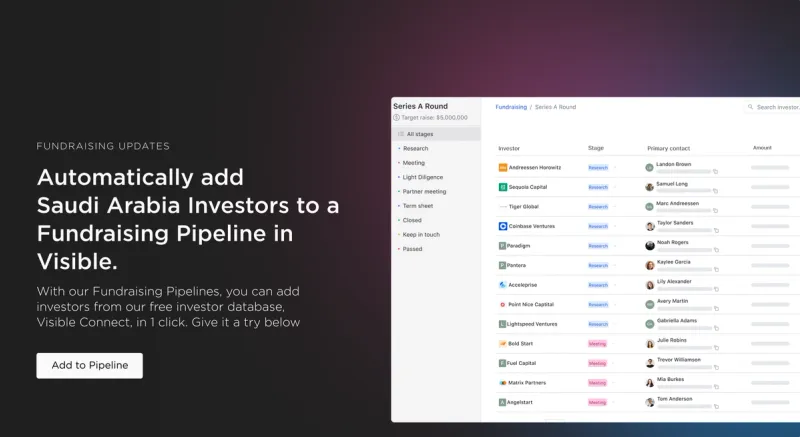
Connect With Investors in Saudi Arabia Using Visible
At Visible, we often times compare a fundraise to a B2B sales and marketing funnel. At the top of your funnel, you are finding new investors. In the middle, you are nurturing and pitching potential investors. At the bottom of the funnel, you are working through diligence and ideally closing new investors.
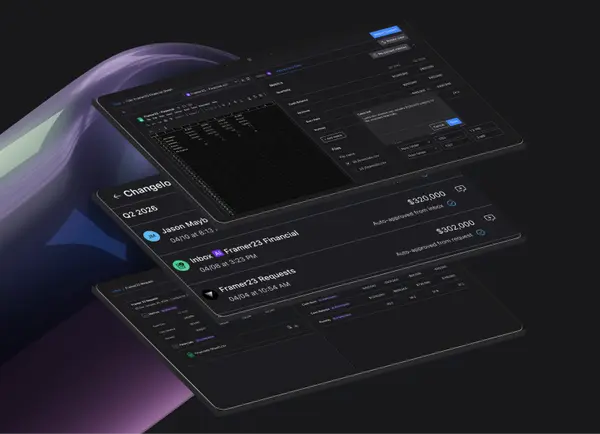
With the introduction of data rooms, you can now manage every aspect of your fundraising funnel with Visible.
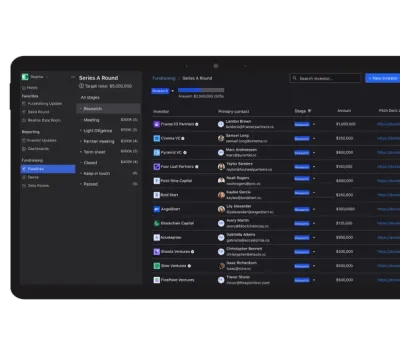
- Find investors at the top of your funnel with our free investor database, Visible Connect and find a filtered list of investors.
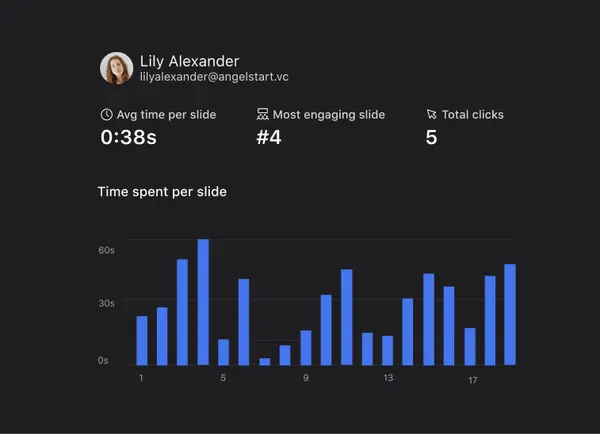
- Track your conversations and move them through your funnel with our Fundraising CRM
- Share your pitch deck and monthly updates with potential investors
- Organize and share your most vital fundraising documents with data rooms
Manage your fundraise from start to finish with Visible. Give it a free try here.
Frequently Asked Questions
How do I raise venture capital in Saudi Arabia as a foreign founder?
Raising venture capital in Saudi Arabia now requires more than a remote pitch. Investors increasingly demand physical presence or a regional headquarters (RHQ). Start by targeting government-backed accelerators like Sanabil 500 or The Garage to build local credibility, then approach active VCs like STV or Raed Ventures that align with Vision 2030 mandates.
What are the most active Venture Capital firms in Saudi Arabia?
The most active VC firms include STV, Raed Ventures, and Impact46. Capital is flowing heavily into Fintech and Retail Tech. Government-backed entities like the Saudi Venture Capital Company (SVC) and Sanabil also play a crucial role as limited partners, de-risking investments for private funds across the Kingdom.
What tax incentives are available for startups in Saudi Arabia?
The Regional Headquarters (RHQ) Program offers a 30-year tax holiday, including 0% corporate and withholding tax, for eligible companies. Additionally, the National Technology Development Program (NTDP) offers "Tech Crew" salary subsidies, covering up to 50% of wages for local technical talent to help extend your startup runway.
Can foreign investors own 100% of a company in Saudi Arabia?
Yes, under the new Investment Law effective February 2025, foreign founders can own 100% of their business without a local sponsor (Kafeel). The process has been streamlined through the Investment Registration Certificate (IRC), allowing for digital registration in days rather than the months previously required for a MISA license.
What is the "Series A Gap" in the Saudi startup market?
The "Series A Gap" refers to the structural difficulty of raising growth capital compared to abundant seed funding. While early-stage deals accounted for 89% of transactions in 2025, Series A rounds remain competitive. Founders need strong unit economics and proven traction to secure growth funding from investors in Riyadh.