
Key Takeaways
-
Founders in Western Europe face a barbell venture capital market where pre-seed and late-stage companies secure abundant funding, but Series A and B rounds remain highly competitive. This comprehensive guide outlines how to navigate this gap by matching your startup with active European investors based on your exact stage and geography.
-
Artificial intelligence startups now command a record 39.1 percent of all venture capital raised in the region, while defense technology has emerged as the fastest-growing sector on the continent. Tracking these specific investment trends allows you to position your pitch to capture institutional capital this year strategically.
-
The fundraising ecosystem is highly localized, meaning a strategy built for Paris will not transfer cleanly to London due to distinct post-Brexit regulations. You will learn how to leverage regional investor networks and align your cap table with the structural preferences of venture firms across major European tech hubs.
-
Strategic founders use government programs like the European Innovation Council and the UK Seed Enterprise Investment Scheme to access millions in non-dilutive funding. Mastering these regional tax credits and grants can materially reduce the amount of equity you must give up during your initial funding rounds.
-
Securing warm investor introductions requires targeting the right ecosystem spaces, such as the AI-focused Station F campus or the highly concentrated Slush conference. You will discover which specific startup accelerators and industry events reliably deliver institutional term sheets instead of just basic operational advice.
Western Europe is the largest venture capital market outside the United States. European startups raised €66.2 billion, yet the number of individual funding rounds fell for the fourth consecutive year. More money. Fewer deals. That gap is the single most important thing to understand before you start outreach.
This guide covers the United Kingdom alongside Continental Western Europe but treats them as distinct fundraising environments. Post-Brexit, the UK runs on its own regulatory framework, its own investor incentive schemes, and a separate relationship with EU-backed capital programs. A fundraising strategy built for Paris will not transfer cleanly to London, and vice versa. Both markets are covered here, with those differences made explicit throughout.
AI startups now command a record 39.1% of all venture capital raised in Europe, defense tech is the fastest-growing sector on the continent, and US investors are returning to European deals at a pace not seen since 2021, drawn by valuations that look attractive compared to inflated US multiples, according to TechCrunch's year-end analysis. At the same time, many European VC firms are deploying from their smallest funds in years, which means they are making fewer bets and holding more capital in reserve.
What this creates for founders is a barbell market. Capital is plentiful at the very top, where category leaders and AI infrastructure companies are raising at scale, and increasingly available at the earliest pre-seed and seed stages. The gap in the middle, specifically at Series A and B for companies without a clear path to profitability, remains the hardest part of the Western European fundraising landscape to navigate.
This guide exists to help you navigate all of it. The investor list maps 15 active firms hub by hub across London, Paris, Berlin, Amsterdam, and beyond. The ecosystem section covers where capital is actually concentrating and what valuation benchmarks look like at each stage in 2026. The founder resources section identifies the accelerators and events worth your time, not just the ones with the best marketing. And the region-specific opportunities section covers the non-dilutive grants, R&D tax credits, and government programs that can materially change how much equity you need to raise in the first place.
Which Venture Capital Firms Are Actively Investing in Western Europe in 2026?
The firms below are organized by city hub. The goal is to match your geography and stage to the right room before you start outreach. Each entry includes typical check size, stage focus, and the sector signals that matter most. Where a firm spans multiple hubs, it is listed under its primary European headquarters.
London (United Kingdom)
The UK operates as a distinct regulatory environment from Continental Europe. The firms below work within the UK's SEIS/EIS framework and are primarily accountable to British financial services regulation. Founders domiciled in EU member states should confirm cross-border compatibility before assuming a London VC's structural preferences align with their cap table.

- Stage Focus: Pre-Seed, Seed, selective Series A
- Typical Check Size: $140,000 to $700,000
- Sector Focus: Software, fintech, SaaS, AI
- Seedcamp is one of the highest-volume seed funds in Europe, with over 500 companies backed since its founding in 2007. Its network is genuinely pan-European, which makes it one of the few London-based early-stage firms that is as relevant to a founder in Paris or Berlin as it is to one building in Shoreditch. Notable portfolio companies include Revolut, Wise, UiPath, and Synthesia. If you are raising a first institutional round and your product has global ambition, Seedcamp is a natural first conversation.
- Stage Focus: Series A, Series B (selective Seed)
- Typical Check Size: £5 million to £30 million
- Sector Focus: European-founded technology, generalist
- Balderton invests exclusively in European-founded companies, which is both its constraint and its focus. With approximately $3 billion in committed capital across eight funds, it is one of the most institutionally serious firms operating at Series A and B in the region. Recent investment activity through early 2026 includes leading Wayve's $1.2 billion Series D at an $8.6 billion valuation and backing Fuse Energy's $70 million Series B. If you are approaching a Series A with strong fundamentals and a clear path to becoming a category leader in your market, Balderton belongs on your shortlist.

- Stage Focus: Series A through growth
- Typical Check Size: $10 million to $100 million+
- Sector Focus: Generalist, with active interest in fintech, climate, enterprise data, and frontier tech
- Atomico was founded by Skype co-founder Niklas Zennström and manages approximately $4.7 billion in assets across six funds, with Fund VI closing at $1.1 billion. The firm is unambiguously focused on European-founded companies and publishes its annual State of European Tech report, which is one of the most cited data resources in the ecosystem. Recent deals include Mews's $300 million Series D in January 2026 and participation in Neko Health's €252 million Series B. Atomico is the right firm to pursue once you have proven product-market fit and need a partner who can support you through Series B and beyond.

- Stage Focus: Pre-Seed through Series C
- Typical Check Size: $500,000 to $5 million+
- Sector Focus: Generalist, with a track record in climate tech, mobility, and enterprise software
- LocalGlobe operates across four funds covering different stages under the same partnership, making it one of the few London firms that can follow a founder from the first institutional check through to growth rounds. The team is deeply embedded in the European founder community and takes a relationship-first approach to sourcing. Portfolio companies include Sylvera and Qogita. If continuity of investor relationship matters to you, LocalGlobe is worth understanding early.

- Stage Focus: Pre-Seed only
- Typical Check Size: Approximately $1 million average first check
- Sector Focus: Generalist, European founders
- Concept Ventures closed an $88 million fund in 2025, making it Europe's largest dedicated pre-seed fund at the time of closing. Over 80% of its LP base is US-based, which gives it structural access to American co-investors at Series A that most European pre-seed funds cannot replicate. Its most prominent early bet is ElevenLabs, which reached a $6.6 billion valuation in 2025. If you are at the earliest stage and want a first check from a fund with the network to help you bridge to a US-networked Series A, Concept Ventures is worth tracking closely.
Paris
Paris has moved from challenger to co-leader of the Western European ecosystem. In 2025, Dealroom ranked it as the top startup hub in Europe across its global benchmark of 288 cities, driven by AI deal flow, deep research university pipelines, and a patent concentration of 133,000, more than twice London's 48,000. The French ecosystem skews toward technically ambitious founders, and the firms below reflect that.

- Stage Focus: Pre-Seed, Seed
- Typical Check Size: €150,000 to €300,000
- Sector Focus: Generalist
- Kima Ventures is the investment vehicle of Xavier Niel, one of the most active early-stage investors in Europe. Operating from Station F in Paris, it invests in approximately 100 startups per year, making it one of the highest-velocity seed funds on the continent. Since 2010, Kima has backed nearly 1,000 companies, including early positions in Wise (then TransferWise), Ledger, and Alma. The trade-off is intentional: Kima writes small, fast checks with limited hands-on involvement. It is a fit for founders who need speed and a strong logo, not active board engagement.

- Stage Focus: Seed through growth
- Typical Check Size: €1 million to €50 million
- Sector Focus: Technology and tech-enabled companies, generalist
- Partech is one of the largest and most established VC firms in Continental Europe, with offices in Paris, San Francisco, Berlin, and Dakar. It covers the full venture lifecycle from Seed to growth and has recently launched a €300 million impact-focused growth fund in 2026, targeting European companies with strong sustainability or social outcomes alongside financial performance. Notable portfolio companies include N26, Otrium, and Lama. For founders who need a single institutional partner with the capacity to write follow-on checks at each stage, Partech is one of the few Continental firms structured to do it.

- Stage Focus: Multi-stage, Seed through growth equity
- Typical Check Size: €5 million to €100 million+
- Sector Focus: Generalist, with particular depth in fintech, health, and consumer brands
- Eurazeo is a publicly listed investment company on Euronext Paris with a diversified portfolio worth €34.1 billion, including nearly €24.1 billion from third-party investments across approximately 590 companies. It operates across private equity, private debt, and venture, which gives portfolio companies access to a broader capital toolkit than most pure-play VCs can offer. For founders at Series B and beyond who are planning a European expansion or approaching pre-IPO territory, Eurazeo's institutional weight and multi-geography presence across Paris, London, Frankfurt, Berlin, and Madrid is a structural advantage.
Berlin
Berlin is Germany's startup capital and the primary landing point for founders targeting the DACH market. Germany posted significant defense tech momentum in 2025, with deals including Helsing's €600 million Series D and Quantum Systems' €180 million Series C. By 2029, German defense spending is projected to reach €153 billion annually, which is already attracting a new class of defense and dual-use investors to the city.

- Stage Focus: Seed through growth
- Typical Check Size: €500,000 to €60 million
- Sector Focus: Internet, fintech, climate tech, and enterprise software
- HV Capital, formerly HV Holtzbrinck Ventures, is one of Germany's oldest and most active venture firms, founded in 2000 and now managing over €2 billion across nine funds, with Fund IX closing at €710 million in May 2023. It has a deep track record in German-language market companies, with early stakes in Zalando and Delivery Hero, and has expanded its investment thesis to include climate tech and pan-European enterprise software. The check range from €500,000 to €60 million means it can engage meaningfully at seed and stay relevant through growth. For DACH-focused founders, HV Capital is one of the most important firms to have in your first round.

- Stage Focus: Pre-Seed through Series D
- Typical Check Size: $1 million to $10 million
- Sector Focus: E-commerce, fintech, healthtech, AI, SaaS
- Project A positions itself as an operational VC, meaning it maintains an in-house team of over 100 functional experts in areas including engineering, marketing, data science, and HR who work directly with portfolio companies. This is a meaningful structural difference from most European firms, which offer capital and introductions. Portfolio companies include WorldRemit and Spryker. For early-stage founders who need hands-on operational support alongside capital, especially in scaling go-to-market or hiring, Project A is a differentiated choice within the Berlin ecosystem.

- Stage Focus: Pre-Seed, Seed
- Typical Check Size: Up to €1 million at initial investment, with follow-on capacity
- Sector Focus: Deep Tech, Industrial Tech, Climate Tech, Digital Tech, Life Sciences, Chemistry
- HTGF is a public-private partnership backed by the German Federal Ministry for Economic Affairs and Energy, KfW Capital, and a consortium of corporate investors. It is the most active early-stage investor in Germany by deal volume and one of the most active in all of Europe. HTGF is particularly important for founders in capital-intensive deep tech or life sciences sectors who need patient, stage-appropriate capital before they can demonstrate the traction required by commercial VCs. If your company is coming out of a German research institution or technical university, HTGF is often the right first call.
Amsterdam
Amsterdam has built a reputation as the most operationally efficient major hub in Western Europe for scaling across EU markets. Dealroom ranks it fifth in the EU for startup productivity. The Dutch capital is particularly active in logistics tech, enterprise SaaS, fintech, and, increasingly, defense tech.

- Stage Focus: Seed through Series B
- Typical Check Size: €1 million to €15 million
- Sector Focus: Defense and security technology, dual-use
- Keen Venture Partners closed the first €150 million tranche of its European defense and security technology fund in 2025, making it the largest dedicated defense-tech VC vehicle on the continent at the time. The firm backs companies building technology for defense and security markets with civilian applications, a category that is attracting disproportionate attention from both private capital and government procurement budgets across NATO member states. If you are building in defense, cybersecurity, drone technology, or dual-use infrastructure, Keen is the most structurally aligned institutional investor in Continental Europe right now.

- Stage Focus: Seed through Series B
- Typical Check Size: €1 million to €5 million
- Sector Focus: Cybersecurity, enterprise software
- Amsterdam-based TIN Capital runs a dedicated cybersecurity fund and has closed additional capital for its Cyber Tech Fund V in 2025, targeting a total of €80 million. The firm invests exclusively in European cybersecurity scaleups, which gives it specific pattern recognition and a procurement network that generalist firms cannot replicate. With the EU's NIS2 Directive driving mandatory security spending across critical infrastructure sectors, TIN is operating in a structurally growing market. For founders building in enterprise security, this is the most focused institutional home in the Netherlands.
Pan-European (Multi-Hub Presence)
These firms maintain substantive European operations with European partners actively leading deals. They are not US funds with a token London office. Each of the three below has a meaningful portion of its portfolio concentrated in Western Europe.

- Stage Focus: Seed through Series C
- Typical Check Size: $1 million to $50 million
- Sector Focus: Generalist, with depth in fintech, SaaS, consumer technology, and gaming
- Index Ventures was founded in Geneva and maintains its primary European operation in London, with a parallel US presence in San Francisco. It is one of the most decorated venture firms in Europe by portfolio quality, with early or growth-stage stakes in Figma, Wise, Revolut, Notion, and Robinhood. Index is a firm where warm introductions from portfolio founders carry significant weight in the sourcing process. If you are raising a Series A or B and have a connection into the network, it is worth pursuing. Cold outreach at this stage is a lower-probability path.

- Stage Focus: Seed through growth
- Typical Check Size: $5 million to $15 million initial; significant follow-on capacity
- Sector Focus: Generalist, with particular depth in enterprise SaaS, security, and consumer technology
- Accel operates one of the most active European practices from its London office and has been backing European founders since the early 2000s. Its portfolio includes Spotify, Slack, UiPath, and Supercell. Accel's European team writes investment decisions independently from its US partnership, which means founders do not need to run a transatlantic process to access the firm's capital. At Series A and B, Accel has the scale to lead a round and the network to attract strong co-investors. It is one of the first firms a growth-stage European founder should be building a relationship with before they formally start a raise.
Top Accelerators and Incubators in Western Europe
The programs below are not ranked. They are organized by hub and selected based on one criterion: demonstrated investor access, not just operational mentorship. A desk and a mentor are easy to find. A warm introduction to the right Series A investor at the right moment is not.
London
Entrepreneur First is the only accelerator in Western Europe that invests in individuals before they have a co-founder or an idea. It is built for technically elite founders, specifically engineers, PhDs, and operators with rare domain expertise, and pairs them with complementary partners during a structured 12-week cohort. EF has supported over 500 founding teams since 2011, with a total portfolio value above $13 billion. Its most notable alumni include Tractable, Magic Pony Technology, and Cleo.
A development worth understanding before you apply: EF closed its France and Germany cohorts in 2025 and relocated its European operations to focus on London and a new US bridge program. Its 2026 strategy pairs 12 weeks in London with a US residency phase, specifically because the most ambitious founders in its European cohorts are seeking faster access to US AI infrastructure and capital. If you are a pre-team founder with deep technical credentials and the ambition to build a global company, EF London remains one of the best possible starting points in Europe.
Founders Factory is a UK-based studio and accelerator running a six-month program that provides access to a network of over 100 operational experts across growth, product, engineering, PR, and fundraising. It operates sector-specific accelerators in partnership with major corporates including Aviva, L'Oréal, and Holtzbrinck, which gives founders structured pathways to enterprise pilots and commercial validation alongside capital. This makes it particularly useful for founders in regulated sectors or B2B categories where a corporate reference customer dramatically changes the fundraising conversation.
Based in Cambridge, Deeptech Labs is a seed-stage fund and accelerator for deep tech startups with established technologies and early teams. Its specific value is the commercialization support it provides to founders emerging from academic research who need help bridging from proof-of-concept to Series A readiness. The program is tightly integrated with the Cambridge research ecosystem and has a strong track record of helping founders prepare for institutional fundraising rather than simply providing early capital.
Paris
Station F is the world's largest startup campus at 34,000 square meters and houses over 1,000 companies across more than 30 active programs. The campus is not simply a co-working space with a branding exercise attached. Companies at Station F have raised over €1.5 billion annually since 2022, with 2025 marking the highest total yet. The campus now describes approximately 80% of its resident companies as working in AI, and it hosted part of France's AI Action Summit in early 2025, drawing Sam Altman, Jensen Huang, and Yann LeCun to the campus.
In February 2026, Station F launched F/ai, a dedicated program bringing together major AI platform leaders. It also announced a partnership with Mistral AI specifically to support AI startups on campus. For any founder building in AI with European ambitions and a desire to operate inside the continent's most active AI community, Station F is the clearest single destination. Desk space starts at €195 per month through the Founders Program, and the Fighters Program offers free space for founders from non-privileged backgrounds with strong ideas.
The HEC Paris Incubator operates at Station F and supports founders through a flexible à la carte program model across periods of up to two years. Since 2007, it has supported over 900 companies, and startups linked to the broader HEC community have collectively raised €16.4 billion and contributed to the creation of 16 companies that reached billion-dollar valuations. The Financial Times ranked the HEC Paris Innovation and Entrepreneurship Institute as Europe's fourth-best startup incubator in 2025. The January 2026 cohort of 38 startups spans AI, cybersecurity, fintech, and data, which reflects the current sectoral priorities across the French ecosystem. For founders with connections to French academic or business networks, or those building in sectors where HEC's alumni base is commercially relevant, this is a strong choice.
Berlin and the DACH Region
UnternehmerTUM is the startup and innovation center of the Technical University of Munich, founded in 2002 by Susanne Klatten as a non-profit. It runs over 20 programs spanning from early prototyping through to Series A readiness, and was ranked the top EU startup hub in 2026 by a joint Financial Times and Sifted assessment. Notable alumni include FlixMobility, Celonis, and Isar Aerospace. If you are a founder emerging from a technical discipline with a product that has manufacturing, industrial, or deep tech dimensions, UnternehmerTUM's operational depth and access to Germany's corporate and investor ecosystem is difficult to replicate elsewhere in the region.
Startup Wise Guys is one of Europe's most active B2B startup accelerators, running multiple cohorts per year across verticals including SaaS, fintech, cybersecurity, sustainability, and AI. It is particularly useful for founders who need help building repeatable sales processes and go-to-market infrastructure before approaching Series A investors. The program operates across multiple European cities and has a track record of preparing companies to raise institutional rounds through operational discipline rather than simply through investor introductions.
Amsterdam
HighTechXL is a hardware-focused accelerator based in Eindhoven, Netherlands, with strong partnerships with CERN, Philips, and ASML. It runs a nine-month program that combines the functions of an incubator and accelerator, supporting teams from the idea stage through MVP and early customer validation. For founders building in hard tech, medtech, energy hardware, robotics, or industrial IoT, HighTechXL provides access to testing facilities, corporate partnerships, and a talent network that most early-stage programs simply cannot offer. Over 60% of companies that have completed the program are still active, which is a meaningful signal in a category where hardware attrition is high.
Pan-European
Antler is a global early-stage VC and company builder that operates in London, Amsterdam, Berlin, Stockholm, and several other Western European cities. Like Entrepreneur First, it invests in individuals before they form teams, running intensive co-founder matching programs over several weeks. It then writes pre-seed checks of up to $250,000 in exchange for a small equity stake for companies that pass its investment committee. Antler runs multiple cohorts per year across its European hubs, which means the application window is effectively always open. It is particularly active with international founders who want a structured entry point into the European ecosystem without an existing network.
The EIT Digital Accelerator is backed by the European Institute of Innovation and Technology and provides growth support specifically for digital tech scaleups with European market ambitions. It focuses on business development and cross-border expansion rather than pre-seed formation, making it most useful for founders who are post-product and approaching Series A or beyond. Its network spans national hubs across Germany, France, the Netherlands, Italy, Spain, Sweden, and Finland, which gives it a structural advantage for founders who need introductions across multiple European markets simultaneously.
Top Events for Founders in Western Europe
Events are only worth attending if you are specific about what you want from them before you arrive. The list below segments by purpose: some are investor-dense and built for deal-making, others are better for ecosystem visibility or sector-specific positioning.
Slush
When: November 18 to 19, 2026 Where: Helsinki, Finland
Slush maintains a ratio of approximately one VC for every two founders in attendance, with investors representing nearly $4 trillion in assets under management. It is organized around pre-bookable one-to-one meeting tables, which means the networking is structured and efficient rather than serendipitous. If you are raising a Seed or Series A round, Slush is the single highest-density investor meeting environment in Europe. Apply early and use the meeting booking system before the event. Showing up without pre-scheduled meetings significantly reduces the return on your trip.
EU-Startups Summit
When: May 7 to 8, 2026 Where: Valletta, Malta
The EU-Startups Summit is a focused, early-stage event built around a prominent pitch competition and a concentrated investor audience drawn from across the European ecosystem. Its size keeps the networking quality high without the logistical complexity of a 100,000-person event. For founders raising Pre-Seed or Seed rounds who want targeted visibility with European institutional investors and press, this is one of the most efficient events on the calendar.
VivaTech
When: May 2026 (dates TBC) Where: Paris, France
VivaTech is Europe's largest tech event, attracting approximately 180,000 attendees in its 2025 edition and drawing speakers including the President of France, Jensen Huang, and Mistral AI's CEO Arthur Mensch. It is the right event for founders who need corporate partnership access, media visibility, or enterprise deal flow alongside investor introductions. Its scale works against focused investor meetings, so treat it as a relationship accelerator and brand positioning exercise, not a primary fundraising vehicle.
Web Summit
When: November 2026 Where: Lisbon, Portugal
With over 70,000 attendees, Web Summit is better described as a temporary tech city than a conference. Its Alpha startup program provides early-stage companies with curated investor meetings, mentor hours, and press access. The event works best for founders at seed or early Series A who want international visibility and introductions to investors beyond their home market. Apply to the Alpha program at least three months before the event, as acceptance determines the quality of your experience.
London Tech Week
When: June 2026 Where: London, UK
London Tech Week is a city-wide festival spanning hundreds of events across a single week, organized around a central conference but extending into dozens of satellite events hosted by VCs, corporates, and startups. Its value is less in any individual session and more in the density of ecosystem players in one place for one week. For UK-based founders, it is an efficient way to meet investors, customers, and potential hires without traveling. For international founders considering expanding to London, it provides an efficient orientation to the UK ecosystem.
Hello Tomorrow
Where: Paris, France
Hello Tomorrow is Europe's leading deep tech conference, connecting science-driven startups with investors and industry partners. It features structured pitch sessions, technology showcases, and investor matchmaking across health, energy, robotics, quantum, and climate. For founders commercializing research-backed technology who want visibility with deep tech-specialist investors rather than generalist VCs, Hello Tomorrow is the most targeted event in the Western European calendar.
Mobile World Congress and 4YFN
When: February 2026 Where: Barcelona, Spain
4YFN (Four Years From Now) runs as the startup event within Mobile World Congress and brings together founders and investors from over 100 countries. For founders building at the intersection of mobile, connectivity, IoT, and enterprise digital transformation, the event provides access to telecom giants, corporate innovation units, and a concentrated pool of B2B decision-makers. MWC also offers direct insight into where the largest infrastructure players in Europe are directing procurement budgets, which is valuable commercial intelligence for founders in any sector adjacent to connectivity.
Online Communities and Networks in Western European
Sifted
Sifted is the Financial Times-backed publication covering the European startup ecosystem. Its newsletter, briefings, and Sifted Pro membership provide some of the best ongoing intelligence on funding rounds, investor moves, and ecosystem trends in Western Europe. Following Sifted closely is a functional substitute for a significant portion of the paid research that founders in other regions would need to commission separately.
La French Tech
La French Tech is a government-backed program supporting French startups internationally through visa programs, investor introductions, and global community chapters. For founders building in France or seeking access to the French ecosystem from abroad, La French Tech membership provides credibility and access to a structured network of French investors and corporates operating internationally.
Tech Nation (UK)
Tech Nation is the UK's primary government-backed network for tech founders, offering programs, reports, and the Global Talent Visa endorsement pathway for high-skill international founders looking to base in the UK. Its annual reports on the UK tech ecosystem are among the most cited data sources for London fundraising benchmarks. Post-Brexit, the Global Talent Visa route Tech Nation endorses has become an important pathway for non-UK founders who want to build in London without the constraints of standard immigration routes.
EU-Wide Non-Dilutive Funding Programs Available to Continental European Founders
The European Innovation Council: Europe's Most Important Grant and Investment Program
The European Innovation Council is the flagship innovation funding arm of the EU's Horizon Europe framework, and its 2026 work programme allocates a total of €1.4 billion specifically to support deep tech research and high-potential startups. For EU-incorporated founders, this program is not optional reading. It is a primary capital source.
The EIC operates through three distinct instruments. Understanding which one applies to your stage is essential before you invest time in an application.
The Pathfinder is for research teams working at the earliest stages of technology development, typically Technology Readiness Levels 1 through 4. It offers grants of up to €4 million per project for visionary, multi-disciplinary research with the potential to produce breakthrough technologies. The total budget for EIC Pathfinder in 2026 is €262 million, split between open calls with no predefined themes and challenge-specific calls. If your company is emerging from or still connected to a research institution, this is the instrument to explore first.
The Transition sits between research and commercialization. It provides grants of up to €2.5 million to help companies validate technologies and develop business plans based on previously funded research results. The total budget for EIC Transition in 2026 is €100 million. Starting in 2026, eligible precursor projects can include a broader range of Horizon Europe-funded activities than in previous years, which expands the pool of companies that can apply.
The Accelerator is the most commercially relevant EIC instrument for founders at the scale-up stage. Its 2026 budget is €634 million, offering grants below €2.5 million combined with equity investments from the EIC Fund ranging from €500,000 to €10 million. Blended finance, combining a grant component with direct equity, is the most common structure and was chosen by 85% of the 61 companies selected in the most recent round. Over 70 EIC-backed companies have reached valuations exceeding €100 million, and six are valued above €500 million.
The Accelerator is highly competitive. In the October 2025 cut-off, 923 full applications were submitted and 71 companies were selected. The top represented countries were Germany, Spain, France, and Sweden. Applications can be submitted at any time via a rolling short application, which is then evaluated within six to eight weeks before full proposals are invited for formal cut-off dates. One critical detail: UK-based applicants can only apply for the grant-only option, not blended or equity-only finance, due to the UK's post-Brexit associated country status.
The STEP Scale-Up is the EIC's largest-ticket instrument, providing equity-only funding of €10 million to €30 million to companies scaling in three strategic areas: digital technologies including semiconductors and quantum, clean and resource-efficient technologies, and biotechnologies. The total budget for STEP Scale-Up in 2026 is €300 million. Applicants must demonstrate a credible plan to use the EIC investment to attract three to five times the EIC amount from private co-investors. For Series B-stage companies in these sectors, the STEP Scale-Up can anchor an entire growth round.
Eurostars
Eurostars is run by the EUREKA Network with Horizon Europe co-funding and targets R&D-intensive SMEs working on international collaborative projects. Call 10 opened on January 16, 2026, with a deadline of March 19, 2026. Call 11 is scheduled for July 9 to September 10, 2026. A minimum of two independent entities from two different Eurostars countries must apply together, with at least one from an EU or Horizon Europe-associated country. One structural advantage: companies that have successfully completed a Eurostars project can bypass Step 1 of the EIC Accelerator and submit directly to Step 2, which is a meaningful time saving in a competitive application process.
What Tax Incentives and Government Programs Does the UK Offer Founders?
SEIS
The Seed Enterprise Investment Scheme is a government-backed tax relief that makes UK early-stage investment significantly more attractive to angel investors by reducing their effective downside. Investors can claim 50% income tax relief on investments up to £200,000 per year, zero capital gains tax on SEIS shares held for at least three years, and loss relief against income tax if the company fails. For a UK founder, the practical effect is straightforward: your first £250,000 round is materially easier to close when investors know the government is absorbing half the downside.
SEIS applies to companies under three years old with gross assets below £350,000 and fewer than 25 employees. To use SEIS in a fundraise, you need Advance Assurance from HMRC before issuing shares. HMRC processing times for Advance Assurance are currently running four to six weeks, so apply well before you plan to open the round. The most common founder mistake is accepting EIS investment before SEIS investment is complete, which permanently eliminates SEIS eligibility. Structure your round so SEIS investors close first.
EIS
The Enterprise Investment Scheme targets companies further along in their development than SEIS allows. Investors receive 30% income tax relief, CGT exemption on gains after three years, and CGT deferral on gains reinvested into EIS-qualifying shares. For founders, the EIS substantially expands the pool of investors willing to back early-scale-up rounds by reducing effective investor risk.
Critically, the April 2026 Budget has materially expanded EIS limits. From April 6, 2026, the annual amount a company can raise under EIS doubles from £5 million to £10 million, and the gross asset threshold for eligibility rises from £15 million to £30 million before investment and £16 million to £35 million after investment. The lifetime fundraising cap doubles from £12 million to £24 million, and for knowledge-intensive companies it doubles from £20 million to £40 million. These changes mean that EIS can now follow a company significantly further into its growth journey than it could before, which is an underappreciated development for UK founders approaching Series A and B.
Innovate UK
Innovate UK is the UK government's innovation agency and provides direct grants and funding competitions across sectors including AI, clean energy, health technology, advanced manufacturing, and creative industries. It operates independently from the EU's EIC framework post-Brexit. Grant sizes vary widely by competition and program, from feasibility studies of £25,000 to collaborative R&D projects exceeding £10 million. Innovate UK competitions run on a rolling basis throughout the year, and the agency publishes a forward calendar of upcoming funding competitions that founders should monitor quarterly.
What Makes France One of the Most Founder-Friendly Tax Environments in Western Europe?
The JEI Status
The Jeune Entreprise Innovante, or JEI, is France's young innovative company status and is one of the most effective non-dilutive capital tools available to any early-stage founder in Western Europe. It applies automatically to qualifying companies and does not require a competitive application process.
To qualify, a company must be a PME under EU standards (fewer than 250 employees, annual turnover under €50 million), must have been created within the last 11 years, and must spend at least 20% of its deductible charges on R&D activities. The benefits are immediate and substantial. JEI status provides full exemption from corporate income tax in the first profitable fiscal year, 50% exemption in the second year, and exemption from employer social contributions on the salaries of all researchers, engineers, and technicians assigned to R&D work. These exemptions apply on a per-establishment basis and are structured to directly reduce the cash cost of building a technical team.
The compounding effect is significant. A company using JEI status alongside an I-Nov grant from Bpifrance can reduce its effective cash contribution to a €2.5 million project by up to €440,000 through payroll exemptions alone. The 2026 Finance Law has also created a new subcategory, the Jeune Entreprise d'Innovation à Impact or JEII, for companies meeting JEI criteria and also qualifying as social solidarity economy enterprises, with property and land tax exemptions extended to 2028.
The Crédit d'Impôt Recherche
The CIR (Crédit d'Impôt Recherche) is a national R&D tax credit available to all French companies regardless of stage. It allows companies to claim back 30% of eligible R&D expenditures from their corporate tax liability, up to €100 million of qualifying costs per year. Below €100 million, the credit rate is 30%. For expenditures above that threshold, it falls to 5%. Crucially, the CIR is stackable with JEI status and with Bpifrance grants, which makes the French innovation funding system one of the most combinable in Europe for founders who understand how to layer the programs.
Bpifrance
Bpifrance is France's public investment bank and acts as a co-investor, grant provider, and accelerator operator across all stages of the startup lifecycle. With 50 regional offices and dedicated programs including i-Lab grants, i-Nov innovation competitions, and the French Tech Seed fund, it is a consistent presence at every stage of the French fundraising journey. In the 2025 round of the EIC Accelerator, Bpifrance provided debt financing support to multiple French companies alongside EU equity. For French founders, Bpifrance is not an alternative to VC. It is a capital source that makes the VC round easier to close by reducing the equity needed from private investors.
What Government Innovation Funding Is Available in Germany?
Germany's R&D Tax Allowance
Germany introduced a dedicated R&D tax allowance in 2020, and as of 2026, SMEs under the EU definition qualify for a 35% R&D tax allowance on eligible activities, up from 25% for larger companies, with an annual funding cap increasing from €10 million to €12 million per company. The allowance covers in-house R&D personnel costs and depreciation on movable R&D assets acquired after March 2024. Subcontracted R&D is now covered at 70% of eligible costs, up from 60%. Applications are processed through the BSFZ Research Allowance Certification Office.
This allowance is technology-neutral, which means it applies equally to AI, biotech, industrial tech, and software. For German founders building in capital-intensive deep tech, it is a meaningful reduction in the cash cost of maintaining a technical team before Series A.
The Zukunftsfonds
The German Federal Government launched the Zukunftsfonds (Future Fund) as a structural intervention to address the growth-stage capital gap in the German ecosystem. The €10 billion vehicle targets all development phases of startups, with a specific focus on growth financing, deployed through KfW Capital and co-investment vehicles. KfW Capital, a subsidiary of KfW development bank, invests specifically in German and European VC funds, which means its capital reaches founders indirectly through the fund managers it backs rather than through direct applications. Founders benefit most from the Zukunftsfonds by ensuring their target investors have or are seeking KfW Capital LP relationships.
R&D Tax Incentives Available in the Netherlands
The WBSO
The WBSO (Wet bevordering speur- en ontwikkelingswerk) is the Netherlands' R&D tax credit scheme and is among the most accessible and generous innovation incentives in Western Europe for founders operating in the country. The 2026 WBSO budget is €1.817 billion, with startups qualifying for a 50% tax benefit on the first €380,000 of eligible R&D wage costs, compared to 36% for established businesses. The credit reduces payroll tax liability, which means it improves cash flow directly and immediately rather than arriving as a tax rebate at year-end.
Applications are submitted to the Netherlands Enterprise Agency (RVO) and can be made on a rolling basis throughout the year. The 2026 window opens November 15, 2025, and closes September 30, 2026, operating on a first-come, first-served basis against the total budget allocation. Apply early in the year. The WBSO is fully combinable with Dutch national innovation credits and Horizon Europe grants, provided no double-counting of cost categories occurs.
What Visa Pathways Help International Founders Access Western European Ecosystems?
The French Tech Visa
The French Tech Visa is a fast-track residency pathway for founders, employees, and investors in the French tech ecosystem. For founders specifically, it provides a four-year renewable residence permit with a processing time significantly faster than standard immigration pathways. To qualify as a founder, your company must be incorporated in France, have a minimum investment of €30,000 in your company, and be sponsored by an accredited French Tech organization or structure. The visa is available to non-EU nationals, including UK citizens post-Brexit. For any international founder building a Paris-based company, it eliminates the immigration barrier that would otherwise slow hiring and founder relocation.
The UK Global Talent Visa
The UK Global Talent Visa provides a route for exceptional individuals in tech, science, arts, and digital technology to live and work in the UK without requiring a job offer or employer sponsorship. For startup founders, the most relevant route is through Tech Nation's endorsement pathway, which grants eligibility based on demonstrated exceptional talent or promise in the digital technology sector. Unlike standard work visas, the Global Talent Visa allows founders to start or join companies freely, makes eventual settlement applications accessible, and can be extended without employer dependency. For non-UK founders considering building in London, this is the most founder-appropriate immigration pathway available.
What Active Angel Networks and Syndicates Should Founders Know About?
Angel Investment Network (UK)
The UK's Angel Investment Network connects founders with over 300,000 investors and is one of the primary platforms for organizing SEIS and EIS-compliant rounds at the pre-seed and seed stages. For UK founders building their first institutional round, it provides direct access to angels who are already educated on the tax schemes and structured for small-check investing.
Bpifrance Angels (France)
Bpifrance's angel program connects French startups with a network of accredited angel investors specifically for pre-seed and seed rounds. Investments through the Bpifrance angel network can be structured to qualify for France's IR-PME tax reduction, which gives individual investors a 25% income tax reduction on qualifying SME investments. For French founders at the earliest stage, building angel rounds through this network is a structurally lower-cost alternative to early institutional dilution.
The EIC Trusted Investor Network
The EIC runs a dedicated Trusted Investor Network that currently unites 111 investors managing a combined €336 billion, specifically committed to co-investing in high-potential deep tech companies alongside EIC Fund investments. The network was established to amplify the impact of EIC equity investments, with the EIC's own track record showing that its direct investments typically attract more than three times the EIC amount from private co-investors. For EU-incorporated founders who have received EIC funding, the Trusted Investor Network is the most direct route to growth-stage institutional co-investment in Continental Europe.
Connect With Investors in Western Europe Using Visible
At Visible, we often times compare a fundraise to a B2B sales and marketing funnel. At the top of your funnel, you are finding new investors. In the middle, you are nurturing and pitching potential investors. At the bottom of the funnel, you are working through diligence and ideally closing new investors.
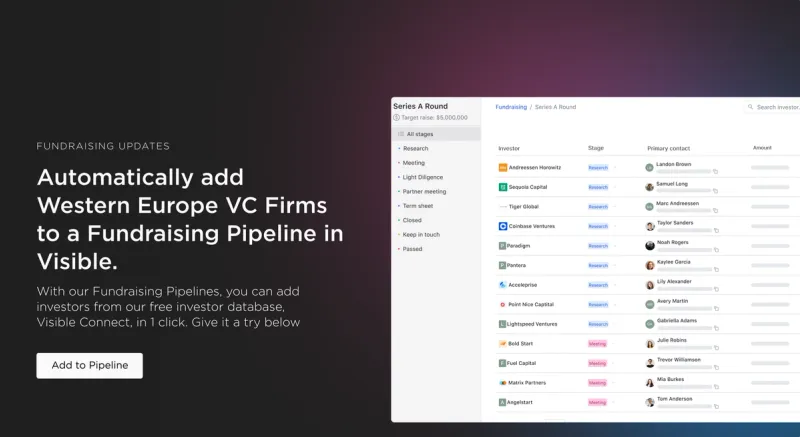
With the introduction of data rooms, you can now manage every aspect of your fundraising funnel with Visible.
- Find investors at the top of your funnel with our free investor database, Visible Connect and find a filtered list of investors.
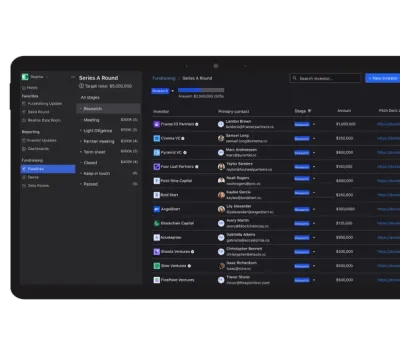
- Track your conversations and move them through your funnel with our Fundraising CRM
- Share your pitch deck and monthly updates with potential investors
- Organize and share your most vital fundraising documents with data rooms
Manage your fundraise from start to finish with Visible. Give it a free try here.
Frequently Asked Questions
What are the most active sectors for venture capital in Western Europe?
Artificial intelligence and defense technology are currently the most active sectors for venture capital in Western Europe. AI startups secure nearly forty percent of all regional funding, while defense technology attracts significant capital due to increased government procurement budgets and new dedicated investment vehicles.
How does fundraising in the UK differ from Continental Europe?
Fundraising in the United Kingdom operates under a separate regulatory framework from Continental Europe. The UK utilizes unique incentives like the Seed Enterprise Investment Scheme, which offers tax relief to angel investors. Founders must ensure their structure aligns with these specific post Brexit financial regulations.
What is the biggest challenge for European startups seeking venture capital?
The biggest challenge for European startups is navigating the funding gap at the Series A and Series B stages. While early stage pre seed funding and late stage capital are plentiful, mid stage companies without a clear path to profitability face a highly competitive venture capital market.
Which Western European cities are the best hubs for raising startup capital?
London and Paris are the dominant hubs for raising startup capital in Western Europe. London offers a massive network of early stage funds, while Paris leads the continent in artificial intelligence deal flow and research. Berlin and Amsterdam also serve as crucial hubs for specific tech sectors.
How can founders access non dilutive funding in Western Europe?
Founders can access non dilutive funding through government programs like the European Innovation Council and regional research tax credits. These programs provide millions in grants and payroll tax exemptions, allowing European startups to scale operations while minimizing the amount of equity they must give up.