























Key Takeaways
-
Pricing payment models: Early stage founders should avoid legacy per page billing and secure flat fee platforms.
-
Sustaining investor engagement: The most effective fundraising operations build trust through regular performance updates and pipeline management before seamlessly transitioning into a secure diligence phase.
-
Essential startup features: Institutional partners require granular access control and detailed activity tracking to gauge true deal intent without the friction of legacy enterprise interfaces.
-
Structured folder hierarchies: Numbered file systems prevent diligence delays by forcing external reviewers to navigate historical financials and cap tables in a strictly logical sequence.
-
Protecting intellectual property: Dynamic watermarking and restricted download permissions remain mandatory to maintain absolute data control when sharing highly sensitive proprietary information.
Virtual Data Room Providers: How to Choose the Right VDR for Your Startup
Closing a funding round is a momentum game. Once a lead investor commits to due diligence, the worst thing a founder can do is stall the process with disorganized files, broken access links, or a clunky user experience.
Nathan Beckord, CEO of Foundersuite.com, described how quickly that gets noticed, writing in TechCrunch. "The best investors are pros at sensing whether a deal has momentum or not — or worse, whether a deal has gone stale." A stall in the data room reads as a stall in the company.
That’s where choosing the right virtual data room (VDR) becomes critical.
But the market for virtual data room providers is notoriously opaque. Founders are frequently forced to choose between legacy enterprise platforms with complex fee structures, or consumer-grade cloud storage that lacks the security and activity tracking institutional investors expect.
Whether you are raising a Pre-Seed round or preparing for Series B due diligence, here is the exact framework to structure your diligence environment without overpaying for enterprise bloat:
- Exactly what features startups actually need in a VDR (and what to ignore).
- Transparent pricing models so you know how to avoid hidden fees.
- A decision framework to choose the right provider based on your stage and deal complexity.
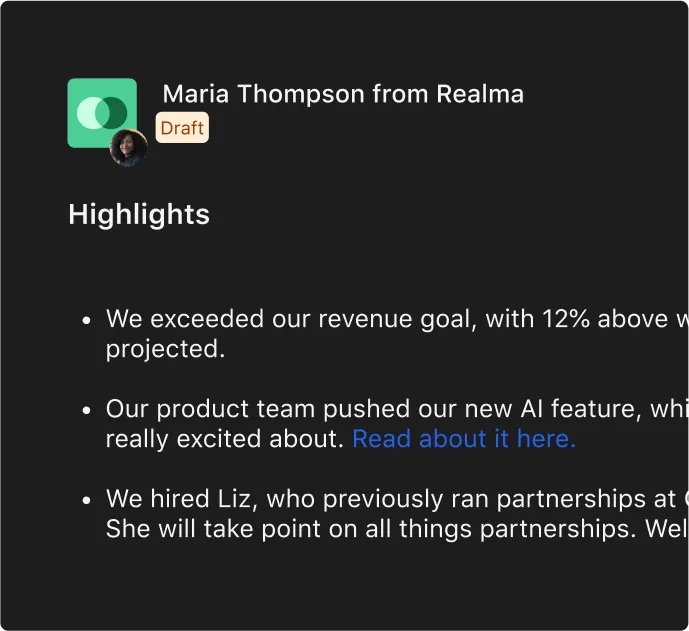
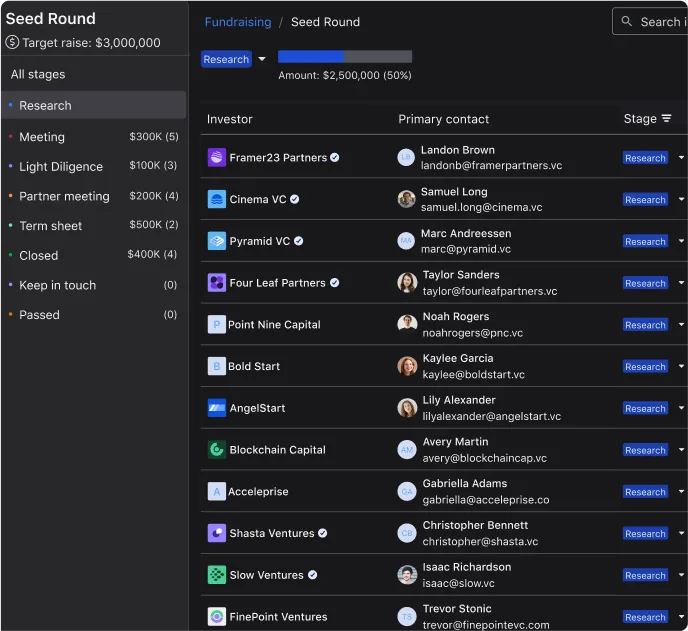
Ultimately, your data room shouldn't be a disconnected island. The most efficient fundraising rounds rely on an integrated approach—where your secure document sharing is a seamless, native extension of how you already track investor engagement, manage your pipeline, and send updates. When your relationship management and VDR share the same analytics engine, you gain a holistic view of investor conviction.
Virtual Data Room Comparison Table (Features & Pricing)
To make a rapid, informed decision, use this side-by-side comparison of the core VDR categories. This matrix is designed to help you quickly identify the right tier of software based on your immediate security needs, without overpaying for unnecessary features.
| Provider Category | Best For | Workflow Fit | Security Level | Pricing Model |
|---|---|---|---|---|
| Lightweight Secure Sharing | Bootstrapped startups & early-stage rounds | Disconnected link sharing | Standard (Watermarking, Basic DRM) | Flat subscription |
| Integrated Fundraising Platforms | Seed to Series B fundraising | Native VDR tied directly to your pipeline, pitch deck tracking, and investor updates | Advanced (Granular permissions, holistic tracking across emails and files, custom CTAs) | Platform Subscription ($59 – $200 / month) |
| Standalone Mid-Market VDRs | Rapid diligence & structured financial audits | Creates a siloed diligence environment | Advanced + Native Q&A workflows | Flat tier |
| Heavy Enterprise & M&A Data Rooms | Complex M&A, IPOs, & regulated deals | Managed entirely by external legal counsel | Military-grade (SOC 2, native redaction) | Custom / Per-page |
What Is a Virtual Data Room (and Why Founders Need One)
What is the purpose of a virtual data room?
A virtual data room (VDR) is a highly secure, controlled online repository used to store and share confidential company documents during the due diligence phase of fundraising. Beyond simple file hosting, a dedicated data room serves four core functions during a fundraise:
- Granular Access Control: Grant or revoke document access instantly for specific individuals or partner firms.
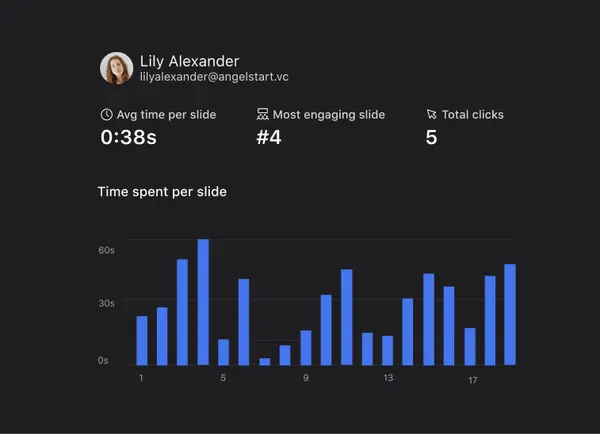
- Activity Tracking: Monitor exactly which files an investor is reviewing to gauge their actual deal intent.
- Data Protection: Prevent unauthorized downloading, printing, or forwarding of your intellectual property and cap table.
- Process Organization: Centralize all diligence requests in one professional environment to accelerate the closing timeline.
The Limitations of Basic Cloud Storage
Founders often start early fundraising conversations by sharing pitch decks via standard, consumer-grade cloud storage links. While acceptable for a preliminary introduction, institutional investors expect a true data room once formal due diligence begins.
Basic file-sharing tools (like Google Drive or Dropbox) lack the necessary security protocols. If you share a standard folder link, it can be easily forwarded, and the files can be downloaded or stored indefinitely by third parties. A VDR ensures your proprietary data remains under your strict control.
Operating a professional VDR also signals operational maturity. Rather than relying on a disconnected system, the most effective workflow keeps investors in a single ecosystem. Moving an investor from relationship-building updates to a native VDR within the same integrated platform maintains momentum and provides you with uninterrupted intent analytics.
Best Virtual Data Room Providers by Use Case
To avoid overpaying or getting stuck with a clunky interface, you must choose a provider category based on your immediate needs. Here is how the market breaks down by specific deal scenarios.
Integrated Fundraising Platforms (Seed to Series B)
For early-stage and growth founders, standard document security must be balanced with investor experience and operational efficiency. Integrated platforms solve the "context gap" by combining your CRM, investor updates, and native data room into a single tool.
- Key features: Holistic intent analytics, digital rights management (DRM), custom CTAs, and simple folder hierarchies.
- Pros: Eliminates the blind spots of siloed software. Because the data room shares the same analytics engine as your pipeline and updates, you can see the complete picture of investor conviction—knowing not just that they opened your financial model, but that they also read your last three performance updates.
- Cons: Not built for the massive, multi-party legal audits required during an IPO or complex acquisition.
- Pricing insight: Highly predictable platform subscriptions typically ranging from $59 to $200 per month.
- Best for: Founders who want a seamless transition from initial pitch to deep diligence without adding friction or paying for disconnected tools.
Heavy Enterprise Platforms (M&A and IPOs)
When a startup is acquired or goes through late-stage private equity diligence, the volume of documents skyrockets. Enterprise providers are designed specifically to handle multi-party audits.
- Key features: Granular document permissions, native redaction tools, and a centralized Q&A module to manage legal inquiries.
- Pros: Highly trusted by legal counsel and financial institutions, featuring infrastructure that does not slow down with high document volume.
- Cons: Absolute overkill for standard venture capital fundraising. The interfaces are built for legal teams, not startup founders.
- Pricing insight: Custom pricing based on deal size or an annual flat fee, generally scaling well past $500 per month.
- Best for: Late-stage startups undergoing acquisition, rigorous financial audits, or complex multi-party due diligence.
Lightweight Secure Sharing
Many founders default to expensive tools simply because they don't know cheaper alternatives exist. Lightweight sharing platforms provide a secure data room environment at a fraction of the cost of legacy providers.
- Key features: Dynamic watermarking, screen-shield (prevents screenshots), and automated document expiration.
- Pros: Very affordable flat-rate tiers and a setup process that takes minutes.
- Cons: Creates a siloed diligence environment disconnected from your CRM and top-of-funnel tracking.
- Pricing insight: Starts around $40/month for basic features and scales to roughly $150/month for team plans.
- Best for: Bootstrapped founders that need secure document control but are managing a very small, highly concentrated list of investors.
Virtual Data Room for Startups: What Actually Matters
When evaluating data room providers, it is easy to get distracted by advanced features built for multinational mergers. For venture-backed startups, most of those features are costly distractions. A startup’s goal is to remove friction for the investor while maintaining strict control over sensitive data.
Features Startups Actually Need (vs Enterprise Features)
To run an efficient fundraising process, focus strictly on platforms that excel at these core capabilities:
- Granular Permission Controls: You need the ability to set view-only access, disable downloading, and instantly revoke permissions at the user level—even after a document has been opened.
- Holistic Intent Analytics: Knowing how investors interact with your data is a major advantage. While standalone VDRs only track document opens, integrated platforms allow you to view a partner's diligence activity directly alongside their CRM pipeline status and engagement with your past updates.
- Investor-Friendly UX: VCs review hundreds of deals a year. Jonah Midanik, General Partner at Forum Ventures, put his own fund's inbound at 300 deals a month, in Visible's webinar on using SaaS metrics to build a fundraising narrative. If your data room requires them to download proprietary software or navigate a complex, multi-step login process, you are adding unnecessary friction to the deal.
- Easy Organization: The platform must support simple, intuitive folder hierarchies that mimic standard file systems so investors can find your cap table or legal docs in seconds.
Real-World Scenario: Imagine you are raising a Series A. You grant access to an associate at a venture firm, who then forwards the data room link to a general partner. With a proper startup-focused VDR, you will receive an alert that a new user is attempting to access the files. Once granted, your activity tracking will show exactly which folder the general partner spent the most time in—giving you a tactical advantage before your next partner meeting.
Common Mistakes Founders Make When Choosing a VDR
Founders often make critical errors when setting up their diligence environment that cost them time, money, or momentum.
- Overpaying for Enterprise Tools: Startups frequently pay thousands of dollars for features like automated redaction and complex legal Q&A workflows. Unless you are going through an acquisition, you do not need these.
- Treating the VDR as a Disconnected Silo: Running your pipeline in one tool, sending updates from another, and hosting diligence in a third creates blind spots. Keeping everything in one platform ensures no context is lost during the handoff to diligence.
- Choosing Based on Legacy Brand Names: Opting for a provider simply because traditional investment banks use them often results in a poor, clunky user experience for modern venture capitalists.
- Treating the VDR as a Dumping Ground: A data room is not an archive. It should be a highly curated presentation of your business. Throwing unorganized, outdated files into a VDR will stall diligence and signal operational disorganization.
Virtual Data Room Pricing: What You’ll Actually Pay
Pricing transparency is one of the biggest gaps in the VDR market. Because many legacy providers cater to massive corporate mergers, they often hide their pricing behind "contact sales" buttons. For a startup managing cash burn, unpredictable software costs are a serious liability.
How much does a virtual data room cost?
The cost of a virtual data room typically ranges from $20 to over $1,000 per month, depending on the platform's target audience and security capabilities. For standard venture capital fundraising, startups should expect to pay between $59 and $200 per month for an integrated platform.
Here is how pricing generally breaks down by category:
- Startup-Friendly Integrated Platforms: $59 – $200 per month. Ideal for early-stage and growth fundraising, providing native VDR security, holistic tracking, and unlimited guest access tied directly to your CRM.
- Mid-Market Diligence Tools: $200 – $1,000+ per month. Built for late-stage startups requiring multiple active data rooms and advanced administrative controls.
- Enterprise Solutions: Custom pricing (often scaling well past $1,000 per month). Designed for complex M&A, IPOs, and massive document volumes.
Common Pricing Models Explained
The actual dollar amount is only half the equation. You must also understand the pricing model the provider uses to calculate that cost.
- Per-Page Pricing: This is a legacy model from the early days of digital M&A. Providers charge a cent-per-page or a flat fee for a strict gigabyte limit, with heavy overages. Startups should avoid this model entirely.
- Per-User Pricing: The provider charges a base rate for the software, plus an additional monthly fee for every user granted access. This model is common but requires careful management of who has access to the room.
- Flat Platform Subscription: The most predictable and startup-friendly model. You pay a set monthly fee for your entire fundraising ecosystem (CRM, updates, and VDR capabilities), usually with generous data limits and a set number of administrator seats, while allowing unlimited external guest viewers.
What Should Be in a Startup Data Room
Curating your data room is an exercise in empathy. Investors are evaluating multiple deals simultaneously; if your data room is a chaotic dump of unorganized files, it signals poor operational management and slows down the capital deployment process.
A high-converting VDR provides exactly what investors need to validate your business—nothing more, nothing less.
What should be in a startup data room?
A startup data room must contain the essential documents required for legal, financial, and operational due diligence. A complete data room should include:
- Finalized Pitch Deck: The exact version used to secure the diligence phase.
- Historical & Pro Forma Financials: P&L statements, balance sheets, and a realistic 24-36 month operational model.
- Clean Capitalization Table: Current equity distribution, option pools, and convertible notes.
- Corporate Legal Documents: Articles of incorporation, bylaws, board meeting minutes, and any material contracts.
- Core Metrics & KPIs: Detailed breakdowns of your unit economics, such as CAC, LTV, churn, and gross margin.
Operator Insight: You should already be tracking your core KPIs and sharing high-level traction through your regular investor updates. The data room is simply where you provide the raw data and financial models that validate the top-line numbers your investors have been following.
How to Structure Your Data Room for Investors
Having the right documents is only half the battle. They must be structured so an associate or partner can navigate them intuitively.
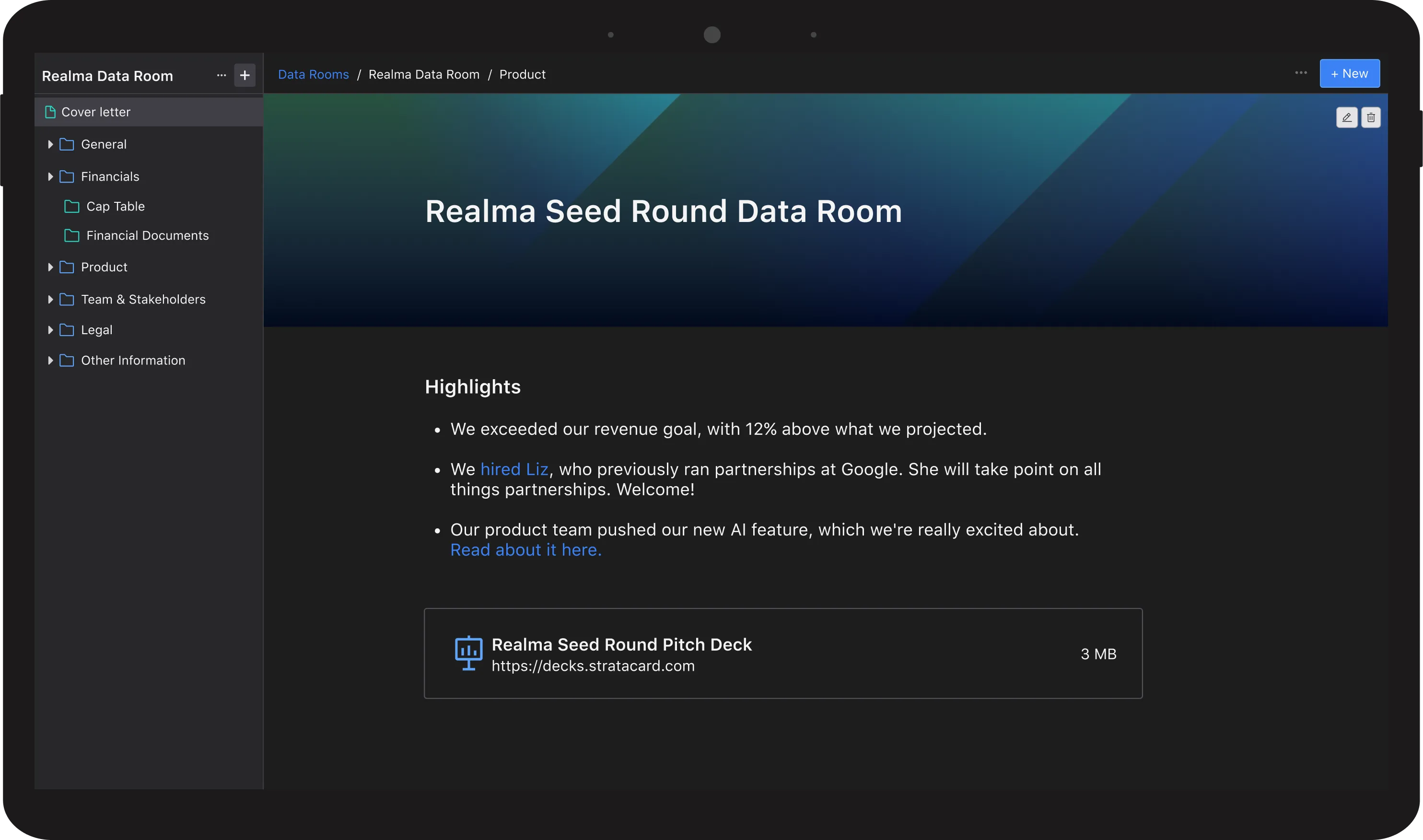
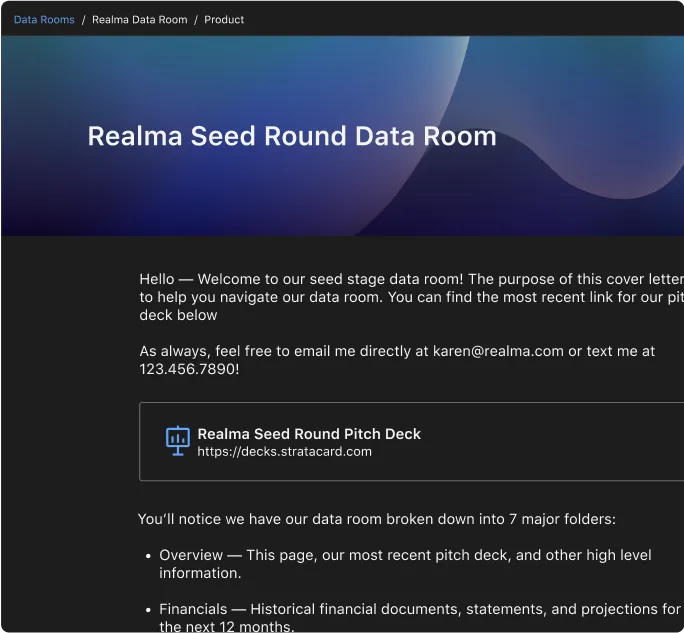
Do not force investors to guess what a file contains. Implement a strict folder hierarchy and use clear, standardized naming conventions (e.g., YYYY-MM-DD_DocumentName_v1). The easiest way to enforce ease of navigation is to use a numbered folder system, which forces the VDR software to display the folders in the exact order you want them reviewed.
Operator Insight: Always use underscores or hyphens instead of spaces in your file and folder names. Spaces can create broken links when shared or trigger extraction errors when legal teams bulk-download your data room for offline review.
Example Startup Data Room Structure:
- 01_Pitch_and_Executive_Summary
- 02_Financials
- 03_Cap_Table_and_Equity
- 04_Legal_and_Corporate
- 05_Product_and_Technology
- 06_Team_and_HR
- 07_Go_To_Market_and_Metrics
How a Virtual Data Room Is Used in Fundraising (Step-by-Step)
A data room is not just a storage locker; it is an active workflow tool. If you wait until an investor asks for diligence to start building your VDR, you are already behind. Here is the exact step-by-step workflow top-tier founders use to manage the due diligence phase without losing deal momentum.
Step 1: Preparing Documents Offline
Never upload draft documents or working files into a VDR. Before you even log into your chosen software, audit your files offline.
- Finalize the numbers: Ensure your historical financials match your tax returns and that your pro forma model is locked.
- Clean the Cap Table: Remove any internal notes or speculative scenarios.
- Convert to PDF: Whenever possible, convert text documents and presentations to PDF format to ensure they render correctly across all devices and prevent accidental edits. Keep spreadsheets in Excel format only if the investor explicitly needs to audit the formulas.
Step 2: Uploading & Configuring Security
Once your files are finalized, upload them into the VDR using the numbered folder structure. At this stage, you must configure your baseline security settings before inviting a single guest. Set up your global rules: apply dynamic watermarks, disable downloading by default, and ensure screen-shielding is active for high-priority intellectual property folders.
Step 3: Executing the Handoff
You do not share a VDR link blindly. You have likely spent months cultivating an investor relationship—sending structured performance updates, tracking their open rates, and managing your pipeline through an integrated platform.
When an investor moves from "interested" to "active diligence," you execute a professional handoff within that same ecosystem. Instead of sending an open link from a disconnected tool, you generate a highly restricted, user-specific invitation.
Example Action: You invite the lead partner with download permissions for the financial model, but you restrict the junior analysts to "view-only" access for the same folder.
Step 4: Monitoring Intent Analytics
Once the data room is live, your job shifts from curation to monitoring. The analytics dashboard of your VDR provides raw intelligence on the investor's actual deal intent.
Instead of waiting passively for the investor to return with questions, monitor their real-time actions alongside their historical engagement data to anticipate their concerns.
Real Founder Workflow: You notice that an associate at a venture firm just spent 45 minutes reviewing your employee contracts and option pool, but zero time looking at your product roadmap. Because your VDR is tied to your relationship CRM, you also see they opened your last update specifically highlighting key hires. You instantly know their technical diligence is complete, and they are now auditing your team's equity structure. You can proactively prepare your legal counsel for questions regarding employee vesting schedules before the investor even sends an email.
How to Choose the Right Virtual Data Room Provider
Selecting a data room is not a lifetime commitment; it is a tactical decision for a specific transaction. The software that works for a Pre-Seed raise will likely break under the weight of Series B due diligence, and the tool built for a corporate merger will suffocate an early-stage founder in unnecessary complexity.
A Simple Decision Framework for Founders
To avoid decision paralysis, run your current fundraising process through this simple four-point framework:
- Stage: Are you raising early-stage venture capital (Pre-Seed/Seed), growth capital (Series A/B), or preparing for an exit?
- Budget: Can you absorb a hefty enterprise flat fee, or do you need a lean solution to conserve runway?
- Deal Complexity: Are you sharing a standard set of 20-30 documents, or are you managing hundreds of files, IP patents, and complex financial audits involving multiple legal teams?
- Security Needs: Does standard digital rights management (DRM) and watermarking suffice, or do you need military-grade compliance (SOC 2, ISO) and native redaction tools?
Which VDR Is Best for Your Situation?
The best virtual data room depends entirely on your stage and deal complexity.
- If you’re raising your first round (Pre-Seed / Seed): Opt for a lightweight secure sharing platform. Your focus should be on speed and basic watermarking. You don't need complex folder permissions yet.
- If you’re raising growth capital (Series A / B): Choose an Integrated Fundraising Platform. Institutional investors expect a clean interface, and you need robust activity tracking to gauge intent. This is the stage where you execute the heavy diligence in the exact same ecosystem where you manage your pipeline and investor relationships, avoiding the blind spots of disconnected software.
- If you’re running an M&A process or IPO: You have no choice but to use a heavy enterprise data room. You need dedicated Q&A modules, unlimited user scaling, and the highest levels of legal compliance.
What Features Matter Most in Due Diligence
When venture capitalists and their analysts actually get into your data room, they only care about speed and accuracy. From the founder's side, you need control and visibility. Ensure your chosen provider excels at these three features:
- Audit Logs and Intent Analytics: You need an uneditable, time-stamped record of every action taken in the data room. More importantly, this data is most powerful when it syncs seamlessly with your CRM, so you know exactly who viewed the cap table and how that correlates with their engagement on your recent performance updates.
- Granular Permissions: You cannot rely on a binary "access or no access" system. You must be able to assign view-only rights to an associate, while allowing a lead partner to download specific, watermarked financial models.
- Q&A Workflows (For Late-Stage): In early rounds, questions are handled via email or Zoom. But in Series B+ or M&A, diligence questions become highly technical. A native Q&A workflow allows investors to highlight a specific document and ask a secure question directly within the VDR, keeping the legal audit trail centralized.
Frequently Asked Questions
What are the best virtual data room providers?
The best virtual data room providers fall into four main categories: lightweight secure sharing tools, startup-native platforms, mid-market solutions, and enterprise M&A data rooms.
- Lightweight tools: Best for low-cost, secure document sharing.
- Startup-native platforms: Best for standard venture capital due diligence.
- Mid-market solutions: Best for rapid, multi-party financial audits.
- Enterprise platforms: Best for complex M&A and highly regulated industries.
What is the best virtual data room?
The best virtual data room is the one that perfectly matches your specific fundraising stage and deal complexity without charging for unused features.
- Early-stage founders should prioritize intuitive UX and basic digital rights management.
- Late-stage founders must prioritize strict access controls and centralized Q&A workflows.
What is the purpose of a virtual data room?
The purpose of a virtual data room is to provide a highly secure, trackable environment for sharing confidential financial and legal documents with investors during due diligence.
- It protects intellectual property from unauthorized downloads.
- It provides actionable analytics on investor engagement.
- It centralizes the legal audit process to accelerate deal closing.
Which VDR is best for startups?
The best VDR for startups is a startup-native platform that balances strong digital rights management with an intuitive, frictionless experience for investors.
- It should not require investors to download proprietary software.
- It must offer document-level activity tracking.
- It should feature transparent, predictable pricing models.
What’s the top data platform for startups?
The top data platform depends on whether you are managing investor relationships or executing legal diligence.
- Relationship Management: Platforms like Visible.vc are used to track engagement, manage your pipeline, and send performance updates.
- Legal Diligence: A VDR is used strictly for hosting finalized legal and financial documents once an investor commits to the audit phase.
How secure are virtual data rooms?
Virtual data rooms are significantly more secure than standard cloud storage, offering advanced digital rights management and granular access controls.
- They feature dynamic watermarking to deter leaks.
- They allow founders to revoke access instantly, even after a file is opened.
- They provide uneditable audit logs of all user activity.
What is the cheapest virtual data room?
The cheapest virtual data rooms are lightweight secure sharing tools that charge a flat monthly fee, typically starting around $40 per month.
- They provide essential features like screen-shielding and document expiration.
- They avoid the expensive per-user or per-page pricing models of legacy providers.
- They are ideal for bootstrapped founders conserving cash runway.