
Key Takeaways
-
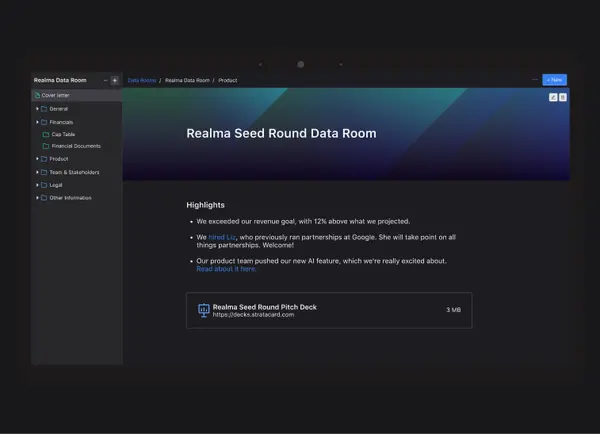
Six core folders: An investor data room contains six categories: company overview, financial records, legal and corporate documents, team materials, product and technology assets, and market and commercial data. The best ones are framed by a short cover note explaining what is inside and why.
-
Stage shapes everything: Pre-seed founders need basic financials and a clean cap table. Seed founders add early customer traction and KPI history. Series A founders need reviewed or audited financials, cohort analysis, and a complete legal record. Building for the wrong stage either looks unprepared or buries the investor in noise.
-
Tiered access matters: A data room is not one room; it is two. Pre-term-sheet materials build the case; post-term-sheet materials let diligence verify it. Mixing both behind a single link slows the conversation and creates legal exposure that didn't need to exist.
-
Seven-step setup: Gather your documents, lock the folder structure, name files consistently, set tiered permissions, write a one-page cover note, pressure-test it with one trusted investor, then update on a quarterly cadence.
-
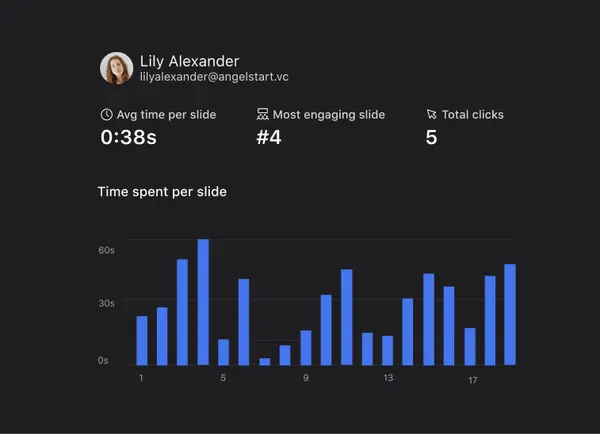
Engagement is the underused signal: The most overlooked feature of a modern data room is investor engagement tracking. Knowing which folders an investor opens, how long they spend, and which documents they share internally lets you tailor follow-up to where their attention has actually been; this is one of the rare leading indicators of a term sheet.
When you're raising capital, a well-organized data room is one of your strongest strategic tools. Investors aren't just evaluating what you include; they're evaluating how you organize and present it. A room that reflects clarity, completeness, and a thoughtful connection to your story accelerates investor confidence and builds the trust that carries a raise across the finish line.
What to Include in Your Investor Data Room?
An investor data room should include six core categories of documents (company overview, financial records, legal and corporate records, team information, product and technology assets, and market and commercial materials), organized in clearly named folders, tiered by sensitivity, and introduced with a one-page cover note. Exclude anything that creates legal exposure or invites questions you cannot quickly answer.
| Category | Status | Why investors look at it |
|---|---|---|
| Company Overview | ✅ | First impression and the lens for everything else in the room |
| Financial Documentation | ✅ | The single most-opened folder during diligence; numbers either match your pitch or they do not |
| Cap Table | ✅ | Clean ownership is a prerequisite for any term sheet conversation |
| Legal and Corporate Records | ⚠️ | Depth scales with stage; pre-seed needs basics, Series A needs the full set |
| Team Information | ✅ | VCs invest in teams before products; bios and org chart are non-negotiable |
| Product and Market Materials | ✅ | Roadmap and demos signal trajectory; market data signals ambition |
| Sensitive IP, customer PII, or draft documents | ❌ | Creates legal risk and slows diligence without adding signal |
Why Disorganized Data Rooms Cost You Deals
When a prospective lead lands in your data room and has to hunt for the cap table, or opens a file called financials_final_v3.xlsx and isn't sure which version is current, deal momentum slows. The data room is not a digital filing cabinet; it is the closest most founders come to letting an investor watch them run the business. The room is read as a proxy for operating discipline. Clean signals competence; chaos signals the opposite, regardless of how good the deck is.
A data room that is logically structured, consistently named, and connected to your narrative accelerates investor confidence. The fastest fundraises Visible sees are those where the data room arrives in the conversation already built, organized, and up to date.
What Should Be in an Investor Data Room? The Master Checklist
This is the master checklist. Every document below maps to a question an investor will ask during diligence, and every requirement is indexed to your fundraising stage.
How to read the symbols:
✅ Include this document at the given stage.
⚠️ Include the version appropriate to your situation, or a lighter version.
❌ Leave it out for now; adding it before your stage warrants creates more questions than it answers.
| Category | Document | Pre-Seed | Seed | Series A | Growth | Where it goes |
|---|---|---|---|---|---|---|
| Welcome | Cover note / welcome letter | ✅ | ✅ | ✅ | ✅ | /Welcome/ |
| Welcome | Document index or map | ⚠️ | ✅ | ✅ | ✅ | /Welcome/ |
| Company Overview | Pitch deck | ✅ | ✅ | ✅ | ✅ | /01 Company Overview/ |
| Company Overview | Executive summary / one-pager | ✅ | ✅ | ✅ | ✅ | /01 Company Overview/ |
| Company Overview | Founder note or recorded intro | ⚠️ | ⚠️ | ⚠️ | ⚠️ | /01 Company Overview/ |
| Company Overview | Investor update archive | ❌ | ⚠️ | ✅ | ✅ | /01 Company Overview/Investor Updates/ |
| Financials | Historical P&L, balance sheet, cash flow | ⚠️ | ✅ | ✅ | ✅ | /02 Financials/Historicals/ |
| Financials | Audited or reviewed financials | ❌ | ❌ | ⚠️ | ✅ | /02 Financials/Historicals/Audited/ |
| Financials | 3 to 5 year financial model | ✅ | ✅ | ✅ | ✅ | /02 Financials/Projections/ |
| Financials | Cap table | ✅ | ✅ | ✅ | ✅ | /02 Financials/Cap Table/ |
| Financials | 409A valuation | ❌ | ⚠️ | ✅ | ✅ | /02 Financials/Cap Table/ |
| Financials | KPI dashboard | ⚠️ | ✅ | ✅ | ✅ | /02 Financials/Metrics/ |
| Financials | Unit economics breakdown | ❌ | ⚠️ | ✅ | ✅ | /02 Financials/Metrics/ |
| Financials | Cohort analysis | ❌ | ⚠️ | ✅ | ✅ | /02 Financials/Metrics/ |
| Financials | Bank statements (3 to 12 months) | ❌ | ⚠️ | ✅ | ✅ | /02 Financials/Bank/ |
| Legal | Incorporation documents | ✅ | ✅ | ✅ | ✅ | /03 Legal/Corporate/ |
| Legal | Bylaws and operating agreements | ✅ | ✅ | ✅ | ✅ | /03 Legal/Corporate/ |
| Legal | Board minutes and resolutions | ⚠️ | ✅ | ✅ | ✅ | /03 Legal/Corporate/ |
| Legal | Prior financing (SAFEs, notes, term sheets) | ✅ | ✅ | ✅ | ✅ | /03 Legal/Financing/ |
| Legal | Major customer, vendor, partner contracts | ❌ | ⚠️ | ✅ | ✅ | /03 Legal/Contracts/ |
| Legal | IP assignments and patents | ⚠️ | ✅ | ✅ | ✅ | /03 Legal/IP/ |
| Legal | Trademark registrations | ⚠️ | ⚠️ | ✅ | ✅ | /03 Legal/IP/ |
| Team | Founder bios | ✅ | ✅ | ✅ | ✅ | /04 Team/ |
| Team | Key team member bios | ⚠️ | ✅ | ✅ | ✅ | /04 Team/ |
| Team | Current org chart | ❌ | ⚠️ | ✅ | ✅ | /04 Team/ |
| Team | Hiring plan and future org | ⚠️ | ✅ | ✅ | ✅ | /04 Team/ |
| Team | Employment / advisory agreements | ❌ | ⚠️ | ✅ | ✅ | /04 Team/Agreements/ |
| Team | Equity grant records and option pool | ❌ | ⚠️ | ✅ | ✅ | /04 Team/Equity/ |
| Product | Product roadmap | ✅ | ✅ | ✅ | ✅ | /05 Product/ |
| Product | Product demo / walkthrough video | ✅ | ✅ | ✅ | ✅ | /05 Product/ |
| Product | Technical architecture | ⚠️ | ✅ | ✅ | ✅ | /05 Product/Technical/ |
| Product | Customer use case studies | ❌ | ⚠️ | ✅ | ✅ | /05 Product/Customer Stories/ |
| Product | Product analytics | ❌ | ⚠️ | ⚠️ | ✅ | /05 Product/Analytics/ |
| Market | Market sizing (TAM/SAM/SOM) | ✅ | ✅ | ✅ | ✅ | /06 Market/ |
| Market | Competitive landscape | ✅ | ✅ | ✅ | ✅ | /06 Market/ |
| Market | Go-to-market strategy | ⚠️ | ✅ | ✅ | ✅ | /06 Market/ |
| Market | Sales pipeline snapshot | ❌ | ⚠️ | ✅ | ✅ | /06 Market/Sales/ |
| Market | Customer logos and testimonials | ❌ | ⚠️ | ✅ | ✅ | /06 Market/Customer Proof/ |
| Market | Customer reference letters / LOIs | ❌ | ⚠️ | ✅ | ✅ | /06 Market/Customer Proof/ |
| Market | Detailed case studies | ❌ | ⚠️ | ✅ | ✅ | /06 Market/Customer Proof/ |
What Each Data Room Folder Should Contain
The master checklist above outlines what to include and at which stage. This section explains what each folder is actually for and what investors expect to find when they open it. The six folders below each map to a top-level folder in your data room, and the cover note that sits in /Welcome/ frames all of them.
Company Overview Materials
The Company Overview folder is where investors form their working hypothesis about the business. Every document in the rest of the room is read against the narrative this folder establishes, which is why the deck and the executive summary need to agree before you upload anything else. Internal contradictions between the two are the most common credibility hit at the opening of diligence.
The non-negotiables at every stage are the current pitch deck and a one-page executive summary. The deck carries the full narrative; the one-pager is what gets forwarded internally to partners who haven't opened the deck yet. A short founder note or recorded intro video is optional and works well at the earliest stages, but it should sit alongside the cover note in /Welcome/ rather than replace it. When investors enter your data room, they should feel guided through your business's evolution and future potential, just as much as they're reviewing materials.
If you've raised before and started sending investor updates, archive them inside Company Overview as a separate subfolder. Updates show momentum over time in a way no static deck can, and by Series A investors expect to see them.
Financial Documentation
The Financials folder is the single most-opened section of any investor data room. Investors come here first because the numbers either match what you said in the deck or they do not, and any gap between the two becomes the dominant story of the diligence call.
What you include scales with stage. Pre-seed founders should expect to share a working financial model and a clean cap table. Seed founders add 6 to 18 months of historical financials and an early KPI dashboard. Series A founders need reviewed or audited financials, cohort analysis, unit economics, and a current 409A. The shape of the folder matters too: separate historicals from projections, and keep the cap table in its own subfolder so investors can find it without re-opening Excel files.
Investors want to understand the "why" behind the numbers, not just the numbers themselves. A short summary explaining key drivers of growth or shifts in spend gives your financials more meaning and preempts questions an investor would already ask.
For a deeper guide to which metrics matter and how to communicate them (ARR, LTV, CAC, retention), see our guide to SaaS financial metrics →.
The most overlooked sub-document at every stage is the metrics dashboard or KPI summary. Investors read it against your monthly investor updates if they have been receiving them, and against your projections if they have not. A mismatch between dashboard numbers and deck numbers is one of the fastest ways to lose credibility inside a folder you control completely.
Across thousands of investor updates sent through the Visible platform, the ten most-tracked metrics are Revenue, Cash Balance, Runway, Headcount, Gross Profit, Gross Margin, EBITDA, ARR/MRR, Net Income, and New Customers.
When the same numbers appear in both your data room dashboard and your monthly update, the two reinforce each other instead of competing for an investor's attention.
Legal and Corporate Documents
The Legal and Corporate folder is the one where stage matters most. Pre-seed investors want to see incorporation documents, bylaws, and any prior financing instruments (SAFEs, notes, or convertibles). Series A diligence teams want the same plus board minutes, IP assignments from every contributor, major customer and vendor contracts, and trademark registrations.
The most consequential gap in this folder at any stage is the IP assignment from former contractors or employees. Founders rarely skip these on purpose; the documents simply weren't created at the time the contributor was working on the codebase. Catching this six weeks into Series A diligence is the kind of finding that ends a deal, and the only fix is going back and getting signatures from people who may no longer have a reason to respond quickly.
A simple document index that outlines what each file is and why it matters helps investors move through this folder quickly and builds confidence that you're organized and prepared. The signal investors look for in this folder is not depth, it is governance discipline. A small, consistently maintained legal record is read as more credible than a large folder of incomplete or outdated files.
Team Information
VCs invest in teams before they invest in products. The Team folder is the one that goes in front of the partnership, and its job is to answer one question: can this team execute the plan in the deck?
At pre-seed, founder bios with relevant experience are sufficient. Seed and Series A founders also need bios for the key team members, an org chart, and a hiring plan tied directly to the use of funds. By Series A, employment and advisory agreements with IP assignment and key-person retention terms become standard diligence asks.
The most strategic sub-document in this folder is the future-state org chart and hiring plan. Headcount is the largest line item the new capital will fund, and the team folder is the place where you show investors exactly what they are paying for. A short section on team culture and hiring philosophy gives investors a clearer view of how you're building toward long-term execution, not just filling seats.
Product and Technology Assets
Show what you've built and how it's evolving. The roadmap is the strategic anchor; the demo is the highest-engagement asset; the technical architecture overview is what makes the demo defensible. When possible, tie product narrative to real customer outcomes. Highlighting what your product has enabled, not just what it does, helps investors understand the value you're delivering in-market.
The roadmap also serves a structural purpose: a roadmap that aligns with the financial projections signals execution discipline (the revenue assumptions in the model and the things the product is actually building toward are the same). A roadmap that floats independent of the financial model signals the opposite, and it is one of the easier red flags for an experienced investor to spot.
For technical companies (infrastructure, AI, deep tech, enterprise), a technical architecture overview is non-negotiable from seed onwards. Investors are testing whether your scaling assumptions are real, not just whether the product works today.
Market and Commercial Information
The Market folder establishes the ceiling on the return investors can expect from the fund's perspective. Market sizing (TAM, SAM, SOM) sets the upper bound; competitive positioning explains how much of that ceiling is realistically yours.
At seed, you can rely on a market thesis, competitive landscape, and a first-pass go-to-market strategy. At Series A, narrative gets replaced with proof: a sales pipeline with stage and probability, customer reference letters, detailed case studies, and customer logos annotated with context on the relationship (paying customer, pilot, or referenceable lead). Logos without context are read as filler.
Customer proof is the highest-leverage content in this folder. One detailed case study with a named customer and a quantified outcome is worth more than ten logos on a slide. If you have customer reference letters, partnership agreements, or LOIs, add them here to validate early momentum. The more you can show proof over promise, the more trust you'll build.
The Cover Note That Frames Everything Else
The cover note is the only document investors read before forming a working opinion of how organized you are. It sits in /Welcome/, it's one page, and it has three short paragraphs: what you're raising and on what terms, what's inside the data room and where to start, and how to reach you with questions.
Write it last, after the rest of the room is built. A cover note written first describes what you intend to include; a cover note written last describes what's actually there, which is the only version that holds up under diligence. Most founders write the cover note first and forget to update it, and the gap between what the cover note promises and what the room contains is the first thing a careful investor will notice.
The cover note is also one of the few places in the data room where the founder's voice shows up directly. Keep it specific, keep it short, and avoid re-pitching the deck. The deck does the pitching; the cover note does the framing.
For the full template and writing approach, see the data room cover letter guide →.
How Does a Data Room Differ at Each Fundraising Stage?
Stage shapes what investors expect to see in your data room more than any other factor. A pre-seed founder showing Series A polish looks over-prepared; a Series A founder showing seed-stage substance looks under-prepared.
| Stage | What investors expect | What you can leave out | Common mistakes |
|---|---|---|---|
| Pre-Seed | Welcome note, deck, founder bios, basic incorporation docs, clean cap table, light projections, market thesis, product demo if it exists | Audited financials, cohort analysis, sales pipeline, customer reference letters, full hiring plan, 409A | Placeholder folders for documents you don't have. Projections without assumptions. Overbuilding before you have outreach. |
| Seed | Pre-seed materials plus 6 to 18 months of historical financials, KPI dashboard, customer logos or traction proof, first-pass GTM, key hire bios, past investor updates | Audited financials, full cohort analysis if too early, customer reference letters, detailed pipeline if pre-revenue | Mixing personal and company expenses. Customer logos without relationship context. Cap table not refreshed after recent SAFEs. |
| Series A | Reviewed or audited financials, full cohort analysis, unit economics, sales pipeline with stage and probability, customer reference letters or case studies, current 409A, comprehensive legal record, IP assignments from every contributor | Outdated seed-stage deck versions, projections that no longer reflect the business | Aggregate retention masking cohort weakness. Missing IP assignments from former contractors. Cap table without recent option grants. |
| Growth (Series B+) | Audited financials with segment-level reporting, multi-year cohorts, net retention and expansion analysis, all material contracts, board records, executive employment agreements, M&A history | Anything from earliest stages that no longer reflects the business | Aggregate masking at segment level. Missing executive retention agreements. Customer concentration not addressed proactively. |
Pre-Seed Data Rooms: Credibility Over Verification
At pre-seed, the data room is more about credibility than verification. You probably do not have audited financials, formal cohort data, or a polished pipeline, and investors do not expect them. They are evaluating whether you can communicate clearly, organize information cleanly, and connect your story to the documents you have.
The biggest mistake at pre-seed is overbuilding. A room with placeholder folders for documents you don't yet have signals more inexperience than a leaner room organized around what is real. Start with the welcome note, the deck, the cap table, basic legal documents, founder bios, and a market thesis. That is enough to keep the conversation moving.
Seed Data Rooms: When the Room Becomes a Real Diligence Tool
At seed, the data room becomes a real diligence environment. Investors expect 6 to 18 months of historical financials, an early KPI dashboard, customer logos or use-case proof, and a first-pass go-to-market strategy. This is also the stage where investors start checking whether the numbers in your deck match the numbers in your room.
If you have been sending investor updates, archive them inside the data room. A seed-stage company with a clean update archive demonstrates communication discipline that no static document can match. Most founders at this stage forget to include them, which is one of the highest-leverage additions you can make in 15 minutes.
Series A Data Rooms: The Verification Bar
At Series A, the data room becomes a verification environment. Every claim in the deck needs to be backed by a document somewhere in the room. Diligence teams will work the room methodically, comparing your cohort retention to your stated net retention, your pipeline coverage to your projected bookings, and your reported headcount to your actual employment agreements. Gaps between any of these surface fast.
As noted in the Legal section, missing IP assignments from former employees or contractors are the most common deal-disrupting finding at this stage and the only fix requires going back to people who may no longer have a reason to respond quickly.
Growth-Stage Data Rooms: The Segment Story
At growth, the data room is no longer about proving the company exists. It is about proving the segments are healthy. Investors expect segment-level financial reporting, multi-year cohort retention with net retention metrics, expansion revenue analysis, all material contracts, board records, executive employment agreements with retention triggers, and any M&A history.
The mistake that scales worst at growth is aggregate masking. A 110% net retention metric at the company level can hide 70% retention in one segment and 140% in another. Investors at Series B and beyond will find this; presenting it transparently is better than waiting for them to surface it.
Not sure which stage you are targeting? Check out: Visible's guide to fundraising stages and what investors expect at each
Should You Tier Your Data Room by Diligence Stage?
Yes. The most underrated structural decision in a data room is treating it as two rooms, not one.
Tier 1 (Pre-Term-Sheet)
The materials that build the case. Everything an investor needs to decide whether to write a term sheet. Deck, executive summary, founder bios, financial model, KPI dashboard, market sizing, competitive landscape, product demo, customer logos with context.
Tier 2 (Post-Term-Sheet)
The materials diligence teams use to verify the case. Audited financials, full cap table with option grants, complete legal record, executed customer contracts, IP assignments, employment agreements, and sensitive technical architecture.
Tiering protects you on three fronts. It keeps the early-conversation experience focused on the narrative rather than buried under legal documents. It limits how much sensitive material is sitting behind a link that gets forwarded inside investment partnerships. And it gives you a clean reason to expand access as the conversation matures: "Now that we're aligned on the basics, here's the rest of the diligence package."
The cleanest way to handle this is with tiered access permissions in the data room itself. Broader diligence reviewers see Tier 1; the most restricted folders (executed customer contracts, executive compensation, pending strategic activity) open only to the lead investor as the conversation matures.
For the practical mechanics of how to set tiered permissions in Visible, see the data room product page →
How Do You Set Up an Investor Data Room?
Setting up an investor-ready data room is a sequenced task, not a one-time push. The seven steps below take a typical founder somewhere between three and six hours to complete from scratch, and the order matters more than the speed.
1. Gather your documents before you build the structure
Pull everything into a single working folder before you organize anything. Trying to categorize as you collect mixes two different mental modes and slows both down. Create an "Inbox" folder on your desktop and drop everything in: spreadsheets, contracts, deck versions, employment agreements, board minutes, customer contracts. Sort later.
2. Build the folder structure before you move a single file
Spend 30 minutes designing the structure first. This investment saves hours of renaming later. Use the seven-folder structure from the master checklist and prefix top-level folders with numbers so they sort consistently across operating systems: "01 Company Overview", "02 Financials", and so on.
3. Name files for the person who will read them, not the person who wrote them
An investor should be able to identify a document from its filename without opening it. Avoid "final," "v2," "updated," and "draft" in filenames; these signal poor version control. Use a date-first convention in YYYY-MM format.
| Bad filename | Good filename | Why it matters |
|---|---|---|
| financials_final_v3.xlsx | 2026-Q1_Financials.xlsx | Date-first sorts chronologically; date itself communicates current ownership |
| pitch_deck_FINAL_v2.pdf | 2026-04_Pitch_Deck.pdf | "FINAL" and "v2" never stay accurate; the date is self-validating |
| cap_table_updated.xlsx | 2026-Q1_Cap_Table.xlsx | "Updated" forces the reader to open the file to confirm which version they have |
| customer_contract.pdf | 2026-03_Acme_Corp_MSA.pdf | A generic filename hides which customer or contract type the document covers |
4. Set access tiers based on document sensitivity
Not every reviewer needs full access to every document. Material customer contracts, executive compensation details, and pending strategic activity should sit behind a more restricted permission than the rest of the room. Tier your access so broader diligence reviewers see what they need, and the most sensitive folders open only to the lead investor.
5. Write the cover note last, after the room is built
The cover note is a map of what is inside the room, not a re-pitch of the deck. Writing it last ensures it accurately describes what is actually there. Keep it to a single page in three short paragraphs: what you are raising and from whom, what is inside the room and where to start, and how investors should reach you with questions.
For the full template, see the data room cover letter guide →
6. Pressure-test the room with one trusted investor before going wider
Before the room becomes part of an active raise, share it with someone whose judgment you trust. They will surface gaps faster than a live diligence process will, and you will have time to fix them before it matters. Send them a single, structured ask: "What is missing or confusing?" An existing investor or an advisor who has reviewed data rooms in their portfolio is the right person.
7. Update the room on a quarterly cadence, not on demand
A data room that is updated only when an investor asks signals poor operating discipline. Block 90 minutes on the first business day of each quarter to refresh the historicals, update the cap table, archive the latest investor update, and verify that no document has gone stale.
Where Do Investors Click First?
Investors don't read a data room sequentially. They open the folders that answer the questions they care about most, and the order is predictable enough to design for. In the Financials folder, the cap table is almost always the second item to click. The pitch deck in Company Overview tends to come third, with the product demo and team bios rounding out a typical first session.
This matters for two reasons. The first is that high-traffic folders need disproportionate polish. A cap table with formula errors or a stale 409A will get caught before an investor has formed a working opinion of the company. The same investor might never open Market and Commercial on their first pass, which means a less polished section there is far less consequential to the room's overall credibility.
The second is that the entry points are predictable enough to design for. If you know the cap table is going to be the second thing an investor opens, put it in its own subfolder, name the file precisely, and confirm the version in the room is the same one your lawyer would sign off on. The shape of the room should reflect the shape of how it's actually read, not the order in which you happened to build it.
What Should You NOT Include in Your Data Room?
Most data room advice focuses on what to include. What you leave out matters at least as much.
Documents That Create Legal Risk
- Raw source code or proprietary algorithms: Investors are evaluating whether the team can build it, not the codebase itself. A technical architecture overview gives them what they need without putting the IP in a folder anyone with access can download.
- Customer personally identifiable information: Names, emails, payment details, or any data covered by GDPR, CCPA, or sector-specific privacy regulations. If you want to demonstrate customer traction, use logo lists, aggregate cohort data, or named case studies that the customer has approved.
- Individual employee compensation tied to names: Aggregate compensation, as a line item in the financials, is fine. Individual salaries, performance reviews, or HR records are not.
- Third-party contracts with confidentiality clauses: Many include provisions that restrict who can see the terms. Sharing the full contract may put you in technical breach of an agreement you signed.
A useful rule of thumb: if a document contains anything you would not want forwarded to a competitor by an associate also reviewing another deal this week, it should not be in the room.
Documents That Create More Questions Than They Answer
- Vanity metrics or partial cohort data: Aggregate retention numbers that mask underlying segment weakness raise more questions than they settle. Either show the cohort breakdown or don't show the metric at all.
- Customer logos without context: A wall of logos invites the question, "are these paying customers, pilots, or names on a slide?" Annotate each one with the relationship type or leave them out.
- Projections without the model behind them: A three-year forecast presented as a chart with no underlying spreadsheet reads as marketing material, not analysis. Include the model with assumptions visible.
- Press releases, awards, and conference acceptance letters: None of these informs a fundraising decision. Including them signals you are reaching for filler.
- Placeholder folders for documents you don't yet have: Empty folders with optimistic names ("Customer Reference Letters", "Audited Financials") at pre-seed and seed signal exactly what they look like.
The "Final Final v3" Problem
A stale document is worse than an absent one. Investors read what is in the room and assume it is current. If what is there contradicts what you said in the diligence call, the gap is on you.
The most common version of this problem is keeping the old document "just in case" alongside the new one. Two versions sit in the same folder, neither one clearly marked as current. The guess almost always lands on the version that creates the most questions. The fix is the quarterly refresh from Step 7 above.
A Note on Risk Disclosure
There is a difference between hiding risk and overstating polish. Brett Brohl, Managing Partner at Bread & Butter Ventures, has noted that "our highest-performing companies are also the best communicators. People are pretty good at sending updates when things are going really well. But as soon as things kind of go sideways or go flat, all of a sudden updates stop coming." The same principle applies inside the data room. A short risks section in the cover note (one paragraph naming the two or three risks you are actively managing and how) does more for credibility than a room engineered to look frictionless. Investors already know things aren't perfect; demonstrating that you know it too is the move.
How Do You Track Which Documents Investors Actually Open?
The data room is the most underused signal in a fundraise. Most founders build it, share it, and forget it, treating it as a static archive that lives next to the deck. The investors on the receiving end are not treating it that way. They are opening folders, downloading specific documents, forwarding files internally to their partners, and timing their follow-up against what they found.
Without engagement tracking, none of that is visible to you. With it, the data room becomes a sensor for what the investor is actually thinking, weeks before they tell you in a meeting.
Why engagement data matters during an active raise. In an active raise, the most consequential question on any given Tuesday is not "what should my next email say?" It is "who is actually still engaged?" Engagement data answers that. An investor who has opened the room three times this week is in a different conversation than one who has not logged in since the first call.
The signal also gets specific at the folder level. Which folder an investor spent time in tells you what they are evaluating. An investor who spent twenty minutes in Financials and skipped Product is doing a different kind of diligence than one who downloaded the demo twice and barely looked at the cap table. Knowing this changes what you lead with in the next conversation.
What to do with the signal.
- The quiet-but-engaged investor: If an investor hasn't responded in a week but you can see they reopened the financials twice in that window, the right move is a short, specific follow-up that references what they would have seen. Not a generic check-in.
- The single-folder reviewer: When a reviewer spends all their time in one section, that's the section to lead with in the next conversation. If they only looked at Team and skipped Financials, you may be in a conversation about whether the team can execute, not whether the numbers work.
- The internal share signal: When a document gets forwarded to a partner who has not been in the room before, the deal is being escalated. That is the moment to prepare for partnership questions, not the moment they show up on the calendar.
- The post-meeting spike: If engagement spikes in the 48 hours after a meeting, that meeting went well in a way the follow-up email might not have made clear. If engagement drops to zero, the opposite signal is telling you something the investor probably won't say directly.
The pattern that consistently surprises founders the first time they see it is how often "silent" investors are actually still engaged. Email response time and data room engagement are not the same metric. An investor can take ten days to respond to your email and still be inside your room twice a week.
See which documents investors are actually opening. Visible's data room is built around investor engagement signal: who opened what, when, for how long, and what they returned to. Try Visible Free →
When Should You Build and Share Your Data Room?
The right time to start building (before you need it). The standard mistake is waiting until an investor asks for materials. By then, you're building under pressure during the same window when you should be running the call schedule. The documents that should signal operational discipline end up signaling the opposite.
The right time to start is 6 to 8 weeks before you plan to open your round. Six weeks gives you time to surface the gaps that always exist before they show up under diligence pressure: the missing IP assignment from a former contractor, the stale 409A that needs refreshing, the cap table that hasn't been updated since the last SAFE closed. None of these are difficult to fix in advance. All of them are deal-disrupting under pressure.
For founders who have not raised before, build a working version as soon as the company exists. The first version doesn't need to be polished. It needs to give you a place to drop documents as they get created, so that 18 months later you are not reconstructing your incorporation paperwork from your inbox.
When to share with the first investor? There is a meaningful difference between the data room being ready and the data room being shared. Ready means structured, named, polished, and current. Shared means the access link has been sent. These should not happen at the same time.
The first share should be intentional. The pattern that works best is sharing with one trusted person one to two weeks before broader outreach. They will surface the gaps you've stopped seeing because you've been inside the room for the past six weeks. That feedback is significantly more useful than the feedback you'll get under active diligence pressure.
During an active raise, the convention shifts. Share the room after a productive first meeting and explicit interest, not before. A founder who shares the room ahead of the first call signals either inexperience or that they're sending the same package to every investor on the list. Neither is the signal you want at the top of a relationship.
The data room is the static layer. Your investor updates are the dynamic ones. A data room shows investors a snapshot. Monthly investor updates show them a trajectory. Across thousands of updates sent through the Visible platform, a monthly cadence is the standard.
The data room and the update cadence work together. Leo Polovets, Partner at Susa Ventures, put the pre-marketing case directly: "If I get good updates and I can see a company is doubling revenue every six months, every time I'm talking to my Series A friends, and they ask what company they should be looking at, I'm telling them about that founder."
The update travels between funds. The data room is what they open when the travel starts.
Build a Data Room That Does More Than Store Documents.
A well-organized, up-to-date data room makes the fundraising process smoother for both you and your investors. It reflects how you operate, how you communicate, and how you build trust with future partners.
Visible gives founders an investor data room with engagement tracking, plus an investor CRM and a monthly update tool, so the documents, the conversations, and the ongoing relationships all live in one place. Free to start. Sign up for Visible →
Frequently Asked Questions
What should be included in an investor data room?
An investor data room should include six core categories of documents: company overview materials (pitch deck, executive summary), financial documentation (historicals, projections, cap table), legal and corporate records, team information, product and technology assets, and market and commercial information. The room should be introduced with a one-page cover note that frames what is inside and where to start. Exact depth scales with fundraising stage, with pre-seed rooms lighter on financials and legal records, and Series A rooms requiring reviewed or audited financials, cohort analysis, and a full legal record.
What do investors look at first in a data room?
Investors typically open the Financials folder first, with the cap table inside that folder as the second click. The pitch deck in Company Overview is usually third, followed by the product demo and team bios. This means the Financials folder needs disproportionate polish: a stale 409A or a cap table that doesn't reflect recent SAFEs will be caught before an investor has formed a working opinion of the company.
What is a data room index?
A data room index is a one-page document, typically sitting in the /Welcome/ folder, that lists every folder and document in the data room along with a short note on what each contains. The index serves two purposes: it tells investors where to find what they came for, and it protects you from being judged on the first folder a reviewer clicks into by accident. Most founders skip this; the ones who include it look significantly more organized than the ones who don't.
What is the difference between a seed and Series A data room?
A seed data room includes pre-seed materials plus 6 to 18 months of historical financials, an early KPI dashboard, customer logos or early traction proof, and a first-pass go-to-market strategy. A Series A data room raises the bar significantly: reviewed or audited financials, full cohort analysis, unit economics, a sales pipeline with stage and probability, customer reference letters or detailed case studies, a current 409A, a comprehensive legal record, and IP assignments from every contributor. Founders who show seed-stage substance at Series A look under-prepared; founders who show Series A polish at seed look over-prepared.
Do I need a data room before I start fundraising?
Yes. The right time to start building is 6 to 8 weeks before you plan to open your round, which gives you time to surface gaps like missing IP assignments, stale 409As, or outdated cap tables before they show up under diligence pressure. Founders who have not raised before should build a working version as soon as the company exists, treating it as a continuously maintained asset rather than a fundraise-trigger project.
Should I include my cap table in the data room?
Yes, at every fundraising stage. The cap table sits inside the Financials folder, usually in its own subfolder, and is one of the first documents investors open. A messy or out-of-date cap table can end a deal before diligence opens, which is why refreshing it after every SAFE, note, or option grant is a standard part of the quarterly data room update.
How do I share my data room securely without an NDA?
Use tiered access permissions instead of an NDA. Broader diligence reviewers see the standard folders; the most sensitive folders (material customer contracts, executive compensation, pending strategic activity) open only to the lead investor as the conversation matures. For documents that would create legal exposure regardless of access controls, such as raw source code or customer personally identifiable information, the right answer is to leave them out of the data room entirely and reference them in summary form instead.
When should I give investors access to my data room?
Share the data room after a productive first meeting and explicit interest, not before. Sharing ahead of the first call signals either inexperience or that you are sending the same package to every investor on the list. A useful exception is the pressure-test share: send the room to one trusted investor or advisor one to two weeks before broader outreach so they can flag gaps you've stopped seeing.
What should I NOT include in my investor data room?
Exclude documents that create legal risk (raw source code, customer PII, individual employee compensation, third-party contracts with confidentiality clauses), documents that create more questions than they answer (vanity metrics, customer logos without context, projections without an underlying model, placeholder folders), and stale or outdated files. Investors assume what is in the room is current; a contradiction between what's in the room and what you said in a meeting is one of the fastest ways to lose credibility.
How often should I update my data room?
Quarterly. Block 90 minutes on the first business day of each quarter to refresh historicals, update the cap table, archive the latest investor update, and verify that no document has gone stale. A data room that only gets updated when an investor asks for the latest financials signals poor operating discipline; a continuously maintained one signals the opposite.
What metrics should appear in my data room dashboard?
The metrics in your data room dashboard should match the metrics in your monthly investor updates. Across thousands of investor updates sent through Visible, the ten most-tracked metrics are Revenue, Cash Balance, Runway, Headcount, Gross Profit, Gross Margin, EBITDA, ARR/MRR, Net Income, and New Customers. When the same metrics appear in both places, your data room and your update cadence reinforce each other instead of telling two different stories.
How long does it take to build a data room?
A typical founder can build a structured data room from scratch in three to six hours of focused work, assuming the underlying documents already exist. The order matters more than the speed: gather documents first, build the folder structure, organize files into it, then write the cover note last. Founders who categorize as they collect end up restructuring multiple times and adding hours to the process.